


Selenium Supportive
$32.84 $1.09 per serving
Product analysis
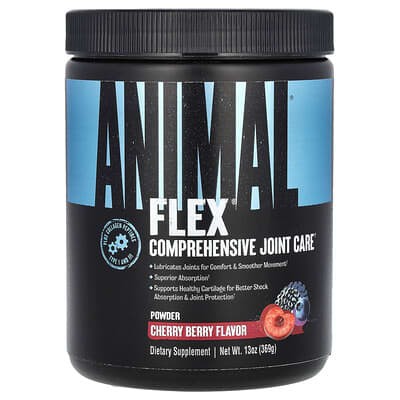
Animal Animal Flex Cherry Berry is a powdered joint support formula with collagen peptides, glucosamine and chondroitin listed on the label. One 12.3 g scoop supplies 3,000 mg of joint construction blend and 6,000 mg of joint lubrication and support blend, though the individual ingredient amounts are not disclosed.
AI assessment of the formula, label and price. How scoring works
Nutrient Quality28
The natural vitamin E form stands out positively, while zinc oxide and inorganic selenium are less favorable choices. The forms and amounts of individual joint blend ingredients are unclear.
Ingredient Transparency67
The formula lists total blend weights and the individual vitamin and mineral amounts. The undisclosed quantities within the joint complexes prevent a clear comparison of collagen and other joint ingredients.
Value For Money38
The selenium amount offers reasonable value, but several other supporting nutrients are relatively expensive at the full scoop price. Value for joint support is difficult to judge without individual quantities of the main ingredients.
Customer Satisfaction80
Customers give the powder a favorable average rating of 4.7 out of 5. Its 886 ratings provide a useful sample of customer experiences.
Product Focus37
Joint support is the clear advertised purpose, but the blend quantities do not establish the contribution of individual joint ingredients. The disclosed vitamins and minerals alone provide mostly secondary nutritional support.
- Format
Powder - Container
- 13 Ounce(s)
- Per serving
- $1.09
- Also available
 Animal Flex$39.95
- Customer rating
- 4.7 · 886 ratings
Goals

Impact
High effect
Selenium · 70 mcgZinc · 15 mgVitamin C · 100 mg
Animal Flex Cherry Berry Flavor has a narrower everyday-health role through selenium and zinc. Selenium at 70 mcg supplies a nutrient used by antioxidant enzymes, while zinc at 15 mg supports normal immune function. Those contributions are most useful when they fill dietary gaps.
Zinc Supportive
Vitamin C Supportive
Ingredients
| Ingredient | Amount per serving | Score |
|---|---|---|
Calories | 16 Calorie(s) | |
Protein | 4 Gram(s) | |
Vitamin C (Ascorbic Acid) | 100 mg | |
Vitamin E (D-Alpha-Tocopherol Succinate) | 64 mg | |
Zinc (Zinc Oxide) | 15 mg | |
Selenium (Sodium Selenite) | 70 mcg | |
Manganese (Manganese Sulfate) | 1 mg | |
Joint Construction Complex | 3000 mg | |
Joint Lubrication and Support Complex | 6000 mg |
Selenium (Sodium Selenite) · 70 mcg OverallScore53
Animal Animal Flex Cherry Berry Flavor offers good value for selenium at $2.95 per 200 mcg, providing 70 mcg per serving as sodium selenite. The full formula costs $1.03 per serving. Sodium selenite is an inorganic form with lower cellular retention than organic forms.
Alternative products
Report alternatives
Sources
Published studies used for the product analysis and the top-ranked studies for each ingredient and goal.
- Associations of selenium status with all-cause and cause-specific mortality: a systematic review and meta-analysis of cohort studies.
- Dietary Antioxidants, Circulating Antioxidant Concentrations, Total Antioxidant Capacity, and Risk of All-Cause Mortality: A Systematic Review and Dose-Response Meta-Analysis of Prospective Observational Studies.
- The efficacy and safety of selenium supplementation versus placebo in the treatment of Graves' orbitopathy: A systematic review and meta-analysis of randomised controlled trials.
- Associations of plasma metal concentrations with the risks of all-cause and cardiovascular disease mortality in Chinese adults.
- Updates on clinical studies of selenium supplementation in radiotherapy.
- Dietary intake and blood concentrations of antioxidants and the risk of cardiovascular disease, total cancer, and all-cause mortality: a systematic review and dose-response meta-analysis of prospective studies.
- Scientific Opinion on the substantiation of a health claim related to vitamin C and increasing non haem iron absorption pursuant to Article 14 of Regulation (EC) No 1924/2006.
- Vitamin C Depletion and All-Cause Mortality in Renal Transplant Recipients.
- Associations of Serum Biomarkers of Fruit and Vegetable Intake With the Risk of Cause-Specific Mortality and All-Cause Mortality: A National Prospective Cohort Study.
- Relation between plasma ascorbic acid and mortality in men and women in EPIC-Norfolk prospective study: a prospective population study. European Prospective Investigation into Cancer and Nutrition.
- Effectiveness of sodium bicarbonate and zinc chloride mouthwashes in the treatment of oral mucositis and quality of life in patients with cancer under chemotherapy.
- Zinc supplementation in young children with acute diarrhea in India.
- Associations of mortality with ocular disorders and an intervention of high-dose antioxidants and zinc in the Age-Related Eye Disease Study: AREDS Report No. 13.
- Effects of zinc and probiotic co-supplementation on inflammation, gastrointestinal symptoms, quality of life, and mood in irritable bowel syndrome patients.
- Effect of zinc sulfate supplementation on premenstrual syndrome and health-related quality of life: Clinical randomized controlled trial.