
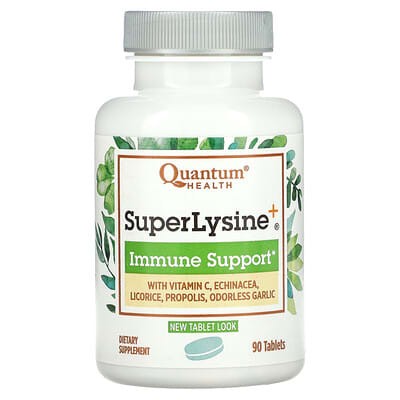

$12.63 $0.42 per serving


Product analysis
Super Lysine+ Immune Support centers on lysine, which offers good value for the amount supplied. The added botanicals have limited or inconsistent evidence, so broad immune benefits remain uncertain.
AI assessment of the formula, label and price. How scoring works
Nutrient Quality34
Several ingredient forms are named, but their relative quality remains uncertain. Echinacea, propolis and licorice lack named forms, making those preparations harder to compare.
Ingredient Transparency67
All ingredient amounts are disclosed, but several botanical forms are missing. The proportions of the calcium sources are also unclear, limiting a complete comparison.
Value For Money52
Lysine offers good value, while propolis is relatively expensive for the amount supplied. Value for the other ingredients remains uncertain, leaving an uneven cost picture.
Customer Satisfaction90
Customer ratings are very positive across a large body of feedback. They do not establish broad immune protection or hair growth.
Product Focus65
Lysine is the main focus, with a wider mix of vitamins and botanicals. The evidence does not establish broad immune protection or routine hair growth from the combination.
- Format
Tablet - Container
- 90 Tablet(s)
- Per serving
- $0.42
- Customer rating
- 4.8 · 5,526 ratings
Goals


Impact
High effect
Lysine · 1500 mgVitamin C · 100 mg
Ingredients
| Ingredient | Amount per serving | Score |
|---|---|---|
Vitamin C (Ascorbic Acid) | 100 mg | |
Calcium (Calcium Stearate, Dicalcium Phosphate) | 29 mg | |
L-Lysine (L-Lysine Hydrochloride) | 1500 mg | |
Garlic Bulb (Allium Sativum) Plant Extract 3:1 (Allicin) | 200 mg | |
Echinacea Whole Plant (Echinacea Purpurea) Plant Extract 4:1 | 100 mg | |
Propolis Plant Extract 2:1 | 25 mg | |
Licorice Root (Glycyrrhiza Glabra) Plant Extract 4:1 | 15 mg |
Lysine (L-Lysine Hydrochloride) · 1500 mg OverallScore81
The serving declares 1500 mg of lysine. The full product cost per estimated amount of lysine is relatively low. The source is L-Lysine Hydrochloride. No grade or sourcing assurance claim is identified.
How this ingredient is rated
Active Ingredient Quality & Bioavailability72
The source is L-Lysine Hydrochloride. No grade, vegan, fermentation or manufacturing-practice claim is identified.
Lysine Chemical Form & Sourcing
The source is L-Lysine Hydrochloride.
Purity and Grade Signals
No grade, vegan, fermentation or manufacturing-practice claim is identified.
Dose, Safety & Label Transparency90
The serving declares 1500 mg of lysine. Ordinary excipients or capsule materials are identified.
Lysine Dose by Declared Basis
The serving declares 1500 mg of lysine.
Clean Label & Additives
Ordinary excipients or capsule materials are identified.
Value80
The full product cost per estimated amount of lysine is relatively low.
Price Per 1000mg of Lysine
The full product cost per estimated amount of lysine is relatively low.
Propolis · 25 mg OverallScore49
The serving lists 25 mg propolis extract; its estimated cost per amount of preparation is high. No flavonoid or polyphenol amount is available. A 2:1 ratio is also stated.
How this ingredient is rated
Composition and Label Disclosure10
No flavonoid or polyphenol amount is available.
Named Propolis Marker Disclosure
A quantified flavonoid or polyphenol marker is not available.
Composition and Label Disclosure100
The preparation amount is stated. A 2:1 ratio is also stated. No flow agent or flagged additive is recorded in the available details.
Preparation Amount and Equivalency Disclosure
The serving declares 25 mg and a 2:1 ratio.
Other Ingredients Disclosure
The available details record no flow agent or flagged additive.
Commercial Price and Usability25
The estimated cost for the declared preparation is high; preparation weight does not establish active yield.
Whole-Product Cost per 100 mg Declared Propolis Preparation
The whole-product cost relative to the declared preparation weight is high; this is an estimate.
Alternative products
Report alternatives
Sources
Published studies used for the product analysis and the top-ranked studies for each ingredient and goal.
- Causes of hair loss and the developments in hair rejuvenation.
- Management of hair loss associated with endocrine therapy in patients with breast cancer: an overview.
- Elucidating causal relationships of diet-derived circulating antioxidants and the risk of non-scarring alopecia: A Mendelian randomization study.
- Alterations of plasma antioxidants and mitochondrial DNA mutation in hair follicles of smokers.
- Removal of synthetic hair dye using formamidine sulfinic acid and other sulfinate precursors.
- A Zinc Sulphate-Resistant Acrodermatitis Enteropathica Patient with a Novel Mutation in SLC39A4 Gene.
- Lysine-fortified wheat flour improves the nutritional and immunological status of wheat-eating families in northern China.
- Success of L-lysine therapy in frequently recurrent herpes simplex infection. Treatment and prophylaxis
- Propolis increases Foxp3 expression and lymphocyte proliferation in HIV-infected people: A randomized, double blind, parallel-group and placebo-controlled study.
- Immune Responses in Broiler Chicks Fed Propolis Extraction Residue-supplemented Diets.
- Integrative Therapies in Wound Healing in Small Animals: An Approach Beyond Traditional Medicine.
- Propolis does not significantly modulate immune function in an older population: A preliminary study.
- A standardized polyphenol mixture extracted from poplar-type propolis for remission of symptoms of uncomplicated upper respiratory tract infection (URTI): A monocentric, randomized, double-blind, placebo-controlled clinical trial.
- Vitamin C and contribution to the normal function of the immune system: evaluation of a health claim pursuant to Article 14 of Regulation (EC) No 1924/2006.
- Therapeutic effects of high-dose vitamin C supplementation in patients with COVID-19: a meta-analysis.
- Effect of micronutrient supplements on influenza and other respiratory tract infections among adults: a systematic review and meta-analysis.
- New evidence for antioxidant properties of vitamin C.
- Enhanced Vitamin C Delivery: A Systematic Literature Review Assessing the Efficacy and Safety of Alternative Supplement Forms in Healthy Adults.