
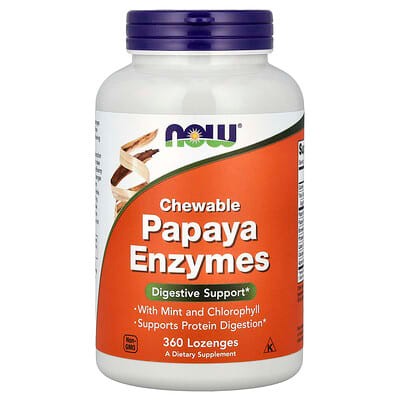

$15.46 $0.08 per serving


Product analysis
Chewable Papaya Enzymes combines papain and other enzymes in a chewable supplement. Most enzyme preparations are not identified, making it difficult to compare their quality.
AI assessment of the formula, label and price. How scoring works
Nutrient Quality27
Most enzyme preparations are unspecified, so their quality cannot be compared confidently. Naming pineapple as the bromelain source does not resolve how well that preparation performs.
Ingredient Transparency67
Amounts are provided for the listed ingredients, supporting serving comparisons. Most forms are omitted, so the enzyme preparations remain difficult to identify.
Value For Money60
The serving cost is competitive for papain but relatively high for the bromelain amount. Other ingredient comparisons remain uncertain, leaving a mixed picture of value.
Customer Satisfaction89
Customer ratings are positive across a very large set of responses. That gives a broad picture of satisfaction without establishing how well the enzymes work.
Product Focus32
The formula centres on enzymes, though the mixture is relatively broad. The available details do not establish how well it meets its intended purpose.
- Format
Lozenge - Container
- 360 Liquid(s)
- Per serving
- $0.08
- Also available
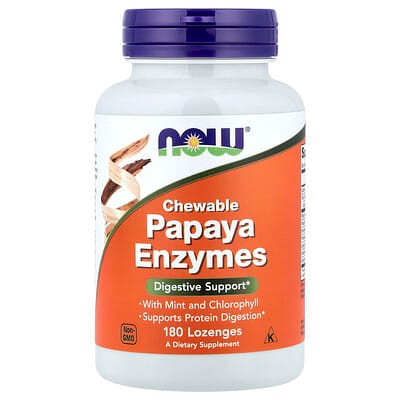 Chewable Papaya Enzymes$6.00
- Customer rating
- 4.6 · 16,753 ratings
Goals

Impact
Lower effect
Papain · 100 mgBromelain · 20 mg
Ingredients
| Ingredient | Amount per serving | Score |
|---|---|---|
Calories | 5 Calorie(s) | |
Total Carbohydrates | 2 Gram(s) | |
Papain | 100 mg | |
Papaya fruit powder | 80 mg | |
Bromelain (Pineapple) | 20 mg | |
Protease | 20 mg | |
Lipase | 2 mg | |
Cellulase | 0.6 mg | |
Alpha-Amylase | 2 mg |
Papain · 100 mg OverallScore100
The labeled serving provides 100 mg of papain per labeled serving at a low cost per serving. Activity is declared, but its unit and basis are unclear in the available details. The papain source is also unspecified.
How this ingredient is rated
Composition and Label Disclosure100
Papain activity is declared, though the activity unit and basis aren’t specified in the available details.
Declared Papain Activity Units
Papain activity is declared, though the activity unit and basis aren’t specified in the available details.
Composition and Label Disclosure100
The labeled serving contains 100 mg of papain; its source isn’t specified.
Individual Preparation Amount Disclosure
The labeled serving contains 100 mg of papain; its source isn’t specified.
Commercial Price and Usability100
The whole product’s cost per labeled serving is low.
Commercial Price per Labeled Serving
The whole product’s cost per labeled serving is low.
Bromelain (Pineapple) · 20 mg OverallScore57
The labeled serving provides 20 mg of bromelain, with a high whole-product cost per 500 mg. The declared concentration is 2400 GDU per gram. Pineapple is named as the source, but the plant part is unspecified.
How this ingredient is rated
Composition and Label Disclosure100
The declared concentration is 2400 GDU per gram.
Enzyme Activity Disclosure
The declared concentration is 2400 GDU per gram.
Declared GDU per Gram
The declared concentration is 2400 GDU per gram.
Composition and Label Disclosure33
The labeled serving contains 20 mg of bromelain. Pineapple is named as the source, but the plant part is unspecified.
Declared Bromelain Mass
The labeled serving contains 20 mg of bromelain.
Botanical Source Disclosure
Pineapple is named as the source, but the plant part is unspecified.
Commercial Price and Usability20
The whole-product cost per 500 mg of declared bromelain is high.
Cost per 500 mg Declared Bromelain
The whole-product cost per 500 mg of declared bromelain is high.
Alternative products
Report alternatives
Sources
Published studies used for the product analysis and the top-ranked studies for each ingredient and goal.
- The role of enzyme supplementation in digestive disorders.
- Effects of bromelain supplementation on disease activity and quality of life in patients with ulcerative colitis: a randomized, triple-blind, placebo-controlled study.
- The incidence and clinical implications of hypersensitivity to papain in an allergic population, confirmed by blinded oral challenge.
- Papaya preparation (Caricol®) in digestive disorders