
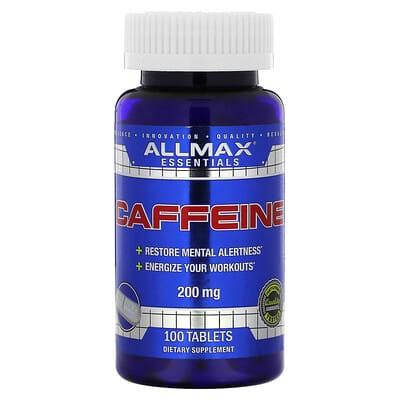

$6.92 $0.06 per serving



Product analysis
Caffeine 200 mg offers short-term support for alertness, attention and exercise performance at a favourable serving cost. Its practical effect varies with timing, tolerance and sensitivity.
AI assessment of the formula, label and price. How scoring works
Nutrient Quality40
Caffeine is clearly identified as anhydrous, making the ingredient easy to check. The named form does not establish an extra performance advantage.
Ingredient Transparency100
The listed amounts are disclosed, helping compare servings. The named forms also make ingredient identity clear.
Value For Money100
The serving cost compares favourably. The single-ingredient formula also makes the caffeine cost straightforward to compare.
Customer Satisfaction90
Customer ratings are generally positive across a substantial review base. The feedback does not establish effectiveness or safety.
Product Focus74
Caffeine provides a clear short-term alertness and exercise-related effect. Those immediate effects do not establish lasting weight loss, muscle gain or improved work output.
- Format
Tablet - Container
- 100 Tablet(s)
- Per serving
- $0.06
- Customer rating
- 4.7 · 15,821 ratings
Goals

Impact
High effect
Caffeine · 200 mg
Caffeine can acutely improve exercise performance, most consistently in endurance activity, while strength and sprint responses vary. The declared amount contributes to this effect, but fixed serving amounts are only approximate comparisons because body mass is unavailable. The supplied evidence does not establish an individualized effective dose or an extra benefit from other accompanying ingredients.
How this product is rated for Fitness
Ingredient fit92
Caffeine provides a relevant fitness contribution. The relevant serving amounts reach the saved comparison endpoints; larger amounts do not establish larger benefits.
Goal fit
Caffeine gives this product a focused connection to the fitness goal.
Dose adequacy
The relevant serving amounts reach the saved comparison endpoints; larger amounts do not establish larger benefits.
Pathways60
The strongest contribution concerns central drive and fatigue perception. Coverage is concentrated in this area.
Depth
The strongest saved contribution concerns central drive and fatigue perception, reflecting the relevant ingredients and serving amounts.
Breadth
Substantial coverage is concentrated in one exercise-related area.
Evidence77
Caffeine has the clearest acute support for endurance performance, with more variable strength and sprint responses.
Evidence strength
Caffeine has the clearest acute support for endurance performance, with more variable strength and sprint responses.
Studied preparation
The relevant preparations meet the saved criteria; this does not establish superiority of forms or replicate a complete study regimen.
Formulation logic100
The relevant ingredients have the partners they require, and no configured conflict was identified. Included amounts meet the saved minimum comparison.
Partner coverage
The relevant ingredients can contribute independently or have their required partners present; an additional combination benefit is not established.
Conflicts
No configured ingredient conflict was identified in the supplied findings.
Effective doses
All included ingredients meet the saved minimum amount comparison; this is not proof of benefit from a single serving.

Impact
High effect
Caffeine · 200 mg
Caffeine can produce a modest, short-lived rise in resting metabolic rate. This product supplies 200 mg per serving, but the comparison does not mean that twice a lower studied amount produces twice the benefit. Repeated use and lasting effects are not established by one serving, and acute thermogenesis does not demonstrate durable fat loss.
How this product is rated for Metabolism Support
Ingredient fit92
Caffeine supplies the product's counted contribution, with full amount allowance in the saved comparison.
Goal fit
Caffeine is the sole credited ingredient; the product is also linked to other goals.
Dose adequacy
The declared serving reaches the comparison's full amount allowance; that does not establish a greater biological benefit.
Pathways51
The saved findings mainly concern adrenergic drive, with limited breadth across other routes.
Depth
The strongest represented route is adrenergic drive; this describes the saved ingredient mapping, not a measured rise in energy expenditure.
Breadth
Only one route reaches the comparison's coverage threshold, so the findings do not span several mechanisms.
Evidence66
Caffeine's strongest relevant evidence concerns a modest, temporary rise in energy expenditure.
Evidence strength
Caffeine has direct evidence of a modest acute effect, without an established lasting fat-loss benefit.
Studied preparation
The saved findings accept the counted preparations; this does not establish that this exact product or combination increased energy expenditure.
Formulation logic100
The retained ingredients meet the amount check and have no missing required partners. No evaluated ingredient conflict was triggered.
Partner coverage
No required partner is missing among the counted ingredients; this does not establish extra benefit from combining them.
Conflicts
None of the evaluated ingredient conflicts was triggered.
Effective doses
All ingredients retained for this check meet its amount threshold; the threshold is not a proven clinical minimum.

Impact
High effect
Caffeine · 200 mg
Caffeine can improve short-term alertness and attention by blocking adenosine signalling. The 200 mg serving receives full amount recognition in the saved comparison, but higher comparison recognition is not proof of more work completed. Timing, tolerance and sleep loss can change its practical effect, and the evidence does not establish sustained occupational productivity.
How this product is rated for Productivity Boost
Ingredient fit92
Caffeine is among the recognized ingredients. The declared amounts reach the saved comparison references; this does not establish greater work output.
Goal fit
The relevant ingredients are prominent in this formula, although links to other goals reduce its exclusive focus on productivity.
Dose adequacy
The declared amounts reach the saved comparison references; this does not establish greater work output.
Pathways60
The strongest saved coverage concerns adenosine-blocking alertness. This describes the configured mechanism rather than measured work improvement. Only one productivity pathway reaches the saved coverage threshold.
Depth
The strongest saved coverage concerns adenosine-blocking alertness. This describes the configured mechanism rather than measured work improvement.
Breadth
Only one productivity pathway reaches the saved coverage threshold.
Evidence76
Caffeine provides the leading saved evidence contribution. The supplied findings concern nutrient needs or cognitive tests rather than established occupational productivity.
Evidence strength
Caffeine leads the saved evidence findings; the supplied population and outcome limitations still restrict what can be expected.
Studied preparation
The saved result recognizes the counted preparations as studied, without extending the findings beyond their specific populations and outcomes.
Formulation logic100
No configured ingredient conflict was identified. The counted ingredients meet the saved minimum amount threshold and have no missing required partner.
Partner coverage
The counted ingredients work independently or have their required partner; no additional benefit from combining them is established.
Conflicts
No configured ingredient conflict was identified.
Effective doses
All counted ingredients reach the saved minimum amount threshold, which is not a validated effective dose for work output.

Impact
Highest effect
Caffeine · 200 mg
Caffeine increases acute alertness and reduces sleepiness. The explicitly declared 200 mg serving reaches the saved amount comparison, without establishing more benefit from increasing the amount. This is an alertness effect rather than cellular fuel or treatment for chronic fatigue; its practical effect can vary with tolerance, timing and sensitivity.
How this product is rated for Energy
Ingredient fit92
Caffeine anchors this product’s saved energy connection. The declared amounts reach the saved comparison levels; this does not make them validated fatigue-treatment doses.
Goal fit
Caffeine is the focused ingredient in the saved energy findings.
Dose adequacy
The declared amounts reach the saved comparison levels; this does not make them validated fatigue-treatment doses.
Pathways60
The saved findings concentrate on central alertness, without establishing the size of a clinical benefit. That is a narrow connection rather than broad energy coverage.
Depth
The saved findings concentrate on central alertness, without establishing the size of a clinical benefit.
Breadth
Coverage is concentrated in central alertness, rather than extending across several distinct energy functions.
Evidence100
Caffeine is relevant to deficiency-related fatigue, without establishing extra energy at adequate intake.
Evidence strength
Caffeine has direct support for acute alertness and reduced sleepiness, rather than chronic-fatigue treatment.
Studied preparation
The preparation qualifies in the saved findings, although population and treatment limits still govern how its effects can be described.
Formulation logic100
No missing partner or specified conflict was identified. The included amounts meet the saved minimum comparisons, without establishing a routine energy benefit.
Partner coverage
The included ingredients do not require a missing partner for the roles described.
Conflicts
No specified ingredient conflict was identified in the supplied findings.
Effective doses
The included ingredients meet the saved minimum amount comparisons; these are not proven fatigue-treatment thresholds.

Impact
High effect
Caffeine · 200 mg
Caffeine can improve short-term alertness, vigilance and attention-task performance. Timing, habitual use and sleep loss can change its practical effect.
How this product is rated for Mental Focus
Ingredient fit92
The included amounts reach the full supplied comparison range; larger amounts do not establish greater focus.
Goal fit
The main ingredients align with the supplied focus comparison, although their roles extend beyond attention.
Dose adequacy
The included amounts reach the full supplied comparison range; larger amounts do not establish greater focus.
Pathways60
The strongest saved connection concerns adenosine-blocking alertness; a mechanism-related finding does not establish broad attention improvement.
Depth
The strongest saved connection concerns adenosine-blocking alertness; a mechanism-related finding does not establish broad attention improvement.
Breadth
Coverage centers on one mechanism, leaving the other focus-related routes unrepresented.
Evidence79
Caffeine has direct acute attention and vigilance findings, with individual response and circumstances affecting relevance.
Evidence strength
Caffeine has direct acute attention and vigilance findings, with individual response and circumstances affecting relevance.
Studied preparation
The saved findings recognize the included preparations, without proving superior delivery or broad focus benefits.
Formulation logic100
No required partner is missing in the supplied findings; this does not establish synergy. No conflict was identified by the supplied checks.
Partner coverage
No required partner is missing in the supplied findings; this does not establish synergy.
Conflicts
No conflict was identified by the supplied checks.
Effective doses
All retained ingredients pass the minimum amount comparison, which is not proof of an effective clinical dose.

Impact
Moderate effect
Caffeine · 200 mg
200 mg of caffeine may temporarily increase heat production and energy expenditure. Habitual use can reduce its effects, and a short-term increase in calorie burning does not guarantee sustained weight loss.
How this product is rated for Weight Loss
Ingredient fit92
Caffeine is the main reviewed contributor, alongside several ingredients aimed at other purposes. Caffeine reaches the saved amount reference.
Goal fit
Caffeine is the main reviewed contributor, alongside several ingredients aimed at other purposes.
Dose adequacy
Caffeine reaches the saved amount reference.
Pathways48
Heat production and energy expenditure are the strongest connection. Only heat production and energy expenditure reach the saved threshold for substantial coverage; other connections are weaker.
Depth
Heat production and energy expenditure are the strongest connection.
Breadth
Only heat production and energy expenditure reach the saved threshold for substantial coverage; other connections are weaker.
Evidence62
Caffeine provides the strongest evidence contribution in the saved findings, with more support for short-term energy expenditure than lasting weight reduction. The saved findings recognize the preparations of the reviewed contributors at qualifying amounts.
Evidence strength
Caffeine provides the strongest evidence contribution in the saved findings, with more support for short-term energy expenditure than lasting weight reduction.
Studied preparation
The saved findings recognize the preparations of the reviewed contributors at qualifying amounts.
Formulation logic100
No configured ingredient conflict was matched in the saved findings. All reviewed contributors meet the saved minimum amount threshold; that threshold is not a guarantee of weight loss.
Partner coverage
The reviewed contributors have no unmet partner requirement in the saved findings.
Conflicts
No configured ingredient conflict was matched in the saved findings.
Effective doses
All reviewed contributors meet the saved minimum amount threshold; that threshold is not a guarantee of weight loss.

Impact
High effect
Caffeine · 200 mg
Caffeine can affect acute strength, power or endurance, which may be relevant to a training session. Those effects do not establish sustained muscle-mass gain from this product. The saved result recognizes the serving amount and training-work-capacity area, but the supplied facts do not establish a chronic hypertrophy outcome or the user's training and intake regimen.
How this product is rated for Muscle Gain
Ingredient fit82
Caffeine is the sole recognized ingredient, although acute performance findings do not establish muscle hypertrophy.
Goal fit
Caffeine is the sole recognized ingredient, although acute performance findings do not establish muscle hypertrophy.
Dose adequacy
Recognized ingredients make differing partial contributions against the saved amount references; these are not validated clinical dose-response thresholds.
Pathways50
Only training work capacity and recovery reaches the saved coverage threshold; other muscle-gain areas remain smaller or absent.
Depth
Training work capacity and recovery is the strongest recognized area; this does not establish chronic muscle growth.
Breadth
Only training work capacity and recovery reaches the saved coverage threshold; other muscle-gain areas remain smaller or absent.
Evidence83
Caffeine drives the strongest saved evidence finding; evidence for acute performance does not establish sustained muscle gain.
Evidence strength
Caffeine drives the strongest saved evidence finding; evidence for acute performance does not establish sustained muscle gain.
Studied preparation
The recognized preparations match the saved preparation criterion; this does not remove the limits on population, regimen and muscle-growth outcomes.
Formulation logic100
No configured ingredient conflict was triggered; this covers only the evaluated combinations. Recognized ingredients meet the saved minimum amount threshold and have no missing required partners.
Partner coverage
Recognized ingredients work independently or have their required partners; this does not establish added muscle growth from combining them.
Conflicts
No configured ingredient conflict was triggered; this covers only the evaluated combinations.
Effective doses
All recognized ingredients meet the saved minimum amount threshold; that does not establish a proven hypertrophy dose.
Ingredients
| Ingredient | Amount per serving | Score |
|---|---|---|
Caffeine (Caffeine Anhydrous) | 200 mg |
Caffeine (Caffeine Anhydrous) · 200 mg OverallScore76
Each serving supplies 200 mg of caffeine, a moderate amount. The whole product costs about $0.07 per serving.
How this ingredient is rated
Active Ingredient Quality & Bioavailability40
The saved information does not identify a specific caffeine form.
Advanced Bioavailability and Release Profiles
Caffeine is recorded, but its specific form is unknown in the saved facts.
Dose, Safety & Label Transparency100
The recorded serving contains a moderate amount of caffeine.
Caffeine Dose Transparency
The saved facts record 200 mg of caffeine per serving.
Dosage Efficacy and Safety Margin
The recorded 200 mg per serving is considered moderate in the evaluation.
Secondary Stimulant Disclosure and Risk
The evaluated ingredient list identifies no additional stimulants.
Value100
The whole-product price per serving is low.
Price Per Serving vs. Collection Median
The whole product costs about $0.07 per serving.
Alternative products
Report alternatives
Sources
Published studies used for the product analysis and the top-ranked studies for each ingredient and goal.
- Cognitive and mood improvements of caffeine in habitual consumers and habitual non-consumers of caffeine.
- Caffeine-containing energy drink improves physical performance of elite rugby players during a simulated match.
- Differential cognitive effects of energy drink ingredients: caffeine, taurine, and glucose.
- Does Single or Combined Caffeine and Taurine Supplementation Improve Athletic and Cognitive Performance without Affecting Fatigue Level in Elite Boxers? A Double-Blind, Placebo-Controlled Study.
- Trait Energy and Fatigue Modify the Effects of Caffeine on Mood, Cognitive and Fine-Motor Task Performance: A Post-Hoc Study.
- Effect of caffeine ingestion on cycling performance: a systematic review and meta-analysis.
- Effects of Caffeine Intake on Endurance Running Performance and Time to Exhaustion: A Systematic Review and Meta-Analysis.
- Acute Effects of Caffeine Supplementation on Movement Velocity in Resistance Exercise: A Systematic Review and Meta-analysis.
- Sex Differences in the Ergogenic Response of Acute Caffeine Intake on Muscular Strength, Power and Endurance Performance in Resistance-Trained Individuals: A Randomized Controlled Trial.
- Can I Have My Coffee and Drink It? A Systematic Review and Meta-analysis to Determine Whether Habitual Caffeine Consumption Affects the Ergogenic Effect of Caffeine.
- Effects of modafinil and caffeine on night-time vigilance of air force crewmembers: A randomized controlled trial.
- Acute effects of caffeine on attention: a comparison of non-consumers and withdrawn consumers.
- Performance and alertness effects of caffeine, dextroamphetamine, and modafinil during sleep deprivation.
- Effects of caffeine on mood and performance: a study of realistic consumption.
- Effects of caffeine or diphenhydramine on visual vigilance.
- A Randomized Study to Examine the Ability of a Caffeine-Based Energy Drink to Impact Energy Expenditure, Fat Oxidation, and Cognitive Performance.
- Oolong tea increases metabolic rate and fat oxidation in men.
- Effect of caffeine intake on fat oxidation rate during exercise: is there a dose-response effect?
- Comparison of changes in energy expenditure and body temperatures after caffeine consumption.
- Caffeine Increases Work Done above Critical Power, but Not Anaerobic Work.