
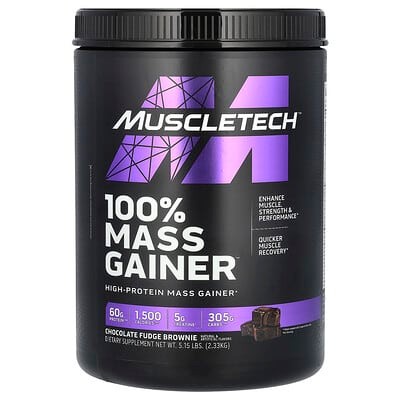
100% Mass Gainer Chocolate Fudge Brownie

Goals
$28.72 $4.10 per serving


Product analysis
100% Mass Gainer Chocolate Fudge Brownie provides protein for training-related muscle needs and creatine that may support repeated high-intensity exercise with regular use. Incomplete source and mixture details make some of the formula harder to compare.
AI assessment of the formula, label and price. How scoring works
Nutrient Quality22
Protein can support training nutrition, but the proportions of its sources are unclear. The quality of many other ingredient forms also remains uncertain.
Ingredient Transparency59
Ingredient totals are stated, but some form details are missing. Undisclosed mixture contents or proportions make a full comparison harder.
Value For Money39
Value is difficult to judge for the protein, carbohydrate and several training-related ingredients. The mineral contributions generally look expensive when considered against the full serving cost.
Customer Satisfaction80
Customer feedback is positive, with a substantial number of ratings. Ratings reflect satisfaction and cannot establish effectiveness or safety.
Product Focus71
The formula has a clear training focus, with protein and creatine providing the main practical roles. Its many additional components make it more complex than a simple protein or creatine supplement.
- Format
Powder - Container
- 5 Pound(s)
- Per serving
- $4.10
- Customer rating
- 4.3 · 5,153 ratings

Ingredients
| Ingredient | Amount per serving | Score |
|---|---|---|
Calories | 1330 Calorie(s) | |
Total Fat | 4.5 Gram(s) | |
Cholesterol | 120 mg | |
Total Carbohydrates | 280 Gram(s) | |
Protein | 44 Gram(s) | |
Calcium | 650 mg | |
Iron | 2.1 mg | |
Sodium | 540 mg | |
Potassium | 460 mg | |
L-Glutamine and Glutamine Precursor (Whey Protein) | 7.5 Gram(s) | |
Creatine Monohydrate | 5 Gram(s) | |
L-Leucine (Whey Protein) | 4.6 Gram(s) | |
L-Valine (Whey Protein) | 2.5 Gram(s) | |
L-Isoleucine (Whey Protein) | 2.4 Gram(s) |
Sodium · 540 mg OverallScore70
Each serving supplies 540 mg of sodium for replenishment. The serving costs more, with the price reflecting a mass gainer. The sodium source is not specified. An artificial sweetener is listed.
How this ingredient is rated
Active Ingredient Quality & Bioavailability48
The sodium source is not specified. The available information does not specify the supporting electrolyte forms.
Sodium Source Purity & Quality
The sodium source is not specified.
Bioavailability of Supporting Electrolytes
The available information does not specify the supporting electrolyte forms.
Trace Mineral Complex & Buffering Forms
No trace mineral complex or sodium bicarbonate is identified.
Dose, Safety & Label Transparency92
The sodium amount, 460 mg of potassium are individually listed. An artificial sweetener is listed.
Sodium Dosage for Athletic Replenishment
Each serving supplies 540 mg of sodium for replenishment.
Ingredient Label Transparency
The sodium amount, 460 mg of potassium are individually listed.
Artificial Color and Sweetener Disclosure
An artificial sweetener is listed.
Value70
The serving costs more, with the price reflecting a mass gainer.
Price Per Serving vs. Collection Median
The serving costs more, with the price reflecting a mass gainer.
Potassium · 460 mg OverallScore39
A serving provides 460 mg of potassium at a high cost per serving. It offers a substantial amount, and the source of the potassium total is unclear.
How this ingredient is rated
Active Ingredient Quality & Bioavailability10
The potassium source is unclear. Dipotassium phosphate appears in Other Ingredients, but its contribution to the potassium total is unknown.
Potassium Form Quality
The potassium source is unclear. Dipotassium phosphate appears in Other Ingredients, but its contribution to the potassium total is unknown.
Dose, Safety & Label Transparency78
The serving lists 460 mg of potassium without explicitly calling it elemental potassium.
Potassium Dosage Potency
A serving provides 460 mg of potassium.
Elemental Yield Transparency
The potassium amount is stated, but the available wording does not explicitly say elemental potassium.
Value20
The cost per serving is high.
Potassium Value Efficiency
The cost per serving is high.
Calcium · 650 mg OverallScore28
A serving provides 650 mg of calcium at a high cost per serving. Calcium carbonate appears in Other Ingredients, but the source of the declared calcium total is unclear. An artificial additive is listed.
How this ingredient is rated
Active Ingredient Quality & Bioavailability37
Calcium carbonate appears in Other Ingredients, but the source of the declared calcium total is unclear. The calcium amount is clearly stated.
Calcium Form & Absorption Potential
Calcium carbonate appears in Other Ingredients, but the source of the declared calcium total is unclear.
Elemental Calcium Transparency
The label states 650 mg of calcium per serving.
Dose, Safety & Label Transparency24
650 mg of calcium per serving is a large single amount, and some may not be absorbed. An artificial additive is listed, and a serving contains 15 g of sugar.
Absorption-Optimized Serving Dose
650 mg of calcium per serving is a large single amount, and some may not be absorbed.
Formulation Purity & Additives
An artificial additive is listed, and a serving contains 15 g of sugar.
Value20
The cost per serving is high.
Price Per Serving Efficiency
The cost per serving is high.
Alternative products
Report alternatives
Sources
Published studies used for the product analysis and the top-ranked studies for each ingredient and goal.
- Creatine in combination with resistance training and improvement in muscle strength: evaluation of a health claim pursuant to Article 13(5) of Regulation (EC) No 1924/2006.
- Effect of creatine and weight training on muscle creatine and performance in vegetarians.
- Long-term creatine intake is beneficial to muscle performance during resistance training.
- Effects of Combined Versus Single Supplementation of Creatine, Beta-Alanine, and L-Citrulline During Short Sprint Interval Training on Basketball Players' Performance: A Double-Blind Randomized Placebo-Controlled Trial.
- The Additive Effects of Creatine Supplementation and Exercise Training in an Aging Population: A Systematic Review of Randomized Controlled Trials.
- Ferric carboxymaltose in patients with heart failure and iron deficiency.
- Marginal iron deficiency without anemia impairs aerobic adaptation among previously untrained women.
- Ferric Carboxymaltose Versus Ferrous Fumarate in Anemic Children with Inflammatory Bowel Disease: The POPEYE Randomized Controlled Clinical Trial.
- Daily iron supplementation for improving anaemia, iron status and health in menstruating women.
- Altered metabolic response of iron-depleted nonanemic women during a 15-km time trial.
- Longitudinal Association Between Sodium and Potassium Intake and Physical Performance in Older Adults.
- Exercise-induced hyperkalaemia can be reduced in human subjects by moderate training without change in skeletal muscle Na,K-ATPase concentration.
- Potassium Nitrate in Heart Failure With Preserved Ejection Fraction: A Randomized Clinical Trial.
- Potassium Bicarbonate Supplementation Lowers Bone Turnover and Calcium Excretion in Older Men and Women: A Randomized Dose-Finding Trial.
- Exercise-Associated Muscle Cramps in Ironman-Distance Triathletes Over 3 Decades.
- Additive effects of beta-alanine and sodium bicarbonate on upper-body intermittent performance.
- Sodium Hyperhydration Improves Performance With No Change in Thermal and Cardiovascular Strain in Female Cyclists Exercising in the Heat Across the Menstrual Cycle.
- Sodium bicarbonate supplementation improves severe-intensity intermittent exercise under moderate acute hypoxic conditions.
- International Society of Sports Nutrition position stand: sodium bicarbonate and exercise performance.
- The effects of sodium bicarbonate ingestion on swimming interval performance in trained competitive swimmers.