
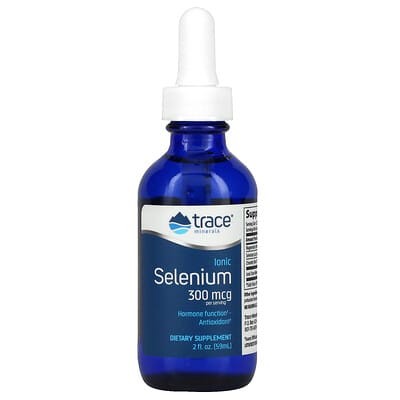

$19.99 $0.41 per serving


Product analysis
Ionic Selenium 300 mcg supplies selenium for normal antioxidant and immune functions, with benefits mainly relevant when intake is low.
AI assessment of the formula, label and price. How scoring works
Nutrient Quality26
Selenium uses sodium selenate, which has less favorable form characteristics in the comparison. The trace-mineral blend also leaves some component details unclear.
Ingredient Transparency73
The main mineral amounts and most forms are stated. The added blend omits its individual component details and proportions.
Value For Money57
Selenium offers moderate value for the amount supplied. The serving also compares favorably on cost for chloride, while the magnesium value remains uncertain.
Customer Satisfaction88
Customer ratings are strongly positive across thousands of reviews. The broad satisfaction picture does not establish extra health benefits.
Product Focus40
Selenium gives the formula a clear nutritional purpose. Additional benefit is mainly relevant when intake is low, and a large serving does not establish greater usefulness.
- Format
Liquid - Container
- 2 Fluid Ounce(s)
- Per serving
- $0.41
- Customer rating
- 4.8 · 2,850 ratings
Goals

Impact
Highest effect
Magnesium · 20 mgSelenium · 300 mcg
Selenium supports normal immune nutrition, with additional benefit mainly relevant when intake is low. The 300 mcg of selenium per serving exceeds the comparison range; retained credit establishes neither extra benefit nor suitability at this exposure.
How this product is rated for Immunity
Ingredient fit83
Selenium account for the main immune connection. The counted amounts meet the saved comparison range.
Goal fit
Relevant immune nutrients sit within a broader formula, so immunity is only part of its focus.
Dose adequacy
The counted amounts reach the saved comparison range; this does not establish an optimal dose or added benefit at higher intakes.
Pathways53
The strongest saved connection is oxidative and inflammatory balance. Other covered areas follow the supplied nutrient and amount findings.
Depth
The strongest saved connection is oxidative and inflammatory balance, rather than a prediction of resistance to infection.
Breadth
The main covered areas are oxidative and inflammatory balance. These describe the saved findings, not proven combined clinical effects.
Evidence85
Selenium provides the clearest evidence connection. The evidence supports the described roles, without establishing general infection prevention.
Evidence strength
Selenium provides the leading evidence connection here, within the supplied limits on normal nutrition and respiratory outcomes.
Studied preparation
The counted preparations match the saved comparisons; that does not imply superior forms or infection prevention.
Formulation logic100
The counted ingredients have no unmet partner requirement or configured conflict. Their amounts meet the saved minimum comparison.
Partner coverage
The counted ingredients have no unmet partner requirement in the supplied findings.
Conflicts
No configured ingredient conflict was identified. This finding does not assess every aspect of suitability.
Effective doses
All counted ingredients meet the saved minimum amount comparison; this is not proof of an effective clinical regimen.

Impact
Highest effect
Magnesium · 20 mgSelenium · 300 mcg
Selenium supplies a nutrient involved in antioxidant enzyme functions, mainly relevant when intake is low. Most US adults obtain adequate selenium, and these roles do not establish added health benefit in selenium-replete users. The selected serving contains 300 mcg, a high nutritional amount whose retained contribution does not establish greater benefit or suitability. Magnesium is present at a small amount that is not independently counted.
How this product is rated for Everyday Health
Ingredient fit97
The relevant ingredients contribute to normal defence functions. Their main value is nutrient availability when intake is low.
Goal fit
The counted ingredients align with the nutritional roles described here, although the product is also linked to other goals.
Dose adequacy
The counted amounts make substantial nutritional contributions; larger amounts do not establish greater benefit or suitability.
Pathways60
The counted ingredients span normal defence functions. These are contributions to normal nutrient functions rather than proof of broad health improvements.
Depth
The strongest nutritional contribution concerns normal antioxidant and immune functions.
Breadth
The saved findings extend across normal defence functions; this describes nutritional roles rather than proven improvements in all these areas.
Evidence82
Selenium anchors the strongest supported nutritional contribution. The preparation findings do not establish extra benefit from named chemical forms or supplementation above adequate intake.
Evidence strength
Selenium provides the strongest supported contribution among the counted ingredients, primarily as nutrition for low intake rather than demonstrated extra benefit above adequacy.
Studied preparation
The counted preparations meet the saved preparation finding; no superiority of a named form or delivery method is established.
Formulation logic100
The independently counted ingredients satisfy the amount and partner checks, with no evaluated conflict triggered. These findings do not establish synergy or overall suitability.
Partner coverage
The counted nutrients work independently or have their required partner present; this does not establish an added combination benefit.
Conflicts
None of the evaluated ingredient combinations triggered a conflict finding; this does not establish overall suitability.
Effective doses
All independently counted ingredients meet the saved amount check; smaller present ingredients may remain outside this finding.
Ingredients
| Ingredient | Amount per serving | Score |
|---|---|---|
Magnesium (Ionic Trace Minerals) | 20 mg | |
Selenium (Sodium Selenate) | 300 mcg | |
Chloride (Ionic Trace Minerals) | 60 mg | |
Ionic Trace Minerals | 350 mg |
Chloride (Ionic Trace Minerals) · 60 mg OverallScore41
The serving provides a relatively small 60 mg of chloride. The specific chloride salt is not identified in the saved facts.
How this ingredient is rated
Active Ingredient Quality & Bioavailability20
The specific chloride salt is not identified in the saved facts.
Chloride source quality
The specific chloride salt is not identified in the saved facts.
Dose, Safety & Label Transparency42
The serving contains 60 mg of chloride; its specific salt source is not identified in the saved facts.
Chloride amount per serving
The serving provides a relatively small 60 mg of chloride.
Amount and source disclosure
The saved facts record 60 mg of chloride per serving, but do not identify its specific salt source.
Value80
The whole-product serving costs about $0.42 and provides 60 mg of chloride.
Price per serving
The whole-product serving costs about $0.42 and provides 60 mg of chloride.
Selenium (Sodium Selenate) · 300 mcg OverallScore44
Each serving provides 300 mcg of selenium as sodium selenate, leaving a narrower margin for selenium from other sources. The whole-product cost works out to about $0.28 per 200 mcg of selenium.
How this ingredient is rated
Active Ingredient Quality & Bioavailability32
Selenium comes from sodium selenate, an identified inorganic form.
Selenium Chemical Form
Sodium selenate is an inorganic selenium form that the evaluation considers less retained than organic forms.
Form Transparency & Isomer Specificity
The selenium compound is identified as sodium selenate.
Dose, Safety & Label Transparency48
Each serving supplies 300 mcg, leaving a narrower margin for selenium from other sources in the evaluation.
Dosage Efficacy Sweet Spot
The 300 mcg serving is a relatively high amount; selenium from other sources also contributes to total intake.
Safety Margin & UL Adherence
At 300 mcg per serving, the evaluation flags a narrower margin for selenium from food and other supplements.
Value60
The whole-product cost works out to about $0.28 per 200 mcg of selenium.
Price per 200 mcg Serving
At the whole-product price, the equivalent of 200 mcg of selenium costs about $0.28.
Alternative products
Report alternatives
Sources
Published studies used for the product analysis and the top-ranked studies for each ingredient and goal.
- Perioperative systemic magnesium to minimize postoperative pain: a meta-analysis of randomized controlled trials.
- Long-term outcome after intravenous magnesium sulphate in suspected acute myocardial infarction: the second Leicester Intravenous Magnesium Intervention Trial (LIMIT-2).
- Association of magnesium sulfate use with mortality in critically ill patients with sepsis: a retrospective propensity score-matched cohort study.
- Hypomagnesemia and Mortality in Incident Hemodialysis Patients.
- The effects of magnesium supplementation on abnormal uterine bleeding, alopecia, quality of life, and acne in women with polycystic ovary syndrome: a randomized clinical trial.
- Associations of selenium status with all-cause and cause-specific mortality: a systematic review and meta-analysis of cohort studies.
- Dietary Antioxidants, Circulating Antioxidant Concentrations, Total Antioxidant Capacity, and Risk of All-Cause Mortality: A Systematic Review and Dose-Response Meta-Analysis of Prospective Observational Studies.
- The efficacy and safety of selenium supplementation versus placebo in the treatment of Graves' orbitopathy: A systematic review and meta-analysis of randomised controlled trials.
- Associations of plasma metal concentrations with the risks of all-cause and cardiovascular disease mortality in Chinese adults.
- Updates on clinical studies of selenium supplementation in radiotherapy.
- Hypomagnesemia Is a Risk Factor for Infections after Kidney Transplantation: A Retrospective Cohort Analysis.
- Higher Intake of Dietary Magnesium Is Inversely Associated With COVID-19 Severity and Symptoms in Hospitalized Patients: A Cross-Sectional Study.
- Mg2+ regulates cytotoxic functions of NK and CD8 T cells in chronic EBV infection through NKG2D.
- Effect of magnesium on granulocyte function and on the exercise induced inflammatory response.
- Maternal and neonatal outcomes following magnesium sulfate in the setting of chorioamnionitis: a meta-analysis.
- Effects of selenium supplementation on selenoprotein gene expression and response to influenza vaccine challenge: a randomised controlled trial.
- Effect of selenium on immune response against hepatitis B vaccine with accelerated method in insulin-dependent diabetes mellitus patients.
- Chemoprevention trial of human hepatitis with selenium supplementation in China.
- Selenium nanoparticles as adjunctive therapy in sepsis: A pilot randomized clinical trial.
- Selenium supplementation in patients with autoimmune thyroiditis decreases thyroid peroxidase antibodies concentrations.