
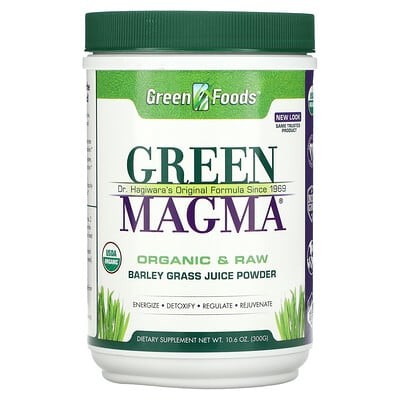

$34.79 $0.69 per serving


Product analysis
Green Magma supplies potassium that supports normal electrolyte balance and blood-vessel function, particularly when mineral intake is low. Its value is mixed across the different nutrients.
AI assessment of the formula, label and price. How scoring works
Nutrient Quality20
Most nutrient forms are unspecified, limiting a confident quality comparison. The named vitamin A source alone does not establish an advantage for the full combination.
Ingredient Transparency65
Declared amounts help explain the serving. Almost all ingredient forms remain unspecified, limiting close preparation comparisons.
Value For Money58
The potassium contribution offers favorable value at the serving cost. Vitamin A and chlorophyll are relatively costly for their amounts, while value for other nutrients remains uncertain.
Customer Satisfaction83
Customer feedback is positive across thousands of ratings. The broad response base describes satisfaction without proving blood-pressure benefits.
Product Focus67
Potassium nutrition provides the clearest connection to blood-vessel function. The 238 mg serving is below amounts used in the highlighted blood-pressure trials, so an equivalent effect cannot be assumed.
- Format
Powder - Container
- 10 Ounce(s)
- Per serving
- $0.69
- Also available
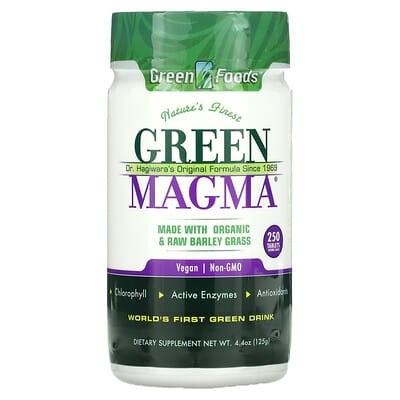 Green Magma$17.69
- Customer rating
- 4.6 · 2,192 ratings
Goals

Impact
High effect
Vitamin K · 18 mcgPotassium · 238 mgMagnesium · 12 mgFolate · 29 mcgVitamin C · 9 mg
Potassium provides the main connection to blood-vessel tone and sodium balance. Blood-pressure findings are most relevant to low habitual mineral intake or selected cardiovascular-risk settings. The 238 mg serving reaches the current supplied comparison reference but remains below the exposures in the highlighted trials, so that finding does not establish an equivalent blood-pressure effect. The unspecified vitamin K form does not support an MK-7-specific claim.
How this product is rated for Cardiovascular Support
Ingredient fit69
Potassium provides the main relevant contribution; the other small nutrient amounts add little to the saved findings. The main counted ingredient reaches the supplied amount reference; this does not establish the same effect as a trial regimen.
Goal fit
Relevant cardiovascular ingredients are present alongside other ingredients or broader product goals, limiting the focus on this goal.
Dose adequacy
The main counted ingredient reaches the supplied amount reference; this does not establish the same effect as a trial regimen.
Pathways59
The strongest saved coverage is blood-vessel tone and sodium balance. Coverage is concentrated in blood-vessel tone and sodium balance, rather than several cardiovascular areas.
Depth
The strongest saved coverage is blood-vessel tone and sodium balance.
Breadth
Coverage is concentrated in blood-vessel tone and sodium balance, rather than several cardiovascular areas.
Evidence86
Potassium has blood-pressure marker evidence, with intake and population limits.
Evidence strength
Potassium has blood-pressure marker evidence, with intake and population limits.
Studied preparation
The counted ingredients pass the saved preparation check; population and outcome limitations still apply.
Formulation logic100
The counted ingredients work alone or have their required partners, with no evaluated conflict identified.
Partner coverage
The counted ingredients work alone or have the partners required by the saved findings.
Conflicts
No evaluated ingredient conflict was identified.
Effective doses
The counted ingredients meet the saved amount threshold; this is not a proven clinical efficacy threshold.
Ingredients
| Ingredient | Amount per serving | Score |
|---|---|---|
Total Calories | 20 {Calories} | |
Total Carbohydrates | 4 Gram(s) | |
Protein | 1 Gram(s) | |
Vitamin A (Beta-Carotene) | 1000 IU | |
Vitamin C | 9 mg | |
Vitamin K | 18 mcg | |
Folic Acid | 29 mcg | |
Calcium | 35 mg | |
Iron | 0.5 mg | |
Sodium | 52 mg | |
Magnesium | 12 mg | |
Potassium | 238 mg | |
Chlorophyll | 13 mg |
Vitamin A (Beta-Carotene) · 1000 IU OverallScore51
Vitamin A comes from beta-carotene, with 1,000 IU per serving. The saved facts identify the full share as beta-carotene.
How this ingredient is rated
Active Ingredient Quality & Bioavailability50
Vitamin A comes from beta-carotene, a provitamin A form; its natural or synthetic origin is not established.
Vitamin A Chemical Form & Source
Beta-carotene is a provitamin A form; the saved information does not establish whether its origin is natural or synthetic.
Dose, Safety & Label Transparency67
The vitamin A amount is 1,000 IU per serving. The saved facts identify beta-carotene and its full source share.
Dosage Efficacy & Safety Thresholds
The evaluation considers the vitamin A amount of 1,000 IU per serving relatively modest.
Label Transparency of Specific Forms
The saved facts identify beta-carotene and its full source share.
Value20
At the whole-product price, the cost is about $3.48 per 5,000 IU of vitamin A.
Price per 5,000 IU Dose
The whole-product price works out to about $3.48 per 5,000 IU of vitamin A.
Chlorophyll · 13 mg OverallScore55
Each serving supplies 13 mg of chlorophyll, a modest amount. Based on the whole-product price, the cost is about $5.35 per 100 mg of chlorophyll.
How this ingredient is rated
Active Ingredient Quality & Bioavailability71
Chlorophyll is recorded, but its specific chemical form is not identified in the saved facts.
Chemical Form & Stability
Chlorophyll is recorded without a specific chemical form in the saved facts.
Botanical Source Transparency
The evaluation recognizes a named botanical source, but its identity is not included in the saved facts.
Dose, Safety & Label Transparency61
The serving provides 13 mg of chlorophyll.
Chlorophyll Potency per Serving
Each serving provides 13 mg of chlorophyll, a modest amount in this evaluation.
Elemental Mineral Disclosure
No copper chlorophyllin complex is identified in the saved facts, so the complex-specific disclosure check does not apply.
Additive Safety & Laxative-Free Guarantee
The evaluated ingredient information records no harsh herbal laxatives or the specified artificial additives.
Value10
The whole-product cost is high relative to the recorded chlorophyll amount.
Price per 100 mg Chlorophyll
Based on the whole-product price, the cost is about $5.35 per 100 mg of chlorophyll.
Potassium · 238 mg OverallScore45
A serving provides 238 mg of potassium. The available facts do not identify its chemical form, limiting comparisons of the source.
How this ingredient is rated
Active Ingredient Quality & Bioavailability0
A food-based origin is recorded, but the available facts do not identify the potassium compound.
Potassium Form Quality
A food-based origin is recorded, but the available facts do not identify the potassium compound.
Dose, Safety & Label Transparency64
The serving provides 238 mg of potassium. The potassium amount is stated for the serving.
Potassium Dosage Potency
The serving provides 238 mg of potassium.
Elemental Yield Transparency
The potassium amount is stated as 238 mg per serving; explicit “elemental potassium” wording is not recorded in the available evidence.
Value100
The whole-product serving costs about $0.70 for 238 mg of potassium; the price covers the entire product.
Potassium Value Efficiency
The whole-product serving costs about $0.70 for 238 mg of potassium; the price covers the entire product.
Alternative products
Report alternatives
Sources
Published studies used for the product analysis and the top-ranked studies for each ingredient and goal.
- Associations of dietary folate, vitamin B6 and B12 intake with cardiovascular outcomes in 115664 participants: a large UK population-based cohort.
- Folate, Homocysteine, and Adverse Outcomes After Ischemic Stroke.
- Effect of folic acid on endothelial function following acute myocardial infarction.
- Folic acid enhances endothelial function and reduces blood pressure in smokers: a randomized controlled trial.
- 5-methyltetrahydrofolate, the active form of folic acid, restores endothelial function in familial hypercholesterolemia.
- Circulating and dietary magnesium and risk of cardiovascular disease: a systematic review and meta-analysis of prospective studies.
- Magnesium and the risk of cardiovascular events: a meta-analysis of prospective cohort studies.
- Quantitative Association Between Serum/Dietary Magnesium and Cardiovascular Disease/Coronary Heart Disease Risk: A Dose-Response Meta-analysis of Prospective Cohort Studies.
- Comparative Efficacy of Nutraceuticals on Endothelial Function: A Systematic Review and Network Meta-Analysis.
- Serum magnesium, mortality, and cardiovascular disease in chronic kidney disease and end-stage renal disease patients: a systematic review and meta-analysis.
- Sex-specific associations between sodium and potassium intake and overall and cause-specific mortality: a large prospective U.S. cohort study, systematic review, and updated meta-analysis of cohort studies.
- Potassium intake, stroke, and cardiovascular disease a meta-analysis of prospective studies.
- Blood pressure response to changes in sodium and potassium intake: a metaregression analysis of randomised trials.
- Twenty-Four-Hour Urinary Sodium and Potassium Excretion and Their Associations With Blood Pressure Among Adults in China: Baseline Survey of Action on Salt China.
- Dietary Sodium and Potassium Intake and Risk of Non-Fatal Cardiovascular Diseases: The Million Veteran Program.
- Vitamin C may reduce troponin and CKMB levels after PCI and CABG: a meta-analysis.
- Vitamin C improves endothelium-dependent vasodilation by restoring nitric oxide activity in essential hypertension.
- Vitamin C supplementation improves blood pressure and oxidative stress after acute exercise in patients with poorly controlled type 2 diabetes mellitus: A randomized, placebo-controlled, cross-over study.
- Vascular benefits of vitamin C supplementation against fine particulate air pollution in healthy adults: A double-blind randomised crossover trial.
- Ascorbic acid reduces blood pressure and arterial stiffness in type 2 diabetes.