
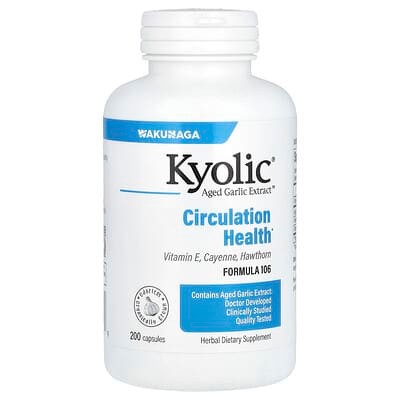

$27.56 $0.27 per serving


Product analysis
Kyolic Vitamin E Cayenne Hawthorn combines vitamin E with garlic, cayenne and hawthorn. The botanical preparations are poorly defined, making its cardiovascular rationale difficult to assess.
AI assessment of the formula, label and price. How scoring works
Nutrient Quality29
Vitamin E uses an identified natural form, which is a favorable preparation choice. The botanical forms are unspecified, so their quality is harder to compare.
Ingredient Transparency72
Ingredient amounts are disclosed, helping you check serving quantities. Only vitamin E has a clearly identified form, limiting comparison of the botanicals.
Value For Money72
Vitamin E and hawthorn offer favorable value for the full serving cost. Garlic value remains uncertain, and a favorable cost does not establish a suitable cardiovascular preparation.
Customer Satisfaction79
Customer ratings indicate very positive satisfaction. Several hundred ratings provide a useful, though still limited, picture of buyer experience.
Product Focus31
The ingredients point toward a relatively narrow cardiovascular purpose. The small hawthorn amount and incomplete preparation details limit how well the formula supports that purpose.
- Format
Capsule - Container
- 200 Capsule(s)
- Per serving
- $0.27
- Also available
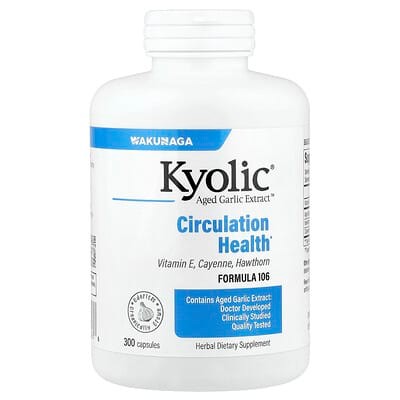 Kyolic Vitamin E Cayenne Hawthorn$38.44
- Customer rating
- 4.8 · 479 ratings
Goals

Impact
Lower effect
Vitamin E · 200 IU

Impact
Situational effect
Vitamin E · 200 IUHawthorn · 100 mg
Kyolic Vitamin E Cayenne Hawthorn has little cardiovascular pathway coverage in the supplied facts. Hawthorn is listed at 100 mg per serving, below the relevant dose range, while vitamin E is declared in IU without a usable milligram amount. Cayenne and garlic are the other listed actives, and neither adds a represented cardiovascular pathway here.
How this product is rated for Cardiovascular Support
Ingredient fit35
Hawthorn and vitamin E are the listed cardiovascular candidates; cayenne and garlic are off-goal actives.
Goal fit
The formula lists cardiovascular candidates alongside two actives tied to other goals.
Dose adequacy
Hawthorn is 100 mg per serving, below its reference range, and no usable vitamin E amount is established.
Pathways0
No cardiovascular pathway reaches a meaningful coverage level.
Depth
None of the listed pathways has meaningful coverage.
Breadth
None of the three target pathways reaches the breadth level.
Evidence0
Neither listed active contributes at an amount that can support the supplied evidence base.
Evidence strength
No ingredient reaches an effective amount for this goal.
Studied preparation
No active is both at an effective amount and in a studied preparation.
Formulation logic75
The ingredient record shows no partner gap or identified conflict, though no active reaches a useful amount.
Partner coverage
No missing partner is identified for the active ingredients.
Conflicts
No cardiovascular conflict is identified in the available facts.
Effective doses
Neither ingredient reaches its relevant dose range; hawthorn is below it and vitamin E remains unknown.
Ingredients
| Ingredient | Amount per serving | Score |
|---|---|---|
Vitamin E (D-Alpha-Tocopheryl Succinate) | 200 IU | |
Aged Garlic extract powder | 600 mg | |
Hawthorn Berry | 100 mg | |
Cayenne Pepper | 20 mg |
Vitamin E (D-Alpha-Tocopheryl Succinate) · 200 IU OverallScore72
A serving provides 200 IU of vitamin E as d-alpha-tocopheryl succinate. The whole-product serving costs about $0.28.
How this ingredient is rated
Active Ingredient Quality & Bioavailability46
The recorded form is d-alpha-tocopheryl succinate, a natural d-alpha form.
Natural (d-alpha) vs. Synthetic (dl-alpha)
d-alpha-tocopheryl succinate is a natural d-alpha form of vitamin E.
Mixed Tocopherol Isomer Diversity
A mixed-tocopherol complex is not identified in the saved facts.
Tocotrienol Complex Inclusion
Tocotrienols are not identified in the saved facts.
Dose, Safety & Label Transparency85
The serving provides 200 IU, with the vitamin E form identified.
Therapeutic Dosage Range
The evaluated vitamin E amount is 200 IU per serving.
Label Transparency and Isomer Specificity
The vitamin E amount and form are identified; individual isomer amounts are not recorded.
Value100
A whole-product serving costs about $0.28.
Cost per Natural-Form Therapeutic Serving
The whole-product serving costs about $0.28.
Hawthorn · 100 mg OverallScore52
A serving of two capsules provides 100 mg of hawthorn berry. The saved facts do not identify the species or provide a marker percentage.
How this ingredient is rated
Composition and Label Disclosure29
The saved facts do not provide a marker percentage or preparation ratio for the hawthorn. The hawthorn species is not identified in the saved facts.
Marker and Preparation Disclosure
The saved facts do not provide a marker percentage or preparation ratio for the hawthorn.
Species Name Disclosure
The hawthorn species is not identified in the saved facts.
Composition and Label Disclosure
No dose or safety rules were evaluated for hawthorn.
Commercial Price and Usability100
A whole-product serving costs about $0.28. Serving prices alone do not establish equivalent hawthorn amounts.
Commercial Price per Labeled Serving
The whole-product serving costs about $0.28.
Alternative products
Report alternatives
Sources
Published studies used for the product analysis and the top-ranked studies for each ingredient and goal.
- Real world effectiveness of Hawthorn special extract WS 1442 in a retrospective cohort study from Germany.
- Hawthorn (Crataegus spp.) Clinically Significantly Reduces Blood Pressure in Hypertension: A Meta-Analysis of Randomized Placebo-Controlled Clinical Trials.
- A randomised double blind placebo controlled clinical trial of a standardised extract of fresh Crataegus berries (Crataegisan) in the treatment of patients with congestive heart failure NYHA II.
- [Crataegus Special Extract WS 1442. Assessment of objective effectiveness in patients with heart failure (NYHA II)].
- Prospective, comparative cohort studies and their contribution to the benefit assessments of therapeutic options: heart failure treatment with and without Hawthorn special extract WS 1442.
- Supplementation with vitamin E alone is associated with reduced myocardial infarction: a meta-analysis.
- Vitamin E ameliorates blood cholesterol level and alters gut microbiota composition: A randomized controlled trial.
- Effects of long-term vitamin E supplementation on cardiovascular events and cancer: a randomized controlled trial.
- Independent and combined associations of dietary antioxidant exposure with all-cause and cause-specific mortality in the general population.
- Tocotrienol rich fraction supplementation improved lipid profile and oxidative status in healthy older adults: A randomized controlled study.
- Effects of delta-tocotrienol supplementation on Glycemic Control, oxidative stress, inflammatory biomarkers and miRNA expression in type 2 diabetes mellitus: A randomized control trial.
- Effect of vitamin E supplementation on serum C-reactive protein level: a meta-analysis of randomized controlled trials.
- Efficacy of Nutritional Interventions on Inflammatory Markers in Haemodialysis Patients: A Systematic Review and Limited Meta-Analysis.
- Vitamin E improves serum markers and histology in adults with metabolic dysfunction-associated steatotic liver disease: Systematic review and meta-analysis.
- Delta-tocotrienol supplementation improves biochemical markers of hepatocellular injury and steatosis in patients with nonalcoholic fatty liver disease: A randomized, placebo-controlled trial.