
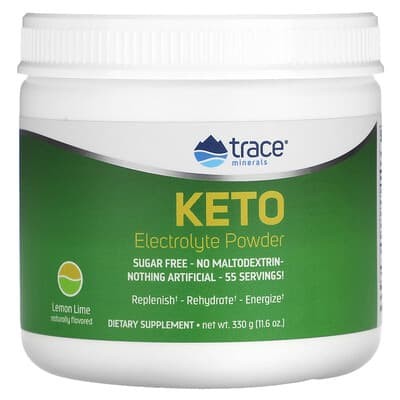
Keto Electrolyte Powder Lemon Lime Flavor

Goals
$37.99 $0.69 per serving


Product analysis
Keto Electrolyte Powder Lemon Lime Flavor supplies potassium and magnesium for normal mineral balance and blood-vessel function. Its unspecified blend makes it difficult to tell what the extras add.
AI assessment of the formula, label and price. How scoring works
Nutrient Quality66
The potassium form is a positive quality feature. The sea-salt chloride source and unidentified blend leave other parts of the form comparison uncertain.
Ingredient Transparency75
Listed amounts and most forms are stated, making the minerals easier to identify. The blend lacks a breakdown, so its individual contributions remain unclear.
Value For Money69
The serving is economical when judged for its potassium content. Chloride offers more moderate value, while the remaining minerals cannot be judged confidently.
Customer Satisfaction87
Customer ratings are positive. Feedback comes from 3344 ratings, providing useful context for that impression.
Product Focus40
Potassium and magnesium provide a clear nutritional link to mineral balance and blood-vessel function. Benefits depend partly on habitual intake, and the blend adds uncertainty about the extras.
- Format
Powder - Container
- 330 Gram(s)
- Per serving
- $0.69
- Customer rating
- 4.7 · 3,344 ratings
Goals

Impact
High effect
Magnesium · 120 mg
Magnesium contributes to electrolyte balance and blood-vessel tone, with small and inconsistent blood-pressure effects. Potassium offers nutritional blood-pressure support that depends on baseline intake and blood pressure.
How this product is rated for Heart Health
Ingredient fit61
Magnesium is a relevant contributor to the formula’s blood-pressure focus.
Goal fit
Relevant ingredients share the formula with other actives, giving it a broader focus than heart health alone.
Dose adequacy
The credited amounts provide partial coverage of the saved comparison anchors, rather than establishing a complete daily regimen.
Pathways44
Electrolyte balance and blood-vessel tone provide the strongest connection, with limited expectations for blood-pressure change.
Depth
Electrolyte balance and blood-vessel tone provide the strongest connection, with limited expectations for blood-pressure change.
Breadth
Only one area reaches the saved coverage benchmark, so support is concentrated rather than broad.
Evidence89
Magnesium supplies the strongest saved evidence finding, although blood-pressure results are small and inconsistent.
Evidence strength
Magnesium supplies the strongest saved evidence finding, although blood-pressure results are small and inconsistent.
Studied preparation
The saved finding recognizes the credited preparations; this does not make different forms interchangeable or establish a daily study regimen.
Formulation logic100
The counted ingredients have their required partners, and no configured conflict was identified.
Partner coverage
No required partner is missing among the credited ingredients; this does not establish added benefit from combining them.
Conflicts
No configured ingredient conflict was matched in the supplied facts.
Effective doses
The counted ingredients meet the saved amount benchmark, which is a comparison convention rather than a proven minimum effective dose.

Impact
High effect
Potassium · 1000 mgMagnesium · 120 mg
Potassium supports blood-pressure regulation, with benefits depending partly on habitual intake and the populations studied. The 1000 mg per serving is still below the daily potassium exposure in the supplied low-intake trial, despite receiving the full saved amount contribution. Magnesium citrate adds a smaller vascular contribution at 120 mg per serving, with inconsistent findings for blood pressure and arterial stiffness. Neither role establishes prevention of cardiovascular events.
How this product is rated for Cardiovascular Support
Ingredient fit66
Potassium and magnesium provide the relevant contributions within the mineral formula.
Goal fit
Other actives make the formula broader than the ingredients counted toward this goal.
Dose adequacy
Potassium receives the full saved amount contribution; magnesium provides a smaller partial contribution.
Pathways60
The saved findings concentrate on blood-vessel tone and sodium balance, with no broader pathway coverage established.
Depth
The strongest represented aspect is blood-vessel tone and sodium balance.
Breadth
Only blood-vessel tone and sodium balance reaches the saved coverage threshold.
Evidence86
Potassium supplies the strongest relevant contribution; the supplied findings remain specific to populations and outcomes.
Evidence strength
Potassium supplies the strongest relevant evidence at the declared amount.
Studied preparation
The counted ingredients were treated as studied preparations, without establishing identical outcomes across forms.
Formulation logic100
The counted ingredients meet the saved amount threshold, with no missing required partner or configured conflict.
Partner coverage
The counted ingredients can contribute independently or have their required partner.
Conflicts
No configured ingredient conflict was identified.
Effective doses
The ingredients counted toward the goal meet the saved amount threshold.
Ingredients
| Ingredient | Amount per serving | Score |
|---|---|---|
Calcium (Calcium Lactate) | 75 mg | |
Magnesium (Magnesium Citrate) | 120 mg | |
Chloride (Sea Salt) | 15 mg | |
Sodium (Sea Salt) | 10 mg | |
Potassium (Potassium Citrate) | 1000 mg | |
Electrolyte Mineral Complex | 100 mg |
Potassium (Potassium Citrate) · 1000 mg OverallScore95
Chloride (Sea Salt) · 15 mg OverallScore35
The disclosed 15 mg of chloride per powder serving provides a small contribution to chloride intake. The whole-product serving costs about $0.69, while the unresolved salt source limits source comparisons.
How this ingredient is rated
Active Ingredient Quality & Bioavailability20
The salt source remains unresolved in the saved information. Knowing the chloride amount does not identify its chemical source or establish purity or absorption.
Chloride source quality
The chemical salt source is unresolved, so source-specific properties cannot be assessed from the chloride amount alone.
Dose, Safety & Label Transparency42
The 15 mg chloride amount is individually disclosed and provides a small contribution. Its salt source remains unresolved.
Chloride amount per serving
The 15 mg chloride amount provides a small contribution to intake in the saved evaluation.
Amount and source disclosure
The 15 mg chloride amount is individually disclosed, but the specific salt source is unresolved.
Value50
The whole product costs about $0.69 per labeled serving, a moderate serving price. Serving prices alone do not account for differences in chloride amount.
Price per serving
About $0.69 per whole-product serving is a moderate serving price; the basis is the labeled serving, not a fixed chloride quantity.
Alternative products
Report alternatives
Sources
Published studies used for the product analysis and the top-ranked studies for each ingredient and goal.
- Circulating and dietary magnesium and risk of cardiovascular disease: a systematic review and meta-analysis of prospective studies.
- Magnesium and the risk of cardiovascular events: a meta-analysis of prospective cohort studies.
- Quantitative Association Between Serum/Dietary Magnesium and Cardiovascular Disease/Coronary Heart Disease Risk: A Dose-Response Meta-analysis of Prospective Cohort Studies.
- Comparative Efficacy of Nutraceuticals on Endothelial Function: A Systematic Review and Network Meta-Analysis.
- Serum magnesium, mortality, and cardiovascular disease in chronic kidney disease and end-stage renal disease patients: a systematic review and meta-analysis.
- Sex-specific associations between sodium and potassium intake and overall and cause-specific mortality: a large prospective U.S. cohort study, systematic review, and updated meta-analysis of cohort studies.
- Potassium intake, stroke, and cardiovascular disease a meta-analysis of prospective studies.
- Blood pressure response to changes in sodium and potassium intake: a metaregression analysis of randomised trials.
- Twenty-Four-Hour Urinary Sodium and Potassium Excretion and Their Associations With Blood Pressure Among Adults in China: Baseline Survey of Action on Salt China.
- Dietary Sodium and Potassium Intake and Risk of Non-Fatal Cardiovascular Diseases: The Million Veteran Program.
- Effects of magnesium supplementation on improving hyperglycemia, hypercholesterolemia, and hypertension in type 2 diabetes: A pooled analysis of 24 randomized controlled trials.
- The effect of lowering blood pressure by magnesium supplementation in diabetic hypertensive adults with low serum magnesium levels: a randomized, double-blind, placebo-controlled clinical trial.
- Positive effects of magnesium supplementation in metabolic syndrome.
- Oral potassium supplementation for management of essential hypertension: A meta-analysis of randomized controlled trials.
- Joint association of urinary sodium and potassium excretion with cardiovascular events and mortality: prospective cohort study.
- Effect of Potassium Supplementation on Endothelial Function: A Systematic Review and Meta-Analysis of Intervention Studies.
- Effects of potassium supplementation on office, home, and 24-h blood pressure in patients with essential hypertension.