
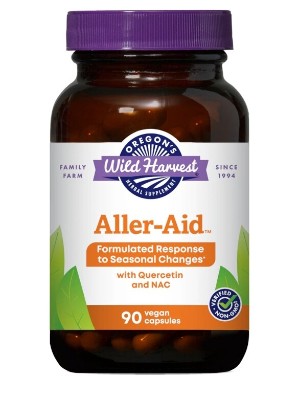

$28.76 $0.63 per serving


Product analysis
Aller-Aid provides vitamin C for antioxidant support alongside nettle and other ingredients. Its support for inflammation is limited, with inconsistent findings for quercetin and N-acetyl cysteine.
AI assessment of the formula, label and price. How scoring works
Nutrient Quality29
Ingredient quality is difficult to compare because three of the four forms are not stated. Vitamin C is identified, but its absorption quality also remains uncertain.
Ingredient Transparency72
Every ingredient amount is stated, which helps you compare servings. Only the vitamin C form is identified, leaving the other three forms unclear.
Value For Money50
The serving cost compares reasonably well for the nettle content. The value of the other ingredients is uncertain, limiting confidence in the whole blend as a purchase.
Customer Satisfaction64
Customer ratings are positive. Feedback comes from just 21 ratings, so the picture of satisfaction is limited.
Product Focus61
The four ingredients are brought together for inflammation-related support. Vitamin C offers antioxidant support, while the additional contribution from the other ingredients is limited or inconsistent.
- Format
Capsule - Container
- 90 Capsule(s)
- Per serving
- $0.63
- Customer rating
- 4.4 · 21 ratings
Goals

Impact
Moderate effect
Vitamin C · 250 mg
Vitamin C at 250 mg provides antioxidant support, while 150 mg of stinging nettle adds limited, context-specific relevance to inflammatory signaling. Quercetin and N-acetyl cysteine have largely null or inconsistent inflammation findings in the supplied evidence, so the combination should be viewed cautiously.
How this product is rated for Inflammation
Ingredient fit59
The relevant ingredients give the formula a clear inflammation-related focus. Low or undisclosed amounts limit the match to the saved dose comparisons.
Goal fit
The relevant ingredients give the formula a clear inflammation-related focus.
Dose adequacy
Low or undisclosed amounts limit the match to the saved dose comparisons.
Pathways9
The strongest assessed connection is to oxidative and mitochondrial stress, with limited coverage in the saved findings. The saved findings show limited breadth across the main inflammation mechanisms.
Depth
The strongest assessed connection is to oxidative and mitochondrial stress, with limited coverage in the saved findings.
Breadth
The saved findings show limited breadth across the main inflammation mechanisms.
Evidence87
Vitamin C provides the strongest assessed evidence in the formula, with relevant but qualified support for this goal. The assessed ingredients at relevant amounts match preparations recognized in the saved findings.
Evidence strength
Vitamin C provides the strongest assessed evidence in the formula, with relevant but qualified support for this goal.
Studied preparation
The assessed ingredients at relevant amounts match preparations recognized in the saved findings.
Formulation logic100
All assessed contributors meet the saved minimum amount comparison. No ingredient conflicts were identified in the saved assessment.
Partner coverage
The assessed ingredients can contribute independently or have their required partner present.
Conflicts
No ingredient conflicts were identified in the saved assessment.
Effective doses
All assessed contributors meet the saved minimum amount comparison.
Ingredients
| Ingredient | Amount per serving | Score |
|---|---|---|
Vitamin C (Ascorbic Acid) | 250 mg | |
Quercetin Dihydrate | 275 mg | |
N-Acetyl Cysteine | 300 mg | |
Nettles | 150 mg |
Stinging Nettle · 150 mg OverallScore54
A serving lists 150 mg of Urtica dioica nettle. The saved source evidence does not identify root or leaf, limiting a part-specific comparison.
How this ingredient is rated
Composition and Label Disclosure0
No root or leaf identification is captured in the evaluated source evidence. The source is identified as nettle, without an established extract or powder preparation in the saved facts.
Root or Leaf Identity Disclosure
No root or leaf identification is captured in the evaluated source evidence.
Nettle Preparation and Marker Detail
The source is identified as nettle, without an established extract or powder preparation in the saved facts.
Composition and Label Disclosure100
The selected serving lists 150 mg of nettle.
Nettle Amount Disclosure
The selected serving lists 150 mg of nettle.
Commercial Price and Usability70
The whole-product serving costs about $0.64.
Selected-Serving Price Comparison
The whole-product serving costs about $0.64.
Alternative products
Report alternatives
Sources
Published studies used for the product analysis and the top-ranked studies for each ingredient and goal.
- The effect of hydro alcoholic Nettle (Urtica dioica) extracts on insulin sensitivity and some inflammatory indicators in patients with type 2 diabetes: a randomized double-blind control trial.
- Urtica Dioica Root Extract on Clinical and Biochemical Parameters in Patients with Benign Prostatic Hyperplasia, Randomized Controlled Trial.
- Safety, Tolerability, and Efficacy of Hox Alpha, a Dry Extract from Stinging Nettle Leaves versus OTC NSAIDs in Osteoarthritis: A Retrospective, Propensity-Matched 12-Week Analysis from the German Pain e-Registry (SIPHARO Study).
- [Recommendations of the DGRh Committee on Complementary Medicine and Nutrition on the application of selected phytotherapeutic drugs and herbal medicines in rheumatology].
- Randomized controlled trial of nettle sting for treatment of base-of-thumb pain
- Efficacy of Vitamin C as Glucocorticoid Substitute for Reducing Pain and Inflammation After Total Hip Arthroplasty: A Randomized Controlled Trial.
- The Impact of Vitamin C on Analgesic, Anti-inflammatory, and Hemostatic Outcomes After Total Hip and Knee Arthroplasty: A Systematic Review and Meta-Analysis.
- The impact of vitamin C supplementation on the perioperative outcomes after total hip and knee arthroplasty: a systematic review and meta-analysis.
- Therapeutic Impact of Ascorbic Acid on Oral and Periodontal Tissues: A Systematic Literature Review.
- Oral vitamin C administration reduces early recurrence rates after electrical cardioversion of persistent atrial fibrillation and attenuates associated inflammation.