
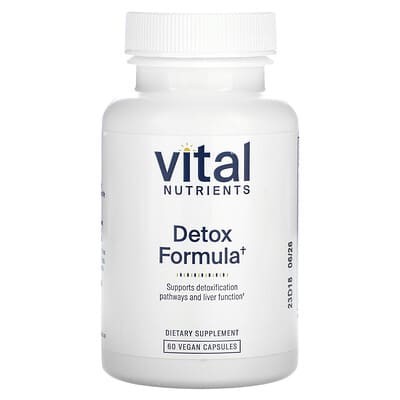

$29.99 $0.99 per serving


Product analysis
Detox Formula combines milk thistle with other plant ingredients and amino acids. Its liver-related evidence is mixed and preparation-specific, so the combination does not establish routine toxin removal.
AI assessment of the formula, label and price. How scoring works
Nutrient Quality23
Most specific ingredient preparations are not identified, which limits a quality comparison. The named turmeric and green-tea components do not resolve the quality of the full formula.
Ingredient Transparency68
Ingredient amounts are disclosed, but most forms are not identified. That makes it easier to compare quantities than to match the preparations with alternatives.
Value For Money21
Several of the priced ingredients offer poor value for the serving cost. Value for the remaining ingredients is uncertain.
Customer Satisfaction71
Customer feedback is very positive, though relatively few ratings support it. The small review base limits confidence about typical satisfaction.
Product Focus61
Milk thistle provides a preparation-specific connection to liver research, with mixed findings. The broader amino-acid and plant mixture does not establish routine clearance of unspecified toxins.
- Format
Capsule - Container
- 60 Capsule(s)
- Per serving
- $0.99
- Customer rating
- 4.7 · 79 ratings
Goals

Impact
High effect
Milk Thistle · 200 mgGlutamine · 250 mgTaurine · 250 mgGlycine · 250 mg
Ingredients
| Ingredient | Amount per serving | Score |
|---|---|---|
Glutamine | 250 mg | |
Glycine | 250 mg | |
Taurine | 250 mg | |
Milk Thistle seed extract | 200 mg | |
Curcuma longa rhizome extract (Total Curcuminoids) | 100 mg | |
N-Acetyl Cysteine | 100 mg | |
Alpha Lipoic Acid | 100 mg | |
Grape seed extract | 50 mg | |
MSM | 50 mg | |
Broccoli sprout powder | 50 mg | |
Yellow Dock | 50 mg | |
Schisandra berry extract | 50 mg | |
Green Tea leaf extract (Catechins) | 25 mg |
Glycine · 250 mg OverallScore24
250 mg of glycine per serving comes at a high cost per gram. Glycine is named, but its purity standard is not specified. Ordinary capsule or tablet ingredients are indicated, but specific excipients are not named.
How this ingredient is rated
Active Ingredient Quality & Bioavailability0
Glycine is named, but its purity standard is not specified.
Glycine Sourcing and Purity Standards
Glycine is named, but its purity standard is not specified.
Dose, Safety & Label Transparency46
It provides 250 mg of glycine per serving. Ordinary capsule or tablet ingredients are indicated, but specific excipients are not named.
Clinically Relevant Dosage
It provides 250 mg of glycine per serving.
Label Transparency and Yield Disclosure
The glycine amount is stated.
Clean Label and Excipient Quality
Ordinary capsule or tablet ingredients are indicated, but specific excipients are not named.
Value30
The cost per gram of glycine is high.
Cost Efficiency per 1,000mg of Glycine
The cost per gram of glycine is high.
Taurine · 250 mg OverallScore53
A serving provides 250 mg of taurine, a modest amount, at a high cost per gram using the full product price. Taurine is named, but its more specific form is not stated. A testing or GMP manufacturing claim is indicated, without a named certification seal.
How this ingredient is rated
Active Ingredient Quality & Bioavailability57
Taurine is named, but its more specific form is not stated. The taurine source and manufacturing origin are not specified in the available information. No artificial colors, flavors, sweeteners, hydrogenated oils or listed flow agents are indicated in the available information.
Chemical Form and Purity
Taurine is named, but its more specific form is not stated.
Sourcing and Branded Ingredients
The taurine source and manufacturing origin are not specified in the available information.
Formulation Cleanliness
No artificial colors, flavors, sweeteners, hydrogenated oils or listed flow agents are indicated in the available information.
Dose, Safety & Label Transparency66
The amount is clearly stated at 250 mg per serving. A testing or GMP manufacturing claim is indicated, without a named certification seal.
Taurine Dosage Potency
A serving provides 250 mg of taurine, a modest amount.
Dose Disclosure
The taurine amount is stated per serving.
Quality Assurance and Testing
A testing or GMP manufacturing claim is indicated, without a named certification seal.
Value20
The full product price gives a high cost per gram of taurine.
Price per Gram of Taurine
Using the full product price, the cost per gram of taurine is high.
Glutamine · 250 mg OverallScore32
Each serving provides 250 mg of glutamine, at a high cost for the amount. The glutamine is listed without specifying its stereochemistry.
How this ingredient is rated
Active Ingredient Quality & Bioavailability40
The glutamine is listed without specifying its stereochemistry.
Glutamine Grade & Purity
The glutamine is listed without specifying its stereochemistry.
Dose, Safety & Label Transparency33
The label individually states 250 mg of glutamine per serving.
Therapeutic Dosage Strength
Each serving provides 250 mg of glutamine.
Label Transparency & Blends
The glutamine amount is individually disclosed.
Value15
The cost for the amount of glutamine is high.
Price per Gram of L-Glutamine
The cost for the amount of glutamine is high.
Alternative products
Report alternatives
Sources
Published studies used for the product analysis and the top-ranked studies for each ingredient and goal.
- Efficacy of glutamine supplementation in postoperative patients undergoing hepatic surgery: a systematic review and meta-analysis of randomized controlled trials.
- Glutamine supplementation in preterm infants receiving parenteral nutrition leads to an early improvement in liver function.
- Parenteral glutamine protects hepatic function during bone marrow transplantation.
- Protective effect of parenteral glutamine supplementation on hepatic function in very low birth weight infants.
- A multistrain probiotic increases the serum glutamine/glutamate ratio in patients with cirrhosis: a metabolomic analysis.
- The impact of obesity-associated glycine deficiency on the elimination of endogenous and exogenous metabolites via the glycine conjugation pathway.
- Metabolic impact of dietary glycine supplementation in individuals with severe obesity.
- Contribution towards a Metabolite Profile of the Detoxification of Benzoic Acid through Glycine Conjugation: An Intervention Study.
- Glycine conjugation of para-aminobenzoic acid (PABA): a quantitative test of liver function.
- The treatment of isovaleric acidemia with glycine supplement
- Therapeutic benefits of green tea extract on various parameters in non-alcoholic fatty liver disease patients.
- The Effect of Green Tea Extract Supplementation on Liver Enzymes in Patients with Nonalcoholic Fatty Liver Disease.
- Green tea with high-density catechins improves liver function and fat infiltration in non-alcoholic fatty liver disease (NAFLD) patients: a double-blind placebo-controlled study.
- Green tea consumption is associated with decreased DNA damage among GSTM1-positive smokers regardless of their hOGG1 genotype.
- Modulation of human glutathione s-transferases by polyphenon e intervention.
- The effect of silymarin on liver enzymes in patients taking isotretinoin: A randomized clinical trial.
- A randomized double-blind, placebo-controlled study of therapeutic effects of silymarin in β-thalassemia major patients receiving desferrioxamine.
- Effect of aerobic training with silymarin consumption on glycemic indices and liver enzymes in men with type 2 diabetes.
- Impact of silymarin-supplemented cookies on liver enzyme and inflammatory markers in non-alcoholic fatty liver disease patients.
- Impact of Silymarin Supplements on Liver Enzyme Levels: A Systematic Review.