
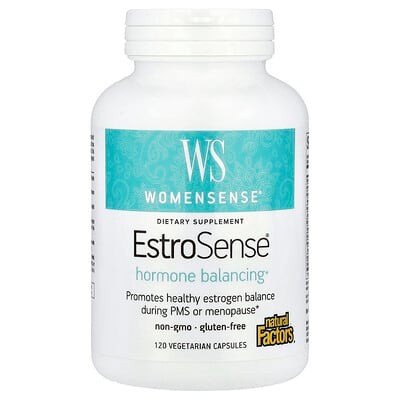

$38.47 $0.64 per serving


Product analysis
EstroSense combines plant ingredients that may support protection of blood fats and vessel walls from oxidative damage. Its heart-related benefits appear limited to that area, and the cost is high for the amount of lycopene supplied.
AI assessment of the formula, label and price. How scoring works
Nutrient Quality39
Ingredient quality remains uncertain because the available information does not establish how well the individual forms perform. Some forms are named, while calcium d-glucarate, I3C and DIM are not described further.
Ingredient Transparency88
Amounts are listed for every active ingredient, making the serving easier to compare. Three ingredients lack form details, leaving part of the formula less clearly described.
Value For Money25
Value is mixed, with the lycopene amount particularly costly for the full serving price. Milk thistle offers a more moderate comparison, while green tea and rosemary cannot be judged reliably.
Customer Satisfaction93
Customer feedback is strongly positive. A substantial review base supports confidence in that satisfaction pattern.
Product Focus57
The heart-related benefit is concentrated on protection of blood fats and vessel walls from oxidative damage. Most of the other ingredients do not contribute to that particular goal.
- Format
Capsule - Container
- 120 Capsule(s)
- Per serving
- $0.64
- Also available
 EstroSense$22.37
- Customer rating
- 4.8 · 17,318 ratings
Goals

Impact
Moderate effect
Lycopene · 5 mg
Ingredients
| Ingredient | Amount per serving | Score |
|---|---|---|
Calcium-D-Glucarate | 150 mg | |
Indole-3-Carbinol | 150 mg | |
Sunphenon decaffeinated Green Tea extract (Polyphenols) | 100 mg | |
Turmeric extract (Curcuminoids) | 50 mg | |
Milk Thistle extract (Silymarin) | 50 mg | |
Di-Indolylmethane | 50 mg | |
Rosemary extract (Carnosic Acid) | 25 mg | |
Lycopene (Tomato) | 5 mg | |
Sulforaphane (BroccoPhane Broccoli sprout powder) | 200 mcg |
Rosemary (Carnosic Acid) · 25 mg OverallScore100
A serving lists 25 mg of rosemary leaf extract. A 6% marker is listed, but its identity is unclear. The price per serving has not been assessed.
How this ingredient is rated
Composition and Label Disclosure100
A 6% marker is listed, but its identity is unclear.
Marker and Preparation Disclosure
A 6% marker is listed, but its identity is unclear.
Composition and Label Disclosure100
A serving lists 25 mg of rosemary leaf extract. The source is rosemary leaf extract.
Amount and Label Disclosure
A serving lists 25 mg of rosemary leaf extract. The source is rosemary leaf extract.
Commercial Price and Usability
The price per serving has not been assessed.
Lycopene (Tomato) · 5 mg OverallScore70
Each serving lists 5 mg of lycopene, with a high cost for the amount supplied. The estimate assigns the full serving price to lycopene, so it may overstate its cost. The lycopene source is unclear in the available information.
How this ingredient is rated
Composition and Label Disclosure
The available information does not identify the lycopene source, so its form is unclear.
Composition and Label Disclosure100
The lycopene amount is stated as 5 mg per serving.
Declared Active Lycopene Amount
The stated serving contains 5 mg of lycopene.
Commercial Price and Usability10
The cost per amount of lycopene is high. The estimate assigns the full serving price to lycopene, so it may overstate its cost.
Whole-Product Cost per 10 mg Declared Active Lycopene
The cost for the lycopene amount is high. The estimate assigns the full serving price to lycopene, so it may overstate its cost.
Green Tea (Polyphenols) · 100 mg OverallScore44
The serving provides 100 mg of camellia sinensis leaf extract. The EGCG amount is unknown, so its cost cannot be determined. The extract is decaffeinated, but its remaining caffeine amount is unknown.
How this ingredient is rated
Composition and Label Disclosure70
The stated composition includes 80% polyphenols.
Declared Green Tea Marker Concentration
The stated composition includes 80% polyphenols.
Composition and Label Disclosure40
The extract is decaffeinated, but its remaining caffeine amount is unknown.
Whole-Product Caffeine Disclosure
The extract is decaffeinated, but its remaining caffeine amount is unknown.
Commercial Price and Usability0
The EGCG amount is unknown, so its cost cannot be determined.
Cost per 200 mg Declared EGCG
The EGCG amount is unknown, so its cost cannot be determined.
Alternative products
Report alternatives
Sources
Published studies used for the product analysis and the top-ranked studies for each ingredient and goal.
- A green tea extract high in catechins reduces body fat and cardiovascular risks in humans.
- The effects of green tea supplementation on cardiovascular risk factors: A systematic review and meta-analysis.
- Effect of Green Tea on Blood Pressure in Healthy Individuals: A Meta-Analysis.
- Effects of green tea on lipid profile in overweight and obese women.
- Green tea consumption and risk of cardiovascular and ischemic related diseases: A meta-analysis.
- Effects of lycopene intake on HDL-cholesterol and triglyceride levels: A systematic review with meta-analysis.
- Improvement of vascular endothelial function by intake of lycopene-rich tomato juice in healthy adults: a randomized, placebo-controlled, double-blind, parallel-group comparative study.
- Tomato and lycopene supplementation and cardiovascular risk factors: A systematic review and meta-analysis.
- Lycopene and tomato and risk of cardiovascular diseases: A systematic review and meta-analysis of epidemiological evidence.
- Lycopene and risk of cardiovascular diseases: A meta-analysis of observational studies.