


Vitamin C Supportive
$19.59 $0.16 per serving
Product analysis
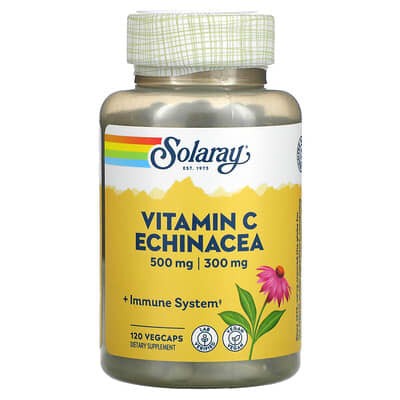
Solaray Vitamin C Echinacea combines 500 mg of vitamin C and 300 mg of mixed echinacea in one capsule for immune support. The vitamin C offers good value and supports normal immune function, while the additional benefit of the echinacea is less consistent and depends on the preparation.
AI assessment of the formula, label and price. How scoring works
Nutrient Quality39
Ascorbic acid gives the formula a clear source of vitamin C, alongside two echinacea species. The vitamin C is unbuffered, and the proportions of the botanical preparation are not established.
Ingredient Transparency70
All three main ingredient amounts are listed, and the vitamin C and echinacea preparations are named. The individual botanical and blend proportions are not specified.
Value For Money79
The vitamin C amount offers good value. The cost of the echinacea cannot be compared reliably without a suitable preparation comparison.
Customer Satisfaction82
Customer feedback is especially favorable. Hundreds of ratings support the high average.
Product Focus40
The formula has a clear immune-support focus. Vitamin C provides the better-established nutritional contribution, while echinacea's additional benefit is uncertain.
- Format
Capsule - Container
- 120 VegCap(s)
- Per serving
- $0.16
- Customer rating
- 4.9 · 624 ratings
Goals

Impact
High effect
Vitamin C · 500 mg
Vitamin C Echinacea offers modest regular-use cold-duration support mainly through its 500 mg of vitamin C. The 300 mg mixed echinacea preparation has small, inconsistent, preparation-dependent effects, so it adds little practical confidence.

Impact
Moderate effect
Vitamin C · 500 mg
Vitamin C Echinacea has a supported everyday-health role through its vitamin C content when dietary intake falls short. The 500 mg of vitamin C as ascorbic acid supplies a nutrient used in normal antioxidant and immune functions.
Vitamin C Supportive

Impact
Moderate effect
Vitamin C · 500 mg
Vitamin C Echinacea has a modest antioxidant fit for inflammation through 500 mg vitamin C as ascorbic acid. Vitamin C is relevant to oxidative stress, but the supplied inflammation-marker findings were mixed overall and more favorable with elevated starting inflammation. Its amount is below the exposure associated with that signal.
Vitamin C Supportive

Impact
High effect
Vitamin C · 500 mg
Vitamin C Echinacea offers nutritional support for skin. Vitamin C at 500 mg supports collagen formation when dietary intake is inadequate.
Vitamin C Supportive
Ingredients
| Ingredient | Amount per serving | Score |
|---|---|---|
Vitamin C (Ascorbic Acid) | 500 mg | |
Echinacea (Echinacea angustifolia, Echinacea purpurea) | 300 mg | |
Vitamin C Support Base | 13 mg |
Vitamin C (Ascorbic Acid) · 500 mg OverallScore66
Solaray Vitamin C Echinacea offers good vitamin C value, with 500 mg per serving from ascorbic acid. Ascorbic acid is unbuffered and may be less comfortable for a sensitive stomach. The full formula costs $0.16 per serving, equivalent to $0.33 per 1,000 mg of vitamin C.
Alternative products
Report alternatives
Sources
Published studies used for the product analysis and the top-ranked studies for each ingredient and goal.
- Dietary intake and blood concentrations of antioxidants and the risk of cardiovascular disease, total cancer, and all-cause mortality: a systematic review and dose-response meta-analysis of prospective studies.
- Scientific Opinion on the substantiation of a health claim related to vitamin C and increasing non haem iron absorption pursuant to Article 14 of Regulation (EC) No 1924/2006.
- Vitamin C Depletion and All-Cause Mortality in Renal Transplant Recipients.
- Associations of Serum Biomarkers of Fruit and Vegetable Intake With the Risk of Cause-Specific Mortality and All-Cause Mortality: A National Prospective Cohort Study.
- Relation between plasma ascorbic acid and mortality in men and women in EPIC-Norfolk prospective study: a prospective population study. European Prospective Investigation into Cancer and Nutrition.
- Vitamin C and contribution to the normal function of the immune system: evaluation of a health claim pursuant to Article 14 of Regulation (EC) No 1924/2006.
- Therapeutic effects of high-dose vitamin C supplementation in patients with COVID-19: a meta-analysis.
- Effect of micronutrient supplements on influenza and other respiratory tract infections among adults: a systematic review and meta-analysis.
- New evidence for antioxidant properties of vitamin C.
- Enhanced Vitamin C Delivery: A Systematic Literature Review Assessing the Efficacy and Safety of Alternative Supplement Forms in Healthy Adults.
- Efficacy of Vitamin C as Glucocorticoid Substitute for Reducing Pain and Inflammation After Total Hip Arthroplasty: A Randomized Controlled Trial.
- The Impact of Vitamin C on Analgesic, Anti-inflammatory, and Hemostatic Outcomes After Total Hip and Knee Arthroplasty: A Systematic Review and Meta-Analysis.
- The impact of vitamin C supplementation on the perioperative outcomes after total hip and knee arthroplasty: a systematic review and meta-analysis.
- Therapeutic Impact of Ascorbic Acid on Oral and Periodontal Tissues: A Systematic Literature Review.
- Oral vitamin C administration reduces early recurrence rates after electrical cardioversion of persistent atrial fibrillation and attenuates associated inflammation.
- Evaluation of the anti-wrinkle effect of an ascorbic acid-loaded dissolving microneedle patch via a double-blind, placebo-controlled clinical study.
- Comparative Study on the Outcome of Periorbital Wrinkles Treated with Laser-Assisted Delivery of Vitamin C or Vitamin C Plus Growth Factors: A Randomized, Double-blind, Clinical Trial.
- Randomized trial of topical ascorbic acid in DMSO versus imiquimod for the treatment of basal cell carcinoma.
- Vitamin C improves healing of foot ulcers: a randomised, double-blind, placebo-controlled trial.
- Dietary nutrient intakes and skin-aging appearance among middle-aged American women.