
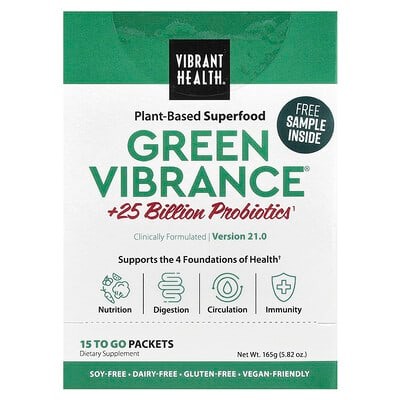

$42.88 $2.85 per serving


Product analysis
Green Vibrance combines many plant ingredients with vitamins and minerals. Incomplete blend breakdowns make its large mixture harder to assess, and several ingredient contributions compare poorly on value.
AI assessment of the formula, label and price. How scoring works
Nutrient Quality28
Some preparations are identified, including eleuthero root extract. Many other sources remain unspecified, preventing a dependable quality judgment for the complete mixture.
Ingredient Transparency57
Most amounts are disclosed, while one blend lacks a stated quantity. Incomplete preparation and blend details limit like-for-like comparisons.
Value For Money34
The full serving cost compares poorly for several individual contributions, including iron, chromium and ginger. Value for many other components remains uncertain.
Customer Satisfaction71
Customer ratings are generally favorable. The relatively small rating pool limits how representative the feedback may be.
Product Focus10
The very large mixture and unidentified blend contents make individual contributions hard to separate. Nutrition-panel headings also do not provide a reliable count of meaningful active ingredients.
- Format
Powder - Container
- 165 Gram(s)
- Per serving
- $2.85
- Customer rating
- 4.6 · 196 ratings
Goals

Impact
Moderate effect
Vitamin K · 54 mcgMagnesium · 25 mgVitamin B12 · 2 mcgGreen Tea · 20 mgVitamin D · 10 mg
Potassium at 200 mg contributes to normal electrolyte balance and vascular tone. Selenium adds nutritional antioxidant-enzyme support, with heart-health relevance mainly where intake is inadequate.
The 40 mg grape-seed extract and small magnesium and green-tea amounts offer limited contributions against the supplied comparison. Vitamin D’s very large retained declaration does not imply added cardiovascular benefit; the supplied trial evidence did not show fewer major cardiovascular events from routine supplementation.
How this product is rated for Heart Health
Ingredient fit52
The relevant ingredients sit within a broader mix aimed at several needs. The assessed amounts come close to the saved comparison benchmarks overall.
Goal fit
The relevant ingredients sit within a broader mix aimed at several needs.
Dose adequacy
The assessed amounts come close to the saved comparison benchmarks overall.
Pathways19
The strongest assessed area is electrolyte and vascular-tone balance, with limited coverage. No assessed area reaches the threshold for substantial coverage.
Depth
The strongest assessed area is electrolyte and vascular-tone balance, with limited coverage.
Breadth
No assessed area reaches the threshold for substantial coverage.
Evidence66
Vitamin D provides the strongest evidence contribution among the assessed ingredients, with important limits on cardiovascular outcomes. The assessed ingredients meeting the amount threshold match the preparations recognized in the saved findings.
Evidence strength
Vitamin D provides the strongest evidence contribution among the assessed ingredients, with important limits on cardiovascular outcomes.
Studied preparation
The assessed ingredients meeting the amount threshold match the preparations recognized in the saved findings.
Formulation logic100
The assessed ingredients can contribute independently or have their required partner. No configured ingredient conflict was matched in the supplied assessment. All ingredients included in this check reach its minimum amount threshold.
Partner coverage
The assessed ingredients can contribute independently or have their required partner.
Conflicts
No configured ingredient conflict was matched in the supplied assessment.
Effective doses
All ingredients included in this check reach its minimum amount threshold.
Ingredients
| Ingredient | Amount per serving | Score |
|---|---|---|
Calories | 45 Calorie(s) | |
Total Fat | 0.5 Gram(s) | |
Total Carbohydrates | 8 Gram(s) | |
Dietary Fiber | 2 Gram(s) | |
Total Sugars | 2 Gram(s) | |
Protein | 2 Gram(s) | |
Vitamin A (Beta-Carotene) | 1.25 mg | |
Vitamin C | 52 mg | |
Calcium | 56 mg | |
Iron | 2 mg | |
Vitamin D (D3) | 25 mcg | |
Vitamin E (Alpha-Tocopheryl Acetate) | 67 mg | |
Vitamin K | 54 mcg | |
Vitamin B12 | 2 mcg | |
Iodine | 154 mcg | |
Magnesium | 25 mg | |
Selenium | 46 mcg | |
Chromium | 80 mcg | |
Sodium | 40 mg | |
Potassium | 200 mg | |
Barley Grass leaf pdr. | 700 mg | |
Oat Grass leaf pdr. | 700 mg | |
Spirulina pdr. | 700 mg | |
Wheat Grass leaf pdr. | 700 mg | |
Acacia Gum Fiber | 600 mg | |
Flaxseed pdr. | 480 mg | |
Apple fruit pdr. | 400 mg | |
Barley Grass juice pdr. | 400 mg | |
Cissus quandrangularis ext. | 400 mg | |
Fructo-Oligosaccharides std. ext. (Inulin, Oligofructose) | 400 mg | |
Oat Grass juice pdr. | 400 mg | |
Tomato fruit pdr. | 400 mg | |
Wheat Grass juice pdr. | 400 mg | |
Amla whole fruit pdr. | 350 mg | |
Sunflower Lecithin pdr. | 350 mg | |
Parsley leaf & stem pdr. | 300 mg | |
Beet root juice pdr. | 250 mg | |
Zucchini (Cucurbita pepo) fruit pdr. | 250 mg | |
Astragalus std. extract (Polysaccharides) | 200 mg | |
Carrot root pdr. | 200 mg | |
Spinach leaf pdr. | 200 mg | |
Strawberry fruit pdr. | 200 mg | |
Broccoli pdr. | 150 mg | |
Goji berry juice pdr. | 150 mg | |
Turmeric root pdr. | 150 mg | |
D-Alpha-Tocopheryl Acetate | 143 mg | |
Camu Camu fruit std. ext. (Vitamin C) | 125 mg | |
Eleutherococcus senticosus root std. ext. (Eleutherosides) | 125 mg | |
Calcium Fructoborate | 120 mg | |
Acerola fruit juice std. ext. (Vitamin C) | 100 mg | |
Ascophyllum nodosum seaweed pdr. | 100 mg | |
Broccoli sprouts pdr. | 100 mg | |
Holy Basil std. ext. (Ursolic Acid) | 100 mg | |
Burdock root 10:1 ext. | 90 mg | |
Moringa oleifera ext. (Chromium) | 80 mg | |
Silimarina Milk Thistle ext. | 55 mg | |
Dandelion root 4:1 ext. | 50 mg | |
Kale leaf pdr. | 50 mg | |
Beta 1,3-1,6 Glucans 70% std. ext. (Saccharomyces cerevisiae) | 30 mg | |
Larch arabinogalactans ext. | 30 mg | |
Ginger root pdr. | 20 mg | |
Ginkgo biloba std. ext. (Ginkgoflavonglycosides, Terpene Lactones) | 20 mg | |
Grape seed std. ext. (OPCs, Polyphenols) | 20 mg | |
Grape skin std. ext. (Polyphenols) | 20 mg | |
Green Tea std. ext. (Catechins, EGCG, Polyphenols) | 20 mg | |
Pomegranate whole fruit std. ext. (Ellagic Acid) | 20 mg | |
Black Mustard seed ext. (Selenium) | 10 mg | |
Enzymes | 10 mg | |
Vitamin D3 | 10 mg | |
Cayenne Pepper pdr. | 2 mg | |
Probiotics | 0 NP |
Eleuthero (Eleutherosides) · 125 mg OverallScore84
A serving contains 125 mg of eleuthero root extract, with 0.8% eleutherosides recorded. The whole product costs about $2.86 per serving.
How this ingredient is rated
Composition and Label Disclosure100
The plant part is identified as root. The saved facts record 0.8% eleutherosides for the eleuthero.
Eleutheroside Marker Disclosure
The saved facts record 0.8% eleutherosides for the eleuthero.
Target Plant-Part Identification
The plant part is identified as root.
Composition and Label Disclosure100
The selected serving lists 125 mg of eleuthero root extract.
Eleuthero Amount Disclosure
The selected serving lists 125 mg of eleuthero root extract.
Commercial Price and Usability20
The whole product costs about $2.86 per serving.
Selected-Serving Price Comparison
The whole product costs about $2.86 per serving.
Acerola (Vitamin C) · 100 mg OverallScore60
Each serving lists 100 mg of acerola with a recorded 17% vitamin C figure. A separate vitamin C yield is not stated in the saved facts.
How this ingredient is rated
Composition and Label Disclosure100
The saved source details record a 17% vitamin C figure for acerola, without a separate vitamin C yield.
Marker and Preparation Disclosure
The saved source details record a 17% vitamin C figure for acerola, without a separate vitamin C yield.
Composition and Label Disclosure20
The saved facts record a fruit-related part and 100 mg per serving, but do not identify the botanical species.
Acerola Botanical Identity Disclosure
The saved facts record a fruit-related part and 100 mg per serving, but do not identify the botanical species.
Commercial Price and Usability
Price was not evaluated for this ingredient.
Iodine · 154 mcg OverallScore68
A serving supplies 154 mcg of iodine, but its chemical form is unspecified. A whole-product serving costs about $2.86.
How this ingredient is rated
Active Ingredient Quality & Bioavailability61
The iodine amount is given, but its chemical form is unspecified. No marine source is recorded in the saved facts.
Iodine Form & Bioavailability
The chemical form of the iodine is unspecified.
Marine Source Purity & Sourcing
No marine source is recorded, so the marine-specific sourcing check does not apply.
Dose, Safety & Label Transparency100
The label gives 154 mcg of iodine per serving, an amount aligned with daily support and below the evaluated upper limit.
Dosage Efficacy for Daily Support
154 mcg per serving is aligned with daily iodine support.
Dosage Safety & Upper Limits
The 154 mcg serving does not exceed the upper limit used in the evaluation.
Elemental Iodine Transparency
The iodine amount is explicitly stated as 154 mcg per serving.
Value20
A whole-product serving costs about $2.86.
Price Per Effective Serving
A whole-product serving costs about $2.86.
Alternative products
Report alternatives
Sources
Published studies used for the product analysis and the top-ranked studies for each ingredient and goal.
- Green tea catechins and blood pressure: a systematic review and meta-analysis of randomised controlled trials.
- Effect of Green Tea on Blood Pressure in Healthy Individuals: A Meta-Analysis.
- Green tea extract reduces blood pressure, inflammatory biomarkers, and oxidative stress and improves parameters associated with insulin resistance in obese, hypertensive patients.
- Green tea intake lowers fasting serum total and LDL cholesterol in adults: a meta-analysis of 14 randomized controlled trials.
- Effects of green tea on lipid profile in overweight and obese women.
- Quantitative Association Between Serum/Dietary Magnesium and Cardiovascular Disease/Coronary Heart Disease Risk: A Dose-Response Meta-analysis of Prospective Cohort Studies.
- Effects of magnesium supplementation on improving hyperglycemia, hypercholesterolemia, and hypertension in type 2 diabetes: A pooled analysis of 24 randomized controlled trials.
- The effect of lowering blood pressure by magnesium supplementation in diabetic hypertensive adults with low serum magnesium levels: a randomized, double-blind, placebo-controlled clinical trial.
- Positive effects of magnesium supplementation in metabolic syndrome.
- Comparative Efficacy of Nutraceuticals on Endothelial Function: A Systematic Review and Network Meta-Analysis.
- Potassium intake, stroke, and cardiovascular disease a meta-analysis of prospective studies.
- Oral potassium supplementation for management of essential hypertension: A meta-analysis of randomized controlled trials.
- Joint association of urinary sodium and potassium excretion with cardiovascular events and mortality: prospective cohort study.
- Effect of Potassium Supplementation on Endothelial Function: A Systematic Review and Meta-Analysis of Intervention Studies.
- Effects of potassium supplementation on office, home, and 24-h blood pressure in patients with essential hypertension.
- Selenium concentration is associated with occurrence and diagnosis of three cardiovascular diseases: A systematic review and meta-analysis.
- Effect of supplementation with high-selenium yeast on plasma lipids: a randomized trial.
- Exploring the Impact of Selenium Supplementation on Nutritional, Inflammatory, and Cardiac Function in Chronic Heart Failure Patients: A Novel Approach to Managing Deficiency.
- Higher serum selenium concentration is associated with lower risk of all-cause and cardiovascular mortality among individuals with chronic kidney disease: A population-based cohort study of NHANES.
- Correlation between dietary selenium intake and stroke in the National Health and Nutrition Examination Survey 2003-2018.