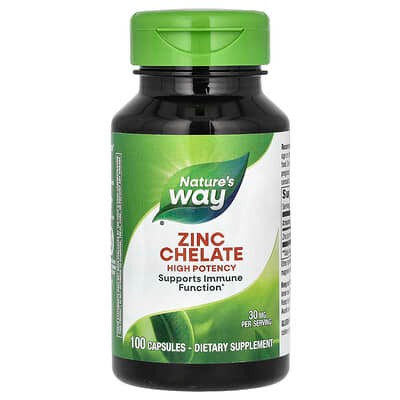
Zinc Chelate 30 mg

Zinc Chelate 30 mg

Nature's Way4.8 (26,116 ratings)
Format:Capsule Quantity: 100 Capsule(s) · 100 servings
Goals

About this product

A focused zinc supplement suits people who need to fill a zinc intake gap. The 30 mg serving uses bisglycinate, a favorable form for absorption, and both the mineral amount and source are clearly stated.

The clearest benefits concern normal immune function and skin maintenance when zinc intake is low. The same nutritional limitation applies to hair and testosterone support: extra zinc has no established added benefit once needs are met. The formula also does not supply the full nutrient combination behind specific eye-health findings.

The low serving cost gives it useful value for someone who specifically needs zinc. Copper content is not established, so the information does not resolve mineral balance during ongoing use. A higher zinc amount is not a reason to expect greater benefits.

Who is it for
  • Adults with a reason to supplement zinc who prefer a single active nutrient.
  • People comparing clearly disclosed zinc forms and amounts.
Best for
  • Filling a specific zinc intake gap.
  • Keeping the cost of targeted zinc supplementation low.

Pros

  • Bisglycinate is a favorable zinc form for absorption.
  • The elemental zinc amount and source are clearly identified.
  • A single active nutrient avoids unrelated supplement ingredients.

Cons

  • Copper content is not established.
  • The formula offers little reason to expect additional hair, hormone or skin benefits when zinc intake is adequate.
  • Not a complete formula for the specific eye-health combinations described.

Warnings

  • Account for the 30 mg zinc serving before adding another zinc-containing supplement; combined intake can become unnecessarily high.


Product analysis

96 out of 100

Zinc Chelate 30 mg offers well-absorbed zinc at an economical serving cost to support normal immune function when intake is low.

AI assessment of the formula, label and price. How scoring works

Nutrient Quality100

Zinc bisglycinate provides favorable absorption potential. The form does not establish additional health benefits when zinc intake is already adequate.

Ingredient Transparency100

The zinc amount and bisglycinate form are clearly identified. That makes the serving straightforward to compare with other zinc options.

Value For Money100

The serving price offers favorable value for the zinc provided. The clear form makes it easier to compare the cost of similar preparations.

Customer Satisfaction93

Customers generally give positive ratings, backed by thousands of opinions. Those ratings describe satisfaction without establishing effectiveness or safety.

Product Focus78

A single nutrient keeps the immune-support purpose straightforward. Its wider skin, hair and hormone roles mainly concern correcting inadequate zinc intake.

Format
Capsule
Container
100 Capsule(s)
Per serving
$0.05
Customer rating
4.8 · 26,116 ratings
Report analysis

Goals

Immunity
Impact
Highest effect
A Ingredient FitB+ PathwaysA+ EvidenceA+ Formulation Logic
Zinc · 30 mg

Zinc supports normal immune-cell function. The 30 mg serving reaches the saved amount comparison, without establishing extra infection protection beyond adequate zinc intake. Chelation does not establish superior clinical benefit, and acute lozenge findings cannot be transferred to this swallowed preparation.

How this product is rated for Immunity

Ingredient fit93

Zinc gives the formula a clear immune-related focus. The declared serving reaches the saved amount comparison; that comparison does not establish an optimal dose.
Goal fit
Zinc gives the formula a clear immune-related focus.
Dose adequacy
The declared serving reaches the saved amount comparison; that comparison does not establish an optimal dose.

Pathways80

The strongest saved connection is lymphocyte function. The ingredient roles support this connection without proving infection protection.
Depth
The strongest saved connection is lymphocyte function. The ingredient roles support this connection without proving infection protection.
Breadth
Two immune functions reach the saved coverage threshold, indicating a broader set of ingredient connections.

Evidence100

Vitamin C supplies the strongest saved evidence connection; its supported role does not establish broad infection prevention.
Evidence strength
Vitamin C supplies the strongest saved evidence connection; its supported role does not establish broad infection prevention.
Studied preparation
The saved preparation matching is favorable; it does not establish superiority over other nutrient forms.

Formulation logic100

Neither specified zinc conflict applies to the supplied facts; these checks do not establish overall safety.
Partner coverage
The included ingredients require no missing partner under the supplied findings; this does not imply extra benefit from combining them.
Conflicts
Neither specified zinc conflict applies to the supplied facts; these checks do not establish overall safety.
Effective doses
All included ingredients counted here meet the saved minimum amount comparison; this is not proof of clinical effectiveness.
Study evidence
Zinc Supportive 73 studies
Everyday Health
Impact
High effect
A Ingredient FitD+ PathwaysB- EvidenceA+ Formulation Logic
Zinc · 30 mg

Zinc supplies an essential nutrient that can help fill a dietary gap. Its normal nutritional role does not establish enhanced immunity or an acute cold-treatment effect when intake is adequate. The 30 mg serving meets the saved amount comparison, but a larger amount does not establish greater general-health benefit.

How this product is rated for Everyday Health

Ingredient fit93

The included ingredients are focused on the supplied nutritional or general-health roles. Declared amounts meet the saved comparisons; larger amounts do not establish benefits beyond nutritional adequacy.
Goal fit
The included ingredients are focused on the supplied nutritional or general-health roles.
Dose adequacy
Declared amounts meet the saved comparisons; larger amounts do not establish benefits beyond nutritional adequacy.

Pathways52

The strongest connection is antioxidant and immune defence. This describes the main supplied functional connection. The findings are concentrated in one functional area.
Depth
The strongest connection is antioxidant and immune defence. This describes the main supplied functional connection.
Breadth
The findings are concentrated in one functional area.

Evidence72

The saved findings recognize evidence and preparation matches for the included ingredients. Nutritional availability and narrower outcomes do not establish routine broad health improvement.
Evidence strength
Zinc leads the saved evidence comparison; its nutritional or indication-specific evidence does not establish broad benefits above adequate status.
Studied preparation
Included preparations matched the saved comparison, without establishing superiority of delivery or chemical form.

Formulation logic100

Included ingredients had no missing required partners or configured conflicts and reached the saved minimum amount threshold.
Partner coverage
No required partner was missing among the included ingredients; this does not establish synergy.
Conflicts
No configured ingredient conflict was identified in the supplied facts.
Effective doses
All included ingredients reached the saved minimum amount threshold; excluded low amounts are not necessarily nutritionally worthless.
Study evidence
Zinc Supportive 60 studies
Impact
High effect
A Ingredient FitF PathwaysA EvidenceA+ Formulation Logic
Zinc · 30 mg

Zinc can help restore testosterone when zinc intake is low; extra zinc has not shown the same benefit when intake is adequate.

How this product is rated for Testosterone Support

Ingredient fit93

Zinc is relevant when low intake affects testosterone. The included amounts were assessed separately from whether they produce a hormone benefit.
Goal fit
Zinc provides a relevant nutritional connection, while the product’s broader purpose limits its focus on testosterone.
Dose adequacy
The included amounts fully meet the saved amount criteria, without establishing a proven hormone-raising dose.

Pathways0

No assessed hormone pathway received support from these ingredients in the saved findings. None of the assessed hormone pathways met the saved coverage requirement.
Depth
No assessed hormone pathway received support from these ingredients in the saved findings.
Breadth
None of the assessed hormone pathways met the saved coverage requirement.

Evidence93

Zinc supplies the strongest human support, specifically for correcting low zinc status. The included preparations meet the saved study-match criteria.
Evidence strength
Zinc supplies the strongest human support, specifically for correcting low zinc status.
Studied preparation
The saved findings recognize the included preparations as studied; this does not establish that the finished product raises testosterone.

Formulation logic100

The counted ingredients meet the saved minimum amount criteria, with no missing required partner or configured conflict. These findings do not demonstrate a benefit from combining them.
Partner coverage
No required ingredient partner was missing in the saved findings; combining these ingredients does not establish an added hormone benefit.
Conflicts
No configured ingredient conflict was identified in the supplied findings.
Effective doses
All counted ingredients met the saved minimum amount criterion; meeting it does not prove a testosterone benefit.
Study evidence
Zinc Disputed 7 studies
Hair Health
Impact
High effect
A Ingredient FitF PathwaysA+ EvidenceA+ Formulation Logic
Zinc · 30 mg

Zinc can help address a deficiency that causes diffuse hair shedding; extra zinc does not establish regrowth when intake is adequate. The 30 mg per serving reaches the upper reference range, but that comparison is not a proven hair-regrowth dose. The declared zinc form does not establish superior hair outcomes. Its role is nutrient sufficiency, so the saved result does not attribute androgen, antioxidant or hair-fibre effects to it.

How this product is rated for Hair Health

Ingredient fit93

Hair-related ingredients contribute through nutrient or ingredient roles, with the amounts and limitations described below. The wider formula affects how focused that connection is.
Goal fit
The relevant ingredients have a focused hair-health connection, although this product is also associated with other goals.
Dose adequacy
The counted ingredients reach their upper reference amounts per serving, without establishing greater benefit from higher intake.

Pathways0

The recorded connection concerns nutrient sufficiency rather than the evaluated androgen, structural, antioxidant or stress-related routes.
Depth
The recorded nutrient-sufficiency contribution does not cover the evaluated androgen, hair-fibre, antioxidant or stress-related routes.
Breadth
None of the evaluated hair-related routes has substantial recorded coverage; nutrient sufficiency is treated separately.

Evidence98

Zinc leads the recorded evidence finding; its specific outcome and population limits still determine what benefits can be described.
Evidence strength
Zinc leads the recorded evidence finding; its specific outcome and population limits still determine what benefits can be described.
Studied preparation
The counted ingredients receive preparation recognition in the saved finding; that does not establish hair-regrowth efficacy for every listed form.

Formulation logic100

The counted ingredients have no missing required partners or identified conflicts among those evaluated. Their amounts meet the minimum comparison.
Partner coverage
The counted ingredients have no missing required partners.
Conflicts
None of the evaluated ingredient conflicts was identified; this is not a complete interaction or safety assessment.
Effective doses
All counted ingredients meet the minimum amount comparison; this does not establish a proven effective hair-growth dose.
Study evidence
Zinc Supportive 22 studies
Eye Health
Impact
High effect
B Ingredient FitD PathwaysB+ EvidenceA+ Formulation Logic
Zinc · 30 mg

Zinc contributes to the visual-cycle aspect of the saved findings. Its vision evidence applies to a defined combination for selected people with AMD, rather than standalone improvement in routine vision. The 30 mg serving provides only part of the saved amount reference and does not establish a complete studied regimen.

How this product is rated for Eye Health

Ingredient fit80

The formula’s connection to vision depends on its relevant ingredients and their declared amounts. The saved amounts vary in how closely they match the references.
Goal fit
The relevant ingredients give the formula a fairly focused connection to vision, although it is also linked to other uses.
Dose adequacy
Several relevant amounts provide partial support relative to the saved references; unresolved quantities cannot establish a contribution.

Pathways47

The saved findings concentrate on photoreceptor structure and visual cycle. Their coverage describes ingredient roles rather than guaranteed changes in vision.
Depth
The strongest saved finding concerns photoreceptor structure and visual cycle, based on the relevant declared ingredients.
Breadth
Only one aspect reaches the saved coverage reference, so the findings are narrow rather than broad vision support.

Evidence84

The strength of the saved ingredient findings must be read alongside their population and preparation limits. Meeting a preparation criterion does not transfer a complete trial result to this product.
Evidence strength
Zinc leads the saved finding, with evidence tied to defined AMD combinations and selected populations.
Studied preparation
The preparations counted in this finding meet the saved preparation criteria; that does not establish the same outcomes for this whole product.

Formulation logic100

The counted ingredients satisfy the saved partner checks, and the specific zinc–copper conflict is not triggered. Amount-related findings remain distinct from proof of practical benefit.
Partner coverage
The saved findings identify no missing required partner among the counted ingredients.
Conflicts
The declared quantities do not trigger the specific high-dose-zinc-without-copper concern.
Effective doses
All ingredients retained in this finding meet its amount reference; this does not establish a proven effective dose for routine vision.
Study evidence
Zinc Supportive 39 studies
Skin Health
Impact
High effect
A Ingredient FitF PathwaysB+ EvidenceA+ Formulation Logic
Zinc · 30 mg

Zinc supports normal skin repair, and low intake can contribute to skin lesions and delayed wound healing. Filling that nutritional gap is its meaningful connection here; extra zinc does not establish better skin in people with adequate intake. The declared amount is recognized in the saved findings, while the selected cosmetic skin mechanisms receive no coverage.

How this product is rated for Skin Health

Ingredient fit93

Zinc provides a relevant connection to this goal. Its recognized serving amount reaches the comparison reference.
Goal fit
The recognized ingredient content is concentrated on this goal, though it is also linked to other uses.
Dose adequacy
The recognized serving amount reaches the saved exposure reference; a larger amount does not establish a greater skin benefit.

Pathways0

No selected cosmetic mechanism receives a contribution. Nutritional relevance remains distinct from proven improvements in hydration, texture or photoaging.
Depth
No contribution is recorded for the selected cosmetic skin mechanisms, despite recognition of the nutrient’s nutritional role.
Breadth
No selected mechanism reaches the breadth threshold, so broad cosmetic skin support is not established.

Evidence83

Zinc leads the recognized evidence. Its contribution is clearest when low intake affects normal skin maintenance.
Evidence strength
Zinc leads the recognized evidence. Its nutritional role does not establish added cosmetic benefit when intake is adequate.
Studied preparation
The saved finding recognizes the eligible preparations; this does not establish that the finished product reproduces trial effects.

Formulation logic100

No required partner is missing and no configured conflict was identified. Recognized ingredients meet the exposure threshold, without establishing synergy.
Partner coverage
No required partner is missing for the recognized ingredients. Their presence does not establish an extra combined benefit.
Conflicts
No configured ingredient conflict was identified in the supplied facts; the finding is limited to the interactions evaluated.
Effective doses
All ingredients included in this finding meet the saved exposure threshold; this does not establish a proven effective cosmetic dose.
Study evidence
Zinc Supportive 66 studies

Ingredients

IngredientAmount per servingScore
Zinc (Zinc Bisglycinate)
30 mg 87
Gluten Free Adults 18–50 Dairy Free
Report overview
A+ Active Ingredient Quality & BioavailabilityC+ Dose, Safety & Label TransparencyA+ Value
Each serving provides 30 mg of zinc as zinc bisglycinate. The whole-product serving costs about $0.06, while the copper amount is unknown.
How this ingredient is rated

Active Ingredient Quality & Bioavailability100

Zinc bisglycinate receives a favorable assessment for its form in this evaluation.
Zinc Form Bioavailability
Zinc bisglycinate receives a favorable assessment for its form in this evaluation.

Dose, Safety & Label Transparency67

The label identifies the zinc amount and source. The serving supplies 30 mg of zinc, an amount in a favorable category in this evaluation. The copper amount is unknown, so the zinc-to-copper balance cannot be assessed.
Elemental Dose Transparency
The label identifies 30 mg of elemental zinc and names its source form.
Zinc Dosage Safety & Effectiveness
The serving supplies 30 mg of zinc, an amount in a favorable category in this evaluation.
Zinc-to-Copper Mineral Balance
The copper amount is unknown, so the zinc-to-copper ratio cannot be assessed.

Value100

A whole-product serving costs about $0.06, at the lower end of this evaluation’s price categories.
Price Per Serving Efficiency
A whole-product serving costs about $0.06, at the lower end of this evaluation’s price categories.
Report alternatives

Sources

Published studies used for the product analysis and the top-ranked studies for each ingredient and goal.

  1. Effectiveness of sodium bicarbonate and zinc chloride mouthwashes in the treatment of oral mucositis and quality of life in patients with cancer under chemotherapy.
    Mohammadi F; Oshvandi K; Kamallan SR; Khazaei S; Ranjbar H; Ahmadi-Motamayel F; Gillespie M; Jenabi E; Vafaei SY · Nursing open · 2022
    Randomized trial144 participantsEveryday Health forZinc
  2. Zinc supplementation in young children with acute diarrhea in India.
    Sazawal S; Black RE; Bhan MK; Bhandari N; Sinha A; Jalla S · The New England journal of medicine · 1995
    Randomized trial937 participantsEveryday Health forZinc
  3. Associations of mortality with ocular disorders and an intervention of high-dose antioxidants and zinc in the Age-Related Eye Disease Study: AREDS Report No. 13.
    Clemons TE; Kurinij N; Sperduto RD; AREDS Research Group · Archives of ophthalmology (Chicago, Ill. : 1960) · 2004
    Randomized trial4,753 participantsEveryday Health forZinc
  4. Effects of zinc and probiotic co-supplementation on inflammation, gastrointestinal symptoms, quality of life, and mood in irritable bowel syndrome patients.
    Rezazadegan M; Soheilipour M; Amani R · Scientific reports · 2026
    Randomized trial84 participantsEveryday Health forZinc
  5. Effect of zinc sulfate supplementation on premenstrual syndrome and health-related quality of life: Clinical randomized controlled trial.
    Siahbazi S; Behboudi-Gandevani S; Moghaddam-Banaem L; Montazeri A · The journal of obstetrics and gynaecology research · 2018
    Randomized trial142 participantsEveryday Health forZinc
  6. Antioxidant vitamin and mineral supplements for age-related macular degeneration.
    Evans JR · The Cochrane database of systematic reviews · 2002
    Systematic review170 participants7 studies pooledEye Health forZinc
  7. Antioxidant vitamin and mineral supplements for slowing the progression of age-related macular degeneration.
    Evans JR; Lawrenson JG · The Cochrane database of systematic reviews · 2023
    Meta-analysis3,790 participants5 studies pooledEye Health forZinc
  8. Oral zinc in macular degeneration.
    Newsome DA; Swartz M; Leone NC; Elston RC; Miller E · Archives of ophthalmology (Chicago, Ill. : 1960) · 1988
    Randomized trial151 participantsEye Health forZinc
  9. A randomized, placebo-controlled, clinical trial of high-dose supplementation with vitamins C and E, beta carotene, and zinc for age-related macular degeneration and vision loss: AREDS report no. 8.
    Age-Related Eye Disease Study Research Group · Archives of ophthalmology (Chicago, Ill. : 1960) · 2001
    Randomized trial3,640 participantsEye Health forZinc
  10. Effect of vitamin A and zinc supplementation on the nutriture of children in Northeast Thailand.
    Udomkesmalee E; Dhanamitta S; Sirisinha S; Charoenkiatkul S; Tuntipopipat S; Banjong O; Rojroongwasinkul N; Kramer TR; Smith JC · The American journal of clinical nutrition · 1992
    Randomized trial133 participantsEye Health forZinc
  11. The effects of minoxidil, 1% pyrithione zinc and a combination of both on hair density: a randomized controlled trial.
    Berger RS; Fu JL; Smiles KA; Turner CB; Schnell BM; Werchowski KM; Lammers KM · The British journal of dermatology · 2003
    Randomized trial200 participantsHair Health forZinc
  12. Incubatory environment of the scalp impacts pre-emergent hair to affect post-emergent hair cuticle integrity.
    Schwartz JR; Henry JP; Kerr KM; Flagler MJ; Page SH; Redman-Furey N · Journal of cosmetic dermatology · 2018
    Randomized trialHair Health forZinc
  13. A comparison of hair quality and cosmetic acceptance following the use of two anti-dandruff shampoos.
    Draelos ZD; Kenneally DC; Hodges LT; Billhimer W; Copas M; Margraf C · The journal of investigative dermatology. Symposium proceedings · 2006
    Randomized trial40 participantsHair Health forZinc
  14. BMI and levels of zinc, copper in hair, serum and urine of Turkish male patients with androgenetic alopecia.
    Ozturk P; Kurutas E; Ataseven A; Dokur N; Gumusalan Y; Gorur A; Tamer L; Inaloz S · Journal of trace elements in medicine and biology : organ of the Society for Minerals and Trace Elements (GMS) · 2015
    Case-control study216 participantsHair Health forZinc
  15. Analysis of serum zinc and copper concentrations in hair loss.
    Kil MS; Kim CW; Kim SS · Annals of dermatology · 2013
    Case-control study342 participantsHair Health forZinc
  16. Nutrient supplementation for prevention of viral respiratory tract infections in healthy subjects: A systematic review and meta-analysis.
    Vlieg-Boerstra B; de Jong N; Meyer R; Agostoni C; De Cosmi V; Grimshaw K; Milani GP; Muraro A; Oude Elberink H; Pali-Schöll I; Roduit C; Sasaki M; Skypala I; Sokolowska M; van Splunter M; Untersmayr E; Venter C; O'Mahony L; Nwaru BI · Allergy · 2022
    Meta-analysis199,055 participants115 studies pooledImmunity forZinc
  17. Zinc supplementation reduces the incidence of acute lower respiratory infections in infants and preschool children: a double-blind, controlled trial.
    Sazawal S; Black RE; Jalla S; Mazumdar S; Sinha A; Bhan MK · Pediatrics · 1998
    Randomized trial609 participantsImmunity forZinc
  18. A randomized controlled trial of zinc supplementation in the treatment of acute respiratory tract infection in Thai children.
    Rerksuppaphol S; Rerksuppaphol L · Pediatric reports · 2020
    Randomized trial64 participantsImmunity forZinc
  19. The effect of zinc and vitamin A supplementation on immune response in an older population.
    Fortes C; Forastiere F; Agabiti N; Fano V; Pacifici R; Virgili F; Piras G; Guidi L; Bartoloni C; Tricerri A; Zuccaro P; Ebrahim S; Perucci CA · Journal of the American Geriatrics Society · 1998
    Randomized trial136 participantsImmunity forZinc
  20. The role of specific nutrients in preventing immune system and blood cell disorders: an umbrella review.
    Vecchietti A; Strano P; Minutolo G; Grieco V; Cappuccio G; Granvillano G; Confalonieri L; Briganti GL; Raso E; Chimienti M; Pellegrini M; Mercogliano M; Spatari G; Lugli C; Urbano T; Lorenzon A · Journal of preventive medicine and hygiene · 2026
    Systematic review13 studies pooledImmunity forZinc