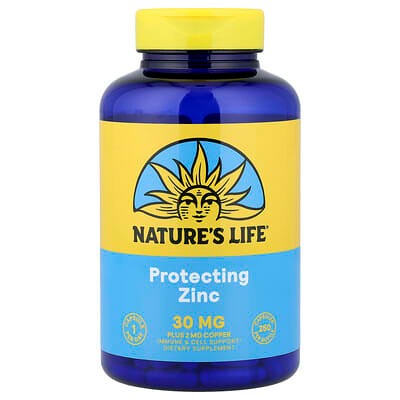
Zinc 30 mg

Zinc 30 mg

Nature's Life4.8 (5,887 ratings)
Format:Capsule Quantity: 250 Capsule(s) · 250 servings
Goals
$24.19 $0.09 per serving

About this product

The formula provides 30 mg zinc as picolinate with 2 mg copper from citrate and gluconate. It is most useful for meeting elevated zinc needs or correcting low intake, while normal immune, skin, hair and hormone roles do not imply extra benefit when zinc status is already adequate.

Copper alongside the zinc is a practical strength. The supplied assessment places the 15:1 zinc-to-copper ratio within its preferred experimental range, and the serving remains below the adult upper zinc limit described in the findings.

Value per serving is very low, and the 250-capsule bottle supports long-term use. The main trade-off is dose: 30 mg is more than many people need for routine maintenance, so total zinc from food and other supplements matters.

Who is it for
  • Adults who have a reason to use a 30 mg zinc dose
  • People who want copper included with higher-dose zinc
  • Users seeking a low-cost long-supply option
Best for
  • Correcting low zinc intake
  • Higher-dose zinc supplementation with copper included
  • Normal immune, skin and hair nutrition when zinc is insufficient

Pros

  • Clearly states 30 mg zinc as picolinate
  • Includes 2 mg copper from named forms
  • Zinc-to-copper ratio is favorable in the supplied assessment
  • Very low cost per serving

Cons

  • 30 mg may be excessive for routine maintenance
  • No added benefit is established when zinc intake is already adequate
  • Large bottle encourages prolonged use of a relatively high dose
  • The named forms do not prove better outcomes

Warnings

  • The 30 mg zinc dose is relatively high for daily maintenance; avoid stacking it with other zinc products without checking total intake.


Product analysis

84 out of 100

Zinc 30 mg provides zinc in a favorably assessed form, with copper alongside it to support nutrient balance. Its main benefits are meeting nutritional needs for normal immunity, skin repair and related functions.

AI assessment of the formula, label and price. How scoring works

Nutrient Quality78

Zinc picolinate is the main quality strength. The copper mixture is less clearly characterized because its two forms have different absorption potential and undisclosed shares.

Ingredient Transparency80

Both nutrient amounts and their forms are disclosed. The split between the two copper forms is missing, which limits a more precise comparison.

Value For Money100

The serving cost is favorable for both zinc and copper. That supports its appeal as a simple nutrient supplement.

Customer Satisfaction91

Customers give consistently favorable ratings across a large review base. The volume makes the satisfaction picture more established, without proving health benefits.

Product Focus73

Zinc provides the main nutritional support, while copper helps maintain balance alongside the higher zinc amount. Broader skin, hair and immune benefits mainly depend on an unmet nutritional need.

Format
Capsule
Container
250 Capsule(s)
Per serving
$0.09
Customer rating
4.8 · 5,887 ratings
Report analysis

Goals

Impact
High effect
B Ingredient FitF PathwaysA EvidenceA+ Formulation Logic
Zinc · 30 mg
Study evidence
Zinc Disputed 7 studies
Immunity
Impact
Highest effect
A Ingredient FitB+ PathwaysA+ EvidenceA+ Formulation Logic
Zinc · 30 mg
Study evidence
Zinc Supportive 73 studies
Everyday Health
Impact
High effect
A Ingredient FitD+ PathwaysB- EvidenceA+ Formulation Logic
Zinc · 30 mg
Study evidence
Zinc Supportive 60 studies
Impact
High effect
A Ingredient FitF PathwaysA+ EvidenceA+ Formulation Logic
Zinc · 30 mg
Study evidence
Copper Adverse 4 studies
Zinc Supportive 22 studies
Fitness
Impact
Moderate effect
B Ingredient FitF PathwaysD+ EvidenceA+ Formulation Logic
Study evidence
Zinc Supportive 7 studies
Impact
Highest effect
A- Ingredient FitD PathwaysA- EvidenceA+ Formulation Logic
Zinc · 30 mgCopper · 2 mg
Study evidence
Copper Supportive 7 studies
Zinc Supportive 39 studies

Ingredients

IngredientAmount per servingScore
Zinc (Zinc Picolinate)
30 mg 99
Copper (Copper Citrate, Copper Gluconate)
2 mg 85
Adults 18–50 Vegetarian
Report overview
A+ Active Ingredient Quality & BioavailabilityA+ Dose, Safety & Label TransparencyA+ Value
A serving provides 30 mg zinc at a low cost per serving. It uses zinc picolinate. It also supplies 2 mg copper.
How this ingredient is rated

Active Ingredient Quality & Bioavailability100

It uses zinc picolinate.
Zinc Form Bioavailability
It uses zinc picolinate.

Dose, Safety & Label Transparency97

The serving provides 30 mg of zinc. The serving also contains 2 mg copper, giving a zinc-to-copper ratio of 15:1.
Elemental Dose Transparency
The elemental zinc amount is clearly stated.
Zinc Dosage Safety & Effectiveness
The serving provides 30 mg of zinc.
Zinc-to-Copper Mineral Balance
The serving also contains 2 mg copper, giving a zinc-to-copper ratio of 15:1.

Value100

The cost per serving is low.
Price Per Serving Efficiency
The cost per serving is low.
C Active Ingredient Quality & BioavailabilityA+ Dose, Safety & Label TransparencyA+ Value
A serving provides 2 mg of copper at a low cost. The amount is clearly stated for the selected serving. It combines copper citrate and copper gluconate, but their proportions are unknown. The serving also contains 30 mg of zinc, a zinc-to-copper ratio of 15.00:1.
How this ingredient is rated

Active Ingredient Quality & Bioavailability62

It combines copper citrate and copper gluconate, but their proportions are unknown. The elemental copper amount and source are stated.
Copper Form Bioavailability
It combines copper citrate and copper gluconate, but their proportions are unknown.
Elemental Copper Labeling Clarity
The elemental copper amount and source are stated.

Dose, Safety & Label Transparency100

The serving contains 2 mg of copper. The serving also contains 30 mg of zinc, a zinc-to-copper ratio of 15.00:1.
Copper Dosage Safety & Efficacy
The selected serving provides 2 mg of copper.
Zinc-to-Copper Balance
The serving also contains 30 mg of zinc, a zinc-to-copper ratio of 15.00:1.

Value100

The cost per serving is low.
Price Per Serving Efficiency
The cost per serving is low.
Report alternatives

Sources

Published studies used for the product analysis and the top-ranked studies for each ingredient and goal.

  1. The Association between Dietary and Circulating Copper Levels and Osteoporosis: a Scoping Review.
    Ju Y; Xiong W; Pang Y; Chen Z; Hou J; Zheng S; Li Z; Liu T; Xia H; Xia M; Zhong Y; Li J; Jiang X · Biological trace element research · 2026
    Scoping review18 studies pooledBone Health forCopper
  2. Association between dietary copper, iron, zinc, selenium intake and osteopenia or osteoporosis in elderly hypertensive patients: a retrospective cohort study.
    Chen M; Jia L; Gao R · Frontiers in nutrition · 2024
    Cohort study5,286 participantsBone Health forCopper
  3. Associations of dietary copper intake with total bone mineral density and lumbar spine bone mineral density in American adults.
    Hu M; Wang Z; Li C; Zheng Y; Hu J · Medicine · 2025
    Cross-sectional studyBone Health forCopper
  4. The association between dietary mineral intake and bone mineral density: a cross-sectional study.
    Wei M; Wei J; Huang S · Journal of health, population, and nutrition · 2025
    Cross-sectional study11,520 participantsBone Health forCopper
  5. Association between dietary copper intake and bone mineral density in children and adolescents aged 8-19 years: A cross-sectional study.
    Cui A; Yan J; Li H; Fan Z; Wei X; Wang H; Zhuang Y · PloS one · 2024
    Cross-sectional study6,965 participantsBone Health forCopper
  6. Increased incidence of fractures in middle-aged and elderly men with low intakes of phosphorus and zinc.
    Elmståhl S; Gullberg B; Janzon L; Johnell O; Elmståhl B · Osteoporosis international : a journal established as result of cooperation between the European Foundation for Osteoporosis and the National Osteoporosis Foundation of the USA · 1999
    Cohort study6,576 participantsBone Health forZinc
  7. Zinc Supplementation Increases Procollagen Type 1 Amino-Terminal Propeptide in Premenarcheal Girls: A Randomized Controlled Trial.
    Berger PK; Pollock NK; Laing EM; Chertin V; Bernard PJ; Grider A; Shapses SA; Ding KH; Isales CM; Lewis RD · The Journal of nutrition · 2016
    Randomized trial147 participantsBone Health forZinc
  8. Randomized controlled trial of prenatal zinc supplementation and fetal bone growth.
    Merialdi M; Caulfield LE; Zavaleta N; Figueroa A; Costigan KA; Dominici F; Dipietro JA · The American journal of clinical nutrition · 2004
    Randomized trial242 participantsBone Health forZinc
  9. The effects of zinc supplementation on serum zinc, alkaline phosphatase activity and fracture healing of bones.
    Sadighi A; Roshan MM; Moradi A; Ostadrahimi A · Saudi medical journal · 2009
    Randomized trial60 participantsBone Health forZinc
  10. Is Zinc an Important Trace Element on Bone-Related Diseases and Complications? A Meta-analysis and Systematic Review from Serum Level, Dietary Intake, and Supplementation Aspects.
    Ceylan MN; Akdas S; Yazihan N · Biological trace element research · 2021
    Meta-analysis40 studies pooledBone Health forZinc
  11. Effectiveness of sodium bicarbonate and zinc chloride mouthwashes in the treatment of oral mucositis and quality of life in patients with cancer under chemotherapy.
    Mohammadi F; Oshvandi K; Kamallan SR; Khazaei S; Ranjbar H; Ahmadi-Motamayel F; Gillespie M; Jenabi E; Vafaei SY · Nursing open · 2022
    Randomized trial144 participantsEveryday Health forZinc
  12. Zinc supplementation in young children with acute diarrhea in India.
    Sazawal S; Black RE; Bhan MK; Bhandari N; Sinha A; Jalla S · The New England journal of medicine · 1995
    Randomized trial937 participantsEveryday Health forZinc
  13. Associations of mortality with ocular disorders and an intervention of high-dose antioxidants and zinc in the Age-Related Eye Disease Study: AREDS Report No. 13.
    Clemons TE; Kurinij N; Sperduto RD; AREDS Research Group · Archives of ophthalmology (Chicago, Ill. : 1960) · 2004
    Randomized trial4,753 participantsEveryday Health forZinc
  14. Effects of zinc and probiotic co-supplementation on inflammation, gastrointestinal symptoms, quality of life, and mood in irritable bowel syndrome patients.
    Rezazadegan M; Soheilipour M; Amani R · Scientific reports · 2026
    Randomized trial84 participantsEveryday Health forZinc
  15. Effect of zinc sulfate supplementation on premenstrual syndrome and health-related quality of life: Clinical randomized controlled trial.
    Siahbazi S; Behboudi-Gandevani S; Moghaddam-Banaem L; Montazeri A · The journal of obstetrics and gynaecology research · 2018
    Randomized trial142 participantsEveryday Health forZinc
  16. What did we learn in 35 years of research on nutrition and supplements for age-related macular degeneration: a systematic review.
    Pameijer EM; Heus P; Damen JAA; Spijker R; Hooft L; Ringens PJ; Imhof SM; van Leeuwen R · Acta ophthalmologica · 2023
    Systematic review27 studies pooledEye Health forCopper
  17. Dietary Nutrient Intake and Progression to Late Age-Related Macular Degeneration in the Age-Related Eye Disease Studies 1 and 2.
    Agrón E; Mares J; Clemons TE; Swaroop A; Chew EY; Keenan TDL; AREDS and AREDS2 Research Groups · Ophthalmology · 2021
    Cohort study8,242 participantsEye Health forCopper
  18. Association between late age-related macular degeneration and dietary intake of copper, iron, zinc and selenium: a 2005-2008 NHANES cross-sectional observational study.
    Lu Y; Li C; Liu Y; Wu T; Lu P · BMC ophthalmology · 2025
    Observational study4,996 participantsEye Health forCopper
  19. Associations between dietary nutrient intake and the risk of multiple age-related ocular diseases: evidence from longitudinal analysis.
    Yang Y; Zou H · The journal of nutrition, health & aging · 2026
    Cohort study103,192 participantsEye Health forCopper
  20. Dietary habits and dietary nutrient intake in patients with age-related macular degeneration: A case-control study.
    Šalková Kráľová J; Kolář P; Kapounová Z; Veselý P; Derflerová Brázdová Z · Central European journal of public health · 2023
    Case-control study151 participantsEye Health forCopper