


Vitamin C Supportive
$13.97 $0.23 per serving
Product analysis
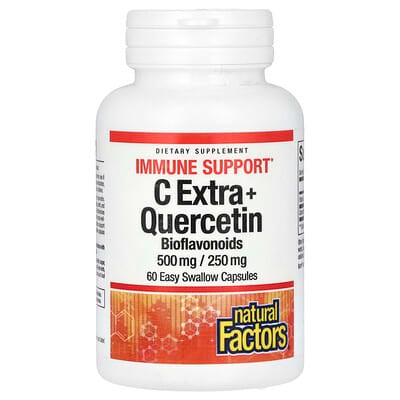
Natural Factors C Extra + Quercetin pairs 500 mg of vitamin C with 250 mg of quercetin in one vegetarian-friendly capsule for immune and antioxidant support. Vitamin C offers good value and helps fill a dietary gap, while the evidence for extra immune benefit from this amount of quercetin is limited and mainly relates to stressed athletes.
AI assessment of the formula, label and price. How scoring works
Nutrient Quality40
The two main ingredients are clearly identified, with vitamin C supplied as ascorbic acid. The precise comparative quality of the quercetin form is uncertain.
Ingredient Transparency100
Both active ingredients have disclosed amounts and identified forms. The simple two-ingredient formula is easy to compare by serving size.
Value For Money78
The vitamin C is inexpensive for the amount supplied. Quercetin does not have a separate value comparison, so the price is better judged primarily against its vitamin C content.
Customer Satisfaction87
Customers generally rate the capsules very highly. Over two thousand ratings provide a useful foundation for the feedback.
Product Focus69
The formula keeps its focus on two antioxidants, with vitamin C supplying the clearest immune and skin nutrition benefits. Quercetin has more limited evidence for these uses in the general population.
- Format
Capsule - Container
- 60 Capsule(s)
- Per serving
- $0.23
- Customer rating
- 4.8 · 2,200 ratings
Goals

Impact
Moderate effect
Vitamin C · 500 mg
C Extra + Quercetin is a focused vitamin C option for an intake gap. Its 500 mg of vitamin C supports normal immune and antioxidant functions.

Impact
High effect
Vitamin C · 500 mg
C Extra + Quercetin is a straightforward option for filling a vitamin C gap relevant to skin health. Its 500 mg of vitamin C supports normal collagen production and wound healing when intake is inadequate.
Vitamin C Supportive

Impact
High effect
Vitamin C · 500 mg
C Extra + Quercetin offers conditional inflammation support through 500 mg of vitamin C. Its antioxidant role is relevant to oxidative stress, with the supplied inflammatory-marker benefit concentrated in people who started with elevated inflammation. Quercetin at 250 mg adds a flavonoid component, but its human inflammation findings are mostly null.
Vitamin C Supportive

Impact
High effect
Vitamin C · 500 mg
C Extra + Quercetin is primarily a vitamin C option for modest regular-use cold-duration support. Vitamin C at 500 mg supplies that connection to immunity. Quercetin at 250 mg has a narrower basis from stressed-athlete settings, so it adds little to a general adult choice.
Vitamin C Supportive

Impact
High effect
Vitamin C · 500 mg
C Extra + Quercetin offers vitamin C for retinal and lens antioxidant defense, with a limited direct fit as a standalone eye-health product. Its 500 mg ascorbic acid serving provides the relevant contribution; the supplied eye-health benefit concerns a defined multi-ingredient regimen for selected people with age-related eye disease.
Vitamin C Disputed
Ingredients
| Ingredient | Amount per serving | Score |
|---|---|---|
Vitamin C (Ascorbic Acid) | 500 mg | |
Quercetin (Bioflavonoids) | 250 mg |
Vitamin C (Ascorbic Acid) · 500 mg OverallScore66
Natural Factors C Extra + Quercetin provides 500 mg vitamin C per serving; its source is ascorbic acid. The price is low at $0.47 per 1,000 mg vitamin C, with the full formula costing $0.23 per serving. Ascorbic acid is an unbuffered acid form. The Other Ingredients panel includes standard processing aids.
Alternative products
Report alternatives
Sources
Published studies used for the product analysis and the top-ranked studies for each ingredient and goal.
- Dietary intake and blood concentrations of antioxidants and the risk of cardiovascular disease, total cancer, and all-cause mortality: a systematic review and dose-response meta-analysis of prospective studies.
- Scientific Opinion on the substantiation of a health claim related to vitamin C and increasing non haem iron absorption pursuant to Article 14 of Regulation (EC) No 1924/2006.
- Vitamin C Depletion and All-Cause Mortality in Renal Transplant Recipients.
- Associations of Serum Biomarkers of Fruit and Vegetable Intake With the Risk of Cause-Specific Mortality and All-Cause Mortality: A National Prospective Cohort Study.
- Relation between plasma ascorbic acid and mortality in men and women in EPIC-Norfolk prospective study: a prospective population study. European Prospective Investigation into Cancer and Nutrition.
- Role of Oral Vitamin 'C' on Astigmatic Errors in Phacoemulsification.
- Ascorbic acid metabolites are involved in intraocular pressure control in the general population.
- Nutritional modulation of cataract.
- Dietary n-3 Fatty Acid, α-Tocopherol, Zinc, vitamin D, vitamin C, and β-carotene are Associated with Age-Related Macular Degeneration in Japan.
- Adherence to a Mediterranean diet, lifestyle and age-related macular degeneration: the Coimbra Eye Study - report 3.
- Vitamin C and contribution to the normal function of the immune system: evaluation of a health claim pursuant to Article 14 of Regulation (EC) No 1924/2006.
- Therapeutic effects of high-dose vitamin C supplementation in patients with COVID-19: a meta-analysis.
- Effect of micronutrient supplements on influenza and other respiratory tract infections among adults: a systematic review and meta-analysis.
- New evidence for antioxidant properties of vitamin C.
- Enhanced Vitamin C Delivery: A Systematic Literature Review Assessing the Efficacy and Safety of Alternative Supplement Forms in Healthy Adults.
- Efficacy of Vitamin C as Glucocorticoid Substitute for Reducing Pain and Inflammation After Total Hip Arthroplasty: A Randomized Controlled Trial.
- The Impact of Vitamin C on Analgesic, Anti-inflammatory, and Hemostatic Outcomes After Total Hip and Knee Arthroplasty: A Systematic Review and Meta-Analysis.
- The impact of vitamin C supplementation on the perioperative outcomes after total hip and knee arthroplasty: a systematic review and meta-analysis.
- Therapeutic Impact of Ascorbic Acid on Oral and Periodontal Tissues: A Systematic Literature Review.
- Oral vitamin C administration reduces early recurrence rates after electrical cardioversion of persistent atrial fibrillation and attenuates associated inflammation.