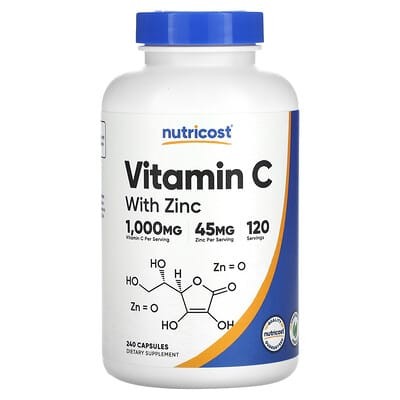
Vitamin C 1000 mg with Zinc 45 mg

Vitamin C 1000 mg with Zinc 45 mg

Nutricost4.8 (863 ratings)
Format:Capsule Quantity: 240 Capsule(s) · 120 servings
Goals
$14.95 $0.12 per serving

About this product

Favorable value is paired with unnecessarily high exposure for many routine users. Vitamin C supports normal collagen formation and antioxidant functions, while zinc supports normal immune nutrition and skin repair. Their usefulness depends on nutritional need, and larger amounts do not establish better hair, nail or hormone outcomes.

The 1,000 mg vitamin C amount is clearly disclosed as plain ascorbic acid, with no stated buffering benefit. Zinc is described only as a chelate, leaving the precise compound and its absorption characteristics unclear. Ingredient totals are visible, but the zinc description is less informative than a named chelate.

The 45 mg zinc serving exceeds the supplied adult upper intake level of 40 mg. No copper amount is established, and the findings flag copper depletion with continued high zinc exposure. Low cost does not resolve that balance concern or establish a reason to use the large serving every day.

Who is it for
  • Adults with a defined reason for combined vitamin C and higher zinc intake, with guidance on the zinc exposure
Best for
  • Supporting collagen-related and immune nutrition when intake is inadequate

Pros

  • Both active amounts are explicitly disclosed
  • Vitamin C source is clearly identified
  • Qualitative value is favorable for both nutrients

Cons

  • The exact zinc chelate is unspecified
  • No vitamin C buffering benefit is stated
  • Large amounts do not establish extra benefits above adequate intake
  • The fixed combination limits adjustment of vitamin C and zinc separately

Warnings

  • The 45 mg zinc serving exceeds the adult upper intake level of 40 mg, which matters for ongoing daily use.
  • Repeated high zinc intake can deplete copper, and the copper amount is not established here.

Product analysis

72 out of 100

Vitamin C 1000 mg with Zinc 45 mg supports normal immune nutrition, particularly when intake of these nutrients is low.

AI assessment of the formula, label and price. How scoring works

Nutrient Quality40

Zinc is identified as a chelate, but that broad description does not establish a clear absorption advantage. Vitamin C is named as ascorbic acid, while its comparative form quality remains uncertain.

Ingredient Transparency100

Both nutrient amounts and forms are clearly stated. You can compare the serving directly with other vitamin C and zinc supplements.

Value For Money80

Both nutrients offer favorable value at the serving cost. That affordability does not mean a larger amount will provide greater benefit.

Customer Satisfaction82

Customer ratings are very positive across a substantial review base. The ratings describe satisfaction without showing whether the supplement improves health.

Product Focus75

The two nutrients support normal immune function and several other nutritional needs, with the clearest benefit when intake is low. The 45 mg zinc serving without copper can deplete copper, which can interfere with normal immune function.

Format
Capsule
Container
240 Capsule(s)
Per serving
$0.12
Customer rating
4.8 · 863 ratings
Report analysis

Goals

Immunity
Impact
Highest effect
A Ingredient FitB+ PathwaysA+ EvidenceA Formulation Logic
Vitamin C · 1000 mgZinc · 45 mg
Study evidence
Vitamin C Supportive 53 studies
Zinc Supportive 73 studies
Impact
Highest effect
A Ingredient FitD+ PathwaysA- EvidenceA+ Formulation Logic
Vitamin C · 1000 mg
Study evidence
Vitamin C Supportive 50 studies
Zinc Supportive 64 studies
Everyday Health
Impact
High effect
A Ingredient FitC PathwaysB- EvidenceA Formulation Logic
Zinc · 45 mgVitamin C · 1000 mg
Study evidence
Vitamin C Supportive 56 studies
Zinc Supportive 60 studies
Impact
Highest effect
A Ingredient FitB+ PathwaysB+ EvidenceA Formulation Logic
Zinc · 45 mgVitamin C · 1000 mg
Study evidence
Vitamin C Disputed 24 studies
Zinc Supportive 39 studies
Skin Health
Impact
High effect
A Ingredient FitF PathwaysA+ EvidenceA+ Formulation Logic
Zinc · 45 mgVitamin C · 1000 mg
Study evidence
Vitamin C Supportive 53 studies
Zinc Supportive 66 studies
Impact
Highest effect
A Ingredient FitC PathwaysA+ EvidenceA+ Formulation Logic
Zinc · 45 mgVitamin C · 1000 mg
Study evidence
Zinc Supportive 22 studies

Ingredients

IngredientAmount per servingScore
Vitamin C (Ascorbic Acid)
1000 mg 64
Zinc (Zinc Chelate)
45 mg 52
Gluten Free Adults 18–50
Report overview
F Active Ingredient Quality & BioavailabilityA Dose, Safety & Label TransparencyB+ Value
It provides 1000 mg of vitamin C per serving. The cost per gram of vitamin C is fairly low, based on the full serving price. It uses ascorbic acid. The stated ascorbic acid form is unbuffered.
How this ingredient is rated

Active Ingredient Quality & Bioavailability30

It uses ascorbic acid. The stated ascorbic acid form is unbuffered.
Vitamin C Chemical Form & Delivery System
It uses ascorbic acid.
Gastric Comfort & pH Balance
The stated ascorbic acid form is unbuffered.

Dose, Safety & Label Transparency91

It provides 1000 mg of vitamin C per serving. The other-ingredient panel has no flagged additives.
Optimal Dosage Targeting
It provides 1000 mg of vitamin C per serving.
Purity & Excipient Quality
The other-ingredient panel has no flagged additives.
Mineral & Source Transparency
The vitamin C amount and ascorbic acid source are stated; no mineral amount is needed for this form.

Value80

The cost per gram of vitamin C is fairly low, based on the full serving price.
Price per Gram of Vitamin C
The cost per gram of vitamin C is fairly low, based on the full serving price.
D- Active Ingredient Quality & BioavailabilityD+ Dose, Safety & Label TransparencyB+ Value
A serving provides 45 mg of zinc at a low cost per serving. The zinc comes from zinc chelate. The copper amount is unknown, leaving the zinc-to-copper balance unclear. The zinc amount exceeds the adult upper intake level.
How this ingredient is rated

Active Ingredient Quality & Bioavailability40

The zinc source is zinc chelate.
Zinc Form Bioavailability
It uses zinc chelate.

Dose, Safety & Label Transparency51

45 mg of zinc exceeds the adult upper intake level, a concern for long-term daily use. The copper amount is unknown.
Elemental Dose Transparency
The label states 45 mg of elemental zinc and names zinc chelate as its source.
Zinc Dosage Safety & Effectiveness
45 mg of zinc exceeds the adult upper intake level, a concern for long-term daily use.
Zinc-to-Copper Mineral Balance
The copper amount is unknown, so the zinc-to-copper balance is unclear.

Value80

The cost per serving is low.
Price Per Serving Efficiency
The price per labeled serving is low.
Report alternatives

Sources

Published studies used for the product analysis and the top-ranked studies for each ingredient and goal.

  1. Dietary intake and blood concentrations of antioxidants and the risk of cardiovascular disease, total cancer, and all-cause mortality: a systematic review and dose-response meta-analysis of prospective studies.
    Aune D; Keum N; Giovannucci E; Fadnes LT; Boffetta P; Greenwood DC; Tonstad S; Vatten LJ; Riboli E; Norat T · The American journal of clinical nutrition · 2019
    Meta-analysis69 studies pooledEveryday Health forVitamin C
  2. Scientific Opinion on the substantiation of a health claim related to vitamin C and increasing non haem iron absorption pursuant to Article 14 of Regulation (EC) No 1924/2006.
    EFSA Panel on Dietetic Products, Nutrition and Allergies (NDA) · EFSA journal. European Food Safety Authority · 2026
    Guideline / consensusEveryday Health forVitamin C
  3. Vitamin C Depletion and All-Cause Mortality in Renal Transplant Recipients.
    Sotomayor CG; Eisenga MF; Gomes Neto AW; Ozyilmaz A; Gans ROB; Jong WHA; Zelle DM; Berger SP; Gaillard CAJM; Navis GJ; Bakker SJ · Nutrients · 2018
    Cohort study598 participantsEveryday Health forVitamin C
  4. Associations of Serum Biomarkers of Fruit and Vegetable Intake With the Risk of Cause-Specific Mortality and All-Cause Mortality: A National Prospective Cohort Study.
    Pu L; Zhang R; Wang X; Zhao T; Sun H; Han L · Frontiers in nutrition · 2022
    Cohort study12,530 participantsEveryday Health forVitamin C
  5. Relation between plasma ascorbic acid and mortality in men and women in EPIC-Norfolk prospective study: a prospective population study. European Prospective Investigation into Cancer and Nutrition.
    Khaw KT; Bingham S; Welch A; Luben R; Wareham N; Oakes S; Day N · Lancet (London, England) · 2001
    Cohort study19,496 participantsEveryday Health forVitamin C
  6. Effectiveness of sodium bicarbonate and zinc chloride mouthwashes in the treatment of oral mucositis and quality of life in patients with cancer under chemotherapy.
    Mohammadi F; Oshvandi K; Kamallan SR; Khazaei S; Ranjbar H; Ahmadi-Motamayel F; Gillespie M; Jenabi E; Vafaei SY · Nursing open · 2022
    Randomized trial144 participantsEveryday Health forZinc
  7. Zinc supplementation in young children with acute diarrhea in India.
    Sazawal S; Black RE; Bhan MK; Bhandari N; Sinha A; Jalla S · The New England journal of medicine · 1995
    Randomized trial937 participantsEveryday Health forZinc
  8. Associations of mortality with ocular disorders and an intervention of high-dose antioxidants and zinc in the Age-Related Eye Disease Study: AREDS Report No. 13.
    Clemons TE; Kurinij N; Sperduto RD; AREDS Research Group · Archives of ophthalmology (Chicago, Ill. : 1960) · 2004
    Randomized trial4,753 participantsEveryday Health forZinc
  9. Effects of zinc and probiotic co-supplementation on inflammation, gastrointestinal symptoms, quality of life, and mood in irritable bowel syndrome patients.
    Rezazadegan M; Soheilipour M; Amani R · Scientific reports · 2026
    Randomized trial84 participantsEveryday Health forZinc
  10. Effect of zinc sulfate supplementation on premenstrual syndrome and health-related quality of life: Clinical randomized controlled trial.
    Siahbazi S; Behboudi-Gandevani S; Moghaddam-Banaem L; Montazeri A · The journal of obstetrics and gynaecology research · 2018
    Randomized trial142 participantsEveryday Health forZinc
  11. Role of Oral Vitamin 'C' on Astigmatic Errors in Phacoemulsification.
    Mohan S; Sah K; Khattri M; Ahmad L; Sachan SK · Current eye research · 2021
    Randomized trial400 participantsEye Health forVitamin C
  12. Ascorbic acid metabolites are involved in intraocular pressure control in the general population.
    Hysi PG; Khawaja AP; Menni C; Tamraz B; Wareham N; Khaw KT; Foster PJ; Benet LZ; Spector TD; Hammond CJ · Redox biology · 2019
    Observational studyEye Health forVitamin C
  13. Nutritional modulation of cataract.
    Weikel KA; Garber C; Baburins A; Taylor A · Nutrition reviews · 2014
    Narrative reviewEye Health forVitamin C
  14. Dietary n-3 Fatty Acid, α-Tocopherol, Zinc, vitamin D, vitamin C, and β-carotene are Associated with Age-Related Macular Degeneration in Japan.
    Aoki A; Inoue M; Nguyen E; Obata R; Kadonosono K; Shinkai S; Hashimoto H; Sasaki S; Yanagi Y · Scientific reports · 2017
    Case-control study530 participantsEye Health forVitamin C
  15. Adherence to a Mediterranean diet, lifestyle and age-related macular degeneration: the Coimbra Eye Study - report 3.
    Raimundo M; Mira F; Cachulo MDL; Barreto P; Ribeiro L; Farinha C; Laíns I; Nunes S; Alves D; Figueira J; Merle BM; Delcourt C; Santos L; Silva R · Acta ophthalmologica · 2019
    Case-control study883 participantsEye Health forVitamin C
  16. Antioxidant vitamin and mineral supplements for age-related macular degeneration.
    Evans JR · The Cochrane database of systematic reviews · 2002
    Systematic review170 participants7 studies pooledEye Health forZinc
  17. Antioxidant vitamin and mineral supplements for slowing the progression of age-related macular degeneration.
    Evans JR; Lawrenson JG · The Cochrane database of systematic reviews · 2023
    Meta-analysis3,790 participants5 studies pooledEye Health forZinc
  18. Oral zinc in macular degeneration.
    Newsome DA; Swartz M; Leone NC; Elston RC; Miller E · Archives of ophthalmology (Chicago, Ill. : 1960) · 1988
    Randomized trial151 participantsEye Health forZinc
  19. A randomized, placebo-controlled, clinical trial of high-dose supplementation with vitamins C and E, beta carotene, and zinc for age-related macular degeneration and vision loss: AREDS report no. 8.
    Age-Related Eye Disease Study Research Group · Archives of ophthalmology (Chicago, Ill. : 1960) · 2001
    Randomized trial3,640 participantsEye Health forZinc
  20. Effect of vitamin A and zinc supplementation on the nutriture of children in Northeast Thailand.
    Udomkesmalee E; Dhanamitta S; Sirisinha S; Charoenkiatkul S; Tuntipopipat S; Banjong O; Rojroongwasinkul N; Kramer TR; Smith JC · The American journal of clinical nutrition · 1992
    Randomized trial133 participantsEye Health forZinc




