



Vitamin C Supportive
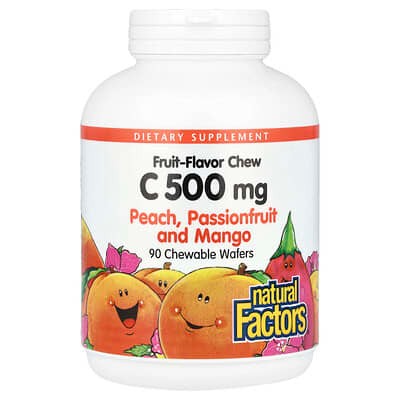
$11.87 $0.13 per serving
Product analysis
Natural Factors C 500 mg Fruit-Flavor Chew provides 500 mg of vitamin C per wafer to support normal immune function, collagen formation and antioxidant protection. The chewable format is convenient for people who dislike swallowing tablets, but each wafer contains 2 g of added sugar.
AI assessment of the formula, label and price. How scoring works
Nutrient Quality36
The main nutrient is vitamin C in a mixture of acidic ascorbic acid and buffered sodium ascorbate. Their proportions are unclear, and the wafer includes 2 g of added sugar.
Ingredient Transparency58
The main nutrient amounts are clearly disclosed per wafer. Ingredient form and composition details are less complete, making the exact vitamin C blend difficult to determine.
Value For Money54
The main vitamin C serving is moderately priced. The sodium amount compares favorably on price, but it is not the main reason to buy the formula.
Customer Satisfaction85
Customer satisfaction is very positive, averaging 4.79 out of 5. More than 1,000 ratings provide a useful range of customer feedback.
Product Focus71
Vitamin C is the main focus, with benefits most directly related to normal collagen formation and immunity. The other intended uses are narrower, and no active ingredients are confirmed to be unnecessary.
- Format
Wafer - Container
- 90 Tablet(s)
- Per serving
- $0.13
- Also available
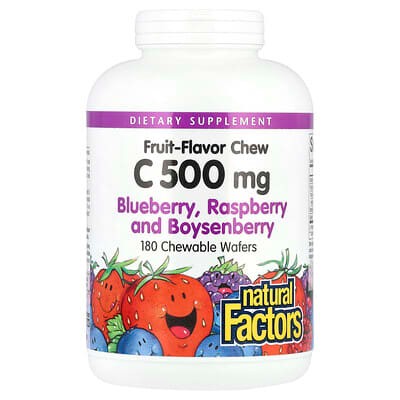 C 500 mg Fruit-Flavor Chew$18.87
- Customer rating
- 4.8 · 1,360 ratings
Goals

Impact
High effect
Vitamin C · 500 mg
C 500 mg Fruit-Flavor Chew offers straightforward support for normal immune function. Each serving supplies 500 mg of vitamin C as ascorbic acid and sodium ascorbate. Regular vitamin C use may modestly shorten cold duration.

Impact
High effect
Vitamin C · 500 mg
C 500 mg Fruit-Flavor Chew is a focused option for topping up vitamin C intake for everyday antioxidant and immune-related nutrition. The serving supplies 500 mg vitamin C from ascorbic acid and sodium ascorbate, supporting its normal nutrient functions when dietary intake falls short.
Vitamin C Supportive

Impact
High effect
Vitamin C · 500 mg
C 500 mg Fruit-Flavor Chew offers focused nutritional support for skin, with added benefit clearest when vitamin C intake is inadequate. Its 500 mg of vitamin C from ascorbic acid and sodium ascorbate supports normal collagen formation and deficiency-related wound healing.
Vitamin C Supportive

Impact
High effect
Vitamin C · 500 mg
C 500 mg Fruit-Flavor Chew offers a focused vitamin C serving with limited support for broad inflammation goals. Its 500 mg of vitamin C from ascorbic acid and sodium ascorbate supports antioxidant protection. The supplied inflammation-marker benefit is confined to people with elevated starting levels.
Vitamin C Supportive

Impact
High effect
Vitamin C · 500 mg
C 500 mg Fruit-Flavor Chew has a limited fit for routine eye health. Vitamin C at 500 mg has eye-health evidence as part of a defined combination for selected people with age-related macular degeneration.
Vitamin C Disputed
Ingredients
| Ingredient | Amount per serving | Score |
|---|---|---|
Calories | 10 Calorie(s) | |
Total Carbohydrates | 2 Gram(s) | |
Vitamin C (Ascorbic Acid, Sodium Ascorbate) | 500 mg | |
Sodium | 35 mg |
Vitamin C (Ascorbic Acid, Sodium Ascorbate) · 500 mg OverallScore64
Natural Factors C 500 mg Fruit-Flavor Chew provides 500 mg of vitamin C per serving as Ascorbic Acid and Sodium Ascorbate, with moderate value at $0.26 per 1,000 mg of vitamin C. The full product costs $0.13 per serving. Sodium ascorbate is buffered, while ascorbic acid is acidic; their proportions are unclear. The formula contains sweeteners.
Alternative products
Report alternatives
Sources
Published studies used for the product analysis and the top-ranked studies for each ingredient and goal.
- Dietary intake and blood concentrations of antioxidants and the risk of cardiovascular disease, total cancer, and all-cause mortality: a systematic review and dose-response meta-analysis of prospective studies.
- Scientific Opinion on the substantiation of a health claim related to vitamin C and increasing non haem iron absorption pursuant to Article 14 of Regulation (EC) No 1924/2006.
- Vitamin C Depletion and All-Cause Mortality in Renal Transplant Recipients.
- Associations of Serum Biomarkers of Fruit and Vegetable Intake With the Risk of Cause-Specific Mortality and All-Cause Mortality: A National Prospective Cohort Study.
- Relation between plasma ascorbic acid and mortality in men and women in EPIC-Norfolk prospective study: a prospective population study. European Prospective Investigation into Cancer and Nutrition.
- Role of Oral Vitamin 'C' on Astigmatic Errors in Phacoemulsification.
- Ascorbic acid metabolites are involved in intraocular pressure control in the general population.
- Nutritional modulation of cataract.
- Dietary n-3 Fatty Acid, α-Tocopherol, Zinc, vitamin D, vitamin C, and β-carotene are Associated with Age-Related Macular Degeneration in Japan.
- Adherence to a Mediterranean diet, lifestyle and age-related macular degeneration: the Coimbra Eye Study - report 3.
- Vitamin C and contribution to the normal function of the immune system: evaluation of a health claim pursuant to Article 14 of Regulation (EC) No 1924/2006.
- Therapeutic effects of high-dose vitamin C supplementation in patients with COVID-19: a meta-analysis.
- Effect of micronutrient supplements on influenza and other respiratory tract infections among adults: a systematic review and meta-analysis.
- New evidence for antioxidant properties of vitamin C.
- Enhanced Vitamin C Delivery: A Systematic Literature Review Assessing the Efficacy and Safety of Alternative Supplement Forms in Healthy Adults.
- Efficacy of Vitamin C as Glucocorticoid Substitute for Reducing Pain and Inflammation After Total Hip Arthroplasty: A Randomized Controlled Trial.
- The Impact of Vitamin C on Analgesic, Anti-inflammatory, and Hemostatic Outcomes After Total Hip and Knee Arthroplasty: A Systematic Review and Meta-Analysis.
- The impact of vitamin C supplementation on the perioperative outcomes after total hip and knee arthroplasty: a systematic review and meta-analysis.
- Therapeutic Impact of Ascorbic Acid on Oral and Periodontal Tissues: A Systematic Literature Review.
- Oral vitamin C administration reduces early recurrence rates after electrical cardioversion of persistent atrial fibrillation and attenuates associated inflammation.