
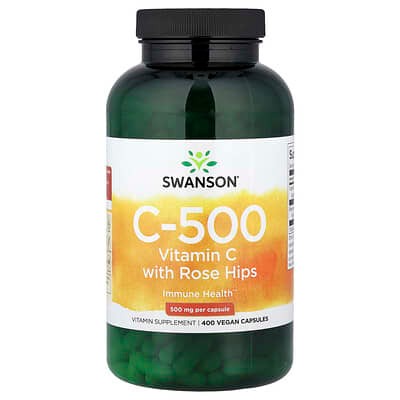

$19.79 $0.04 per serving

Product analysis
C 500 mg may help cover a vitamin C shortfall and support normal immune function and collagen formation. The small rose amount is unlikely to add meaningful support for joint discomfort.
AI assessment of the formula, label and price. How scoring works
Nutrient Quality33
Vitamin C is identified as ascorbic acid, while the rose ingredient lacks a specified form. That makes the rose portion harder to compare with other preparations.
Ingredient Transparency81
Both ingredient amounts are disclosed. Vitamin C is clearly identified, but the rose preparation is less specific.
Value For Money80
The vitamin C content is inexpensive for the amount provided. Whether the rose ingredient adds worthwhile value remains uncertain.
Customer Satisfaction93
Customer feedback is very positive and comes from a large number of ratings. The broad response offers a useful view of satisfaction, although it does not establish health benefits.
Product Focus69
The formula centers on vitamin C for normal immune, skin and everyday nutritional support. Benefits mainly concern meeting nutritional needs, and the rose amount adds little support for the joint findings considered.
- Format
Capsule - Container
- 400 Capsule(s)
- Per serving
- $0.04
- Also available
 C 500 mg$17.39
- Customer rating
- 4.8 · 9,310 ratings
Goals

Impact
High effect
Vitamin C · 500 mg
Vitamin C offers modest support for shorter colds when taken regularly, without promising to prevent infection or treat an established cold. The 500 mg per serving makes a partial contribution in the saved amount comparison. The accompanying source and bioflavonoid material does not establish extra vitamin C or an additional immune benefit.
How this product is rated for Immunity
Ingredient fit74
The declared amounts provide partial contributions overall, rather than all reaching their saved comparison endpoints.
Goal fit
Vitamin C contributes to the identified immune-related area; links to several goals broaden the product's intended use.
Dose adequacy
The declared amounts provide partial contributions overall, rather than all reaching their saved comparison endpoints.
Pathways40
The identified contributions cover innate immune cell activity.
Depth
The strongest identified coverage is in innate immune cell activity.
Breadth
The identified coverage extends to innate immune cell activity.
Evidence100
Vitamin C has modest regular-use cold-duration support, without establishing general prevention or treatment of an existing cold.
Evidence strength
Vitamin C has modest regular-use cold-duration support, without establishing general prevention or treatment of an existing cold.
Studied preparation
The saved preparation finding accepts the counted forms; no superiority for a particular form or delivery method follows.
Formulation logic100
The counted ingredients meet the minimum amount and partner requirements. No configured ingredient conflict was triggered by the supplied facts.
Partner coverage
Each counted ingredient works alone or has its required partner; this does not establish added clinical benefit from combining them.
Conflicts
No configured ingredient conflict was triggered by the supplied facts.
Effective doses
The counted ingredients reach the saved minimum amount criterion, which is not a proven clinical threshold.

Impact
Moderate effect
Vitamin C · 500 mg
Vitamin C contributes to normal antioxidant and immune functions and may help cover an inadequate dietary intake. The 500 mg amount exceeds ordinary adult daily needs; the supplied review supports its nutritional role without assuming additional benefit from higher intake.
How this product is rated for Everyday Health
Ingredient fit60
The saved assessment identifies 1 goal-related ingredients alongside 1 other actives, so the formula serves a broader purpose than everyday health alone. The saved amount assessment considers 1 ingredients; undisclosed individual amounts limit the contribution that can be assigned.
Goal fit
The saved assessment identifies 1 goal-related ingredients alongside 1 other actives, so the formula serves a broader purpose than everyday health alone.
Dose adequacy
The saved amount assessment considers 1 ingredients; undisclosed individual amounts limit the contribution that can be assigned.
Pathways17
The strongest saved connection concerns antioxidant and immune defence. No reviewed mechanism reaches the saved level for substantial coverage.
Depth
The strongest saved connection concerns antioxidant and immune defence.
Breadth
No reviewed mechanism reaches the saved level for substantial coverage.
Evidence74
The saved evidence finding is led by Vitamin C, among ingredients meeting the assessment’s amount requirement; this does not imply uniform health benefit. The saved assessment recognizes preparation matches for the ingredients meeting its amount requirement, within the limitations of their underlying evidence.
Evidence strength
The saved evidence finding is led by Vitamin C, among ingredients meeting the assessment’s amount requirement; this does not imply uniform health benefit.
Studied preparation
The saved assessment recognizes preparation matches for the ingredients meeting its amount requirement, within the limitations of their underlying evidence.
Formulation logic100
The saved findings identify no missing required partner among the assessed ingredients. No configured ingredient conflict was identified in the saved assessment. 1 of 1 credited ingredients meet the saved minimum amount criterion.
Partner coverage
The saved findings identify no missing required partner among the assessed ingredients.
Conflicts
No configured ingredient conflict was identified in the saved assessment.
Effective doses
1 of 1 credited ingredients meet the saved minimum amount criterion.

Impact
High effect
Vitamin C · 500 mg
Vitamin C supports normal collagen formation and wound healing when intake is low. The 500 mg per serving reaches the saved amount plateau, but extra vitamin C has no established skin benefit once needs are met. Oral vitamin C alone has not shown improved UV redness in the supplied evidence. The declared form does not establish a separate cosmetic benefit.
How this product is rated for Skin Health
Ingredient fit80
Vitamin C supplies the main skin-related nutritional connection. Vitamin C reaches the saved amount plateau; the large serving does not establish extra cosmetic benefit.
Goal fit
Vitamin C supplies the main skin-related nutritional connection.
Dose adequacy
Vitamin C reaches the saved amount plateau; the large serving does not establish extra cosmetic benefit.
Pathways0
The saved findings recognize nutrient sufficiency without assigning a targeted skin-pathway contribution.
Depth
No targeted collagen, hydration, barrier or UV pathway contribution was assigned.
Breadth
None of the targeted skin aspects meets the saved coverage criterion.
Evidence100
Vitamin C leads the saved evidence finding through its established nutritional role. The declared vitamin C preparation is accepted without separate cosmetic efficacy for its form.
Evidence strength
Vitamin C leads the saved evidence finding through its established nutritional role.
Studied preparation
The declared vitamin C preparation is accepted without separate cosmetic efficacy for its form.
Formulation logic100
No missing required partner or specified conflict was identified. The counted ingredients meet the saved minimum amount criterion; that criterion does not prove visible skin improvement.
Partner coverage
The counted ingredients have no missing required partner; this does not establish an added combination benefit.
Conflicts
No specified ingredient conflict was identified in the supplied facts.
Effective doses
The counted ingredients meet the saved minimum amount criterion; that criterion does not prove visible skin improvement.

Impact
High effect
Vitamin C · 500 mg
Vitamin C has an antioxidant role, but its vision evidence comes from a defined multi-ingredient AREDS regimen in selected macular-degeneration populations. Taking vitamin C alone does not establish prevention of eye disease or improved visual performance.
How this product is rated for Eye Health
Ingredient fit80
The relevant declarations provide mixed nutritional coverage for vision, with the amount findings reflecting the individual ingredients.
Goal fit
The formula includes relevant nutritional ingredients alongside ingredients serving other purposes.
Dose adequacy
The known amounts meet the supplied comparison references, without establishing a proven vision-effective dose.
Pathways47
The ingredients connect to selected vision-related processes, without demonstrating vision improvement through those mechanisms.
Depth
The main connection is to retinal and lens antioxidant defense, which does not itself establish improved hair growth.
Breadth
Coverage is concentrated in one vision-related process.
Evidence68
The strongest evidence contribution and preparation matches describe different aspects of the ingredients; neither guarantees vision improvement.
Evidence strength
Vitamin C supplies the strongest evidence contribution, subject to the ingredient’s specific limitations.
Studied preparation
Eligible declarations are recognized as studied forms; this does not establish improved vision in people with adequate nutrient intake.
Formulation logic100
The formula has no matched missing partner or listed conflict. The amount findings distinguish meaningful declarations from small or unresolved quantities.
Partner coverage
No required ingredient partner is missing from the supplied findings.
Conflicts
No listed ingredient conflict was matched; this finding does not establish the absence of every possible interaction.
Effective doses
The ingredients counted here clear the minimum comparison amount; that threshold is not a proven effective vision-effective dose.

Impact
High effect
Vitamin C · 500 mg
Vitamin C has a limited connection to inflammatory markers: a trial at 1000 mg daily found no overall reduction, with a CRP signal confined to people who started with elevated levels. That subgroup result does not establish routine anti-inflammatory benefit. Buffered or branded forms do not establish an advantage for this outcome. Rose hip’s 12.5 mg per serving is far below the 5 g daily seed-and-husk powder studied for osteoarthritis pain, so it adds no contribution here.
How this product is rated for Inflammation
Ingredient fit74
The included relevant ingredient gives a focused connection to this goal, though its other linked uses broaden that focus. The serving amount provides partial support relative to the configured reference, rather than a proven effective daily regimen.
Goal fit
The included relevant ingredient gives a focused connection to this goal, though its other linked uses broaden that focus.
Dose adequacy
The serving amount provides partial support relative to the configured reference, rather than a proven effective daily regimen.
Pathways17
The strongest assigned connection concerns inflammatory gene signaling, without establishing a broad clinical effect.
Depth
The strongest assigned connection concerns inflammatory gene signaling, without establishing a broad clinical effect.
Breadth
No mechanism reaches the saved coverage threshold, so coverage remains limited.
Evidence87
Vitamin C anchors this finding, while the specific population and outcome limitations remain relevant.
Evidence strength
Vitamin C anchors this finding, while the specific population and outcome limitations remain relevant.
Studied preparation
The evaluated preparation matches the saved criteria, without extending the limited clinical findings to a broader population or outcome.
Formulation logic100
Partner requirements are satisfied and no evaluated conflict was identified. The included amounts meet the saved inclusion threshold.
Partner coverage
The evaluated ingredient works alone or has its required partner, without establishing added combination benefit.
Conflicts
No conflict was identified by the evaluated rules.
Effective doses
The counted ingredients meet the configured inclusion threshold; this is not a proven minimum effective dose.
Ingredients
| Ingredient | Amount per serving | Score |
|---|---|---|
Vitamin C (Ascorbic Acid) | 500 mg | |
Rose Hips 4:1 extract | 12.5 mg |
Vitamin C (Ascorbic Acid) · 500 mg OverallScore68
Alternative products
Report alternatives
Sources
Published studies used for the product analysis and the top-ranked studies for each ingredient and goal.
- Dietary intake and blood concentrations of antioxidants and the risk of cardiovascular disease, total cancer, and all-cause mortality: a systematic review and dose-response meta-analysis of prospective studies.
- Scientific Opinion on the substantiation of a health claim related to vitamin C and increasing non haem iron absorption pursuant to Article 14 of Regulation (EC) No 1924/2006.
- Vitamin C Depletion and All-Cause Mortality in Renal Transplant Recipients.
- Associations of Serum Biomarkers of Fruit and Vegetable Intake With the Risk of Cause-Specific Mortality and All-Cause Mortality: A National Prospective Cohort Study.
- Relation between plasma ascorbic acid and mortality in men and women in EPIC-Norfolk prospective study: a prospective population study. European Prospective Investigation into Cancer and Nutrition.
- Role of Oral Vitamin 'C' on Astigmatic Errors in Phacoemulsification.
- Ascorbic acid metabolites are involved in intraocular pressure control in the general population.
- Nutritional modulation of cataract.
- Dietary n-3 Fatty Acid, α-Tocopherol, Zinc, vitamin D, vitamin C, and β-carotene are Associated with Age-Related Macular Degeneration in Japan.
- Adherence to a Mediterranean diet, lifestyle and age-related macular degeneration: the Coimbra Eye Study - report 3.
- Vitamin C and contribution to the normal function of the immune system: evaluation of a health claim pursuant to Article 14 of Regulation (EC) No 1924/2006.
- Therapeutic effects of high-dose vitamin C supplementation in patients with COVID-19: a meta-analysis.
- Effect of micronutrient supplements on influenza and other respiratory tract infections among adults: a systematic review and meta-analysis.
- New evidence for antioxidant properties of vitamin C.
- Enhanced Vitamin C Delivery: A Systematic Literature Review Assessing the Efficacy and Safety of Alternative Supplement Forms in Healthy Adults.
- Efficacy of Vitamin C as Glucocorticoid Substitute for Reducing Pain and Inflammation After Total Hip Arthroplasty: A Randomized Controlled Trial.
- The Impact of Vitamin C on Analgesic, Anti-inflammatory, and Hemostatic Outcomes After Total Hip and Knee Arthroplasty: A Systematic Review and Meta-Analysis.
- The impact of vitamin C supplementation on the perioperative outcomes after total hip and knee arthroplasty: a systematic review and meta-analysis.
- Therapeutic Impact of Ascorbic Acid on Oral and Periodontal Tissues: A Systematic Literature Review.
- Oral vitamin C administration reduces early recurrence rates after electrical cardioversion of persistent atrial fibrillation and attenuates associated inflammation.