



Vitamin C Supportive
$22.89 $0.61 per serving
Product analysis
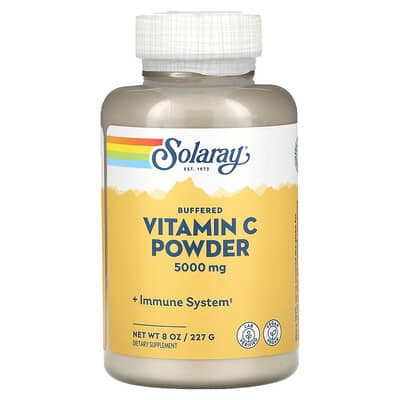
Solaray Vitamin C Powder 5000 mg provides buffered vitamin C for immune and antioxidant support, along with calcium. Its panel lists 5,000 mg of vitamin C and 610 mg of calcium, but the serving descriptions disagree substantially and the very high declared vitamin C amount raises the risk of diarrhea, so the portion needs clarification before comparing or using it.
AI assessment of the formula, label and price. How scoring works
Nutrient Quality44
Calcium ascorbate supplies buffered vitamin C and calcium. The calcium has moderate assessed absorption potential, and the very high declared vitamin C amount may cause digestive problems.
Ingredient Transparency100
Both nutrient amounts and their forms are stated. However, the listed tablespoon measure conflicts with other serving instructions, so the amount in the recommended portion is unclear.
Value For Money95
The declared vitamin C and calcium amounts compare favorably in price. Those comparisons depend on the declared serving, whose measure needs clarification.
Customer Satisfaction64
The available customer ratings are generally positive. The relatively small sample means the average should be interpreted cautiously.
Product Focus76
The two nutrients provide a focused option for vitamin C and calcium nutrition across several health goals. The serving discrepancy limits how confidently their practical benefits can be compared.
- Format
Powder - Container
- 8 Liquid(s)
- Per serving
- $0.61
- Customer rating
- 4.3 · 64 ratings
Goals

Impact
Highest effect
Vitamin C · 5000 mg
Vitamin C Powder 5000 mg offers vitamin C support, but its conflicting tablespoon and teaspoon serving descriptions should be resolved before choosing a dose. The declared 5,000 mg calcium ascorbate is conditional on the captured serving, rather than a reliable amount for the usage directions. Vitamin C has modest regular-use support for shorter colds, and the supplied facts give no additional benefit for this larger amount or for the buffered form.

Impact
High effect
Vitamin C · 5000 mg
Vitamin C Powder 5000 mg has a narrow skin-health fit through nutritional support for collagen formation. Its 5,000 mg of vitamin C as calcium ascorbate supplies the cofactor needed for normal collagen production and wound healing when intake is inadequate; the large amount does not imply a larger skin benefit.
Vitamin C Supportive

Impact
High effect
Vitamin C · 5000 mg
Vitamin C Powder 5000 mg supplies a large vitamin C contribution for a dietary gap. Its 5000 mg of vitamin C supports normal antioxidant and immune functions, while 610 mg of calcium adds bone mineral nutrition.
Vitamin C Supportive

Impact
Highest effect
Calcium · 610 mgVitamin C · 5000 mg
Vitamin C Powder 5000 mg could contribute calcium for bone mineralization, but its conflicting serving descriptions need clarification before comparing amounts. The captured panel lists 610 mg calcium and 5,000 mg vitamin C, while the serving notes use tablespoons and the directions use a teaspoon. Calcium is the main direct bone-building mineral here. Vitamin C supports collagen formation, with its bone value chiefly tied to meeting nutritional needs.
Calcium Supportive
Vitamin C Supportive

Impact
High effect
Vitamin C · 5000 mg
Vitamin C Powder 5000 mg has a conditional inflammation-related fit, with a serving conflict that needs resolution before comparing portions. The panel records 6.1 tablespoons, its note says one heaping tablespoon, and the directions say one heaping teaspoon. The 5000 mg vitamin C declaration remains conditional on that unresolved serving; its inflammation-marker connection depends on elevated baseline inflammation.
Vitamin C Supportive

Impact
High effect
Vitamin C · 5000 mg
Vitamin C Powder 5000 mg has a narrow antioxidant connection to eye health, but its serving descriptions conflict materially. The captured panel uses 6.1 tablespoons, a note says one heaping tablespoon, and the directions say one heaping teaspoon, so the declared 5,000 mg of vitamin C is conditional on resolving that discrepancy. Vitamin C is a component of selected eye-health combinations, with limited support for standalone routine vision improvement.
Vitamin C Disputed
Ingredients
| Ingredient | Amount per serving | Score |
|---|---|---|
Vitamin C (Calcium Ascorbate) | 5000 mg | |
Calcium (Calcium Ascorbate) | 610 mg |
Vitamin C (Calcium Ascorbate) · 5000 mg OverallScore79
Solaray Vitamin C Powder 5000 mg is a cautious choice because its 5,000 mg per serving, a very large amount that can raise diarrhea risk. Calcium ascorbate is a buffered mineral form of vitamin C. Good value at $0.12 per 1,000 mg of vitamin C and $0.62 per serving.
Calcium (Calcium Ascorbate) · 610 mg OverallScore70
Solaray Vitamin C Powder 5000 mg has a large calcium serving, with 610 mg per labeled serving. The calcium is listed as calcium ascorbate. Its low calcium comparison price is $0.101 per 100 mg; the full product costs $0.62 per serving.
Alternative products
Report alternatives
Sources
Published studies used for the product analysis and the top-ranked studies for each ingredient and goal.
- What is the impact of daily oral supplementation of vitamin D3 (cholecalciferol) plus calcium on the incidence of hip fracture in older people? A systematic review and meta-analysis.
- Calcium supplementation prevents seasonal bone loss and changes in biochemical markers of bone turnover in elderly New England women: a randomized placebo-controlled trial.
- The effects of calcium supplementation (milk powder or tablets) and exercise on bone density in postmenopausal women.
- The efficacy of calcium supplementation alone in elderly Thai women over a 2-year period: a randomized controlled trial.
- Calcium-enriched foods and bone mass growth in prepubertal girls: a randomized, double-blind, placebo-controlled trial.
- Can Dietary Intake of Vitamin C-Oriented Foods Reduce the Risk of Osteoporosis, Fracture, and BMD Loss? Systematic Review With Meta-Analyses of Recent Studies.
- Dietary vitamin C intake and the risk of hip fracture: a dose-response meta-analysis.
- Smoking, antioxidant vitamins, and the risk of hip fracture.
- Micronutrients and the risk of hip fracture: Case-control study.
- Favorable effect of dietary vitamin C on bone mineral density in postmenopausal women (KNHANES IV, 2009): discrepancies regarding skeletal sites, age, and vitamin D status.
- Dietary intake and blood concentrations of antioxidants and the risk of cardiovascular disease, total cancer, and all-cause mortality: a systematic review and dose-response meta-analysis of prospective studies.
- Scientific Opinion on the substantiation of a health claim related to vitamin C and increasing non haem iron absorption pursuant to Article 14 of Regulation (EC) No 1924/2006.
- Vitamin C Depletion and All-Cause Mortality in Renal Transplant Recipients.
- Associations of Serum Biomarkers of Fruit and Vegetable Intake With the Risk of Cause-Specific Mortality and All-Cause Mortality: A National Prospective Cohort Study.
- Relation between plasma ascorbic acid and mortality in men and women in EPIC-Norfolk prospective study: a prospective population study. European Prospective Investigation into Cancer and Nutrition.
- Role of Oral Vitamin 'C' on Astigmatic Errors in Phacoemulsification.
- Ascorbic acid metabolites are involved in intraocular pressure control in the general population.
- Nutritional modulation of cataract.
- Dietary n-3 Fatty Acid, α-Tocopherol, Zinc, vitamin D, vitamin C, and β-carotene are Associated with Age-Related Macular Degeneration in Japan.
- Adherence to a Mediterranean diet, lifestyle and age-related macular degeneration: the Coimbra Eye Study - report 3.