
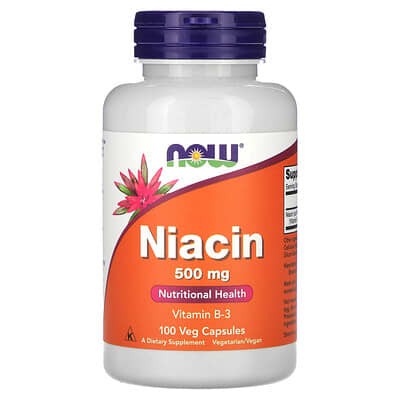

$7.00 $0.07 per serving


Product analysis
Niacin 500 mg is geared toward blood-fat metabolism, though changes in blood-fat levels do not establish better heart outcomes.
AI assessment of the formula, label and price. How scoring works
Nutrient Quality0
The exact niacin form is unclear because the vitamin B3 name does not identify it. That limits comparison with other niacin products.
Ingredient Transparency100
The niacin amount and a vitamin B3 name are disclosed. The name still leaves the exact form unclear.
Value For Money40
Value is harder to judge when the exact niacin form is unclear. Different forms cannot be compared confidently on the serving amount alone.
Customer Satisfaction88
Customer ratings are positive. Nearly 10,000 ratings give that feedback a broad base.
Product Focus68
Niacin has a connection to blood-fat metabolism, but improved blood-fat markers do not establish fewer heart problems. The heart-related evidence concerns monitored use and cannot be assumed to apply to routine supplementation.
- Format
Capsule - Container
- 100 Capsule(s)
- Per serving
- $0.07
- Customer rating
- 4.6 · 9,960 ratings
Goals

Impact
High effect
Niacin · 500 mg
Nicotinic acid can change lipid markers, which gives this niacin product its main cardiovascular connection. The 500 mg serving reaches the saved amount reference, but this does not establish the size of a lipid change. Improvements in these markers do not establish fewer cardiovascular events; the supplied evidence includes a statin-treated trial that found no event benefit and more adverse effects with its specific niacin regimen.
How this product is rated for Cardiovascular Support
Ingredient fit96
Vitamin B3 (Niacin) gives the formula a clear connection to cardiovascular support. The relevant declared amounts reach the saved comparison reference; that reference does not predict the size of a benefit.
Goal fit
Vitamin B3 (Niacin) gives the formula a clear connection to cardiovascular support.
Dose adequacy
The relevant declared amounts reach the saved comparison reference; that reference does not predict the size of a benefit.
Pathways53
The strongest saved connection is triglyceride metabolism. One aspect reaches substantial coverage; support across other aspects is limited or absent.
Depth
The strongest saved connection is triglyceride metabolism.
Breadth
One aspect reaches substantial coverage; support across other aspects is limited or absent.
Evidence74
The supplied studies support specific marker or nutrient roles, with the limitations described for the relevant ingredients.
Evidence strength
Vitamin B3 (Niacin) provides the strongest amount-qualified evidence connection, subject to its population and outcome limitations.
Studied preparation
The preparations that qualify by amount match those accepted in the supplied evidence; this does not establish superiority over other forms.
Formulation logic100
The contributing ingredients work independently or have the partners required by the supplied findings. No listed formulation conflict was identified in the supplied facts.
Partner coverage
The contributing ingredients work independently or have the partners required by the supplied findings.
Conflicts
No listed formulation conflict was identified in the supplied facts.
Effective doses
All contributing ingredients meet the saved minimum amount check; this is not a guarantee of clinical benefit.

Impact
Moderate effect
Niacin at 500 mg is relevant to blood-lipid metabolism. The supplied evidence distinguishes monitored lipid treatment from routine supplements and shows that improving lipid markers does not by itself establish fewer cardiovascular events.
How this product is rated for Heart Health
Ingredient fit96
The assessed ingredients are closely centered on the heart-health goal. The included amount fully meets the saved dose benchmark.
Goal fit
The assessed ingredients are closely centered on the heart-health goal.
Dose adequacy
The included amount fully meets the saved dose benchmark.
Pathways18
Lipid metabolism is the strongest mechanism in the saved findings, with partial coverage. None of the three target mechanisms reaches the saved coverage threshold.
Depth
Lipid metabolism is the strongest mechanism in the saved findings, with partial coverage.
Breadth
None of the three target mechanisms reaches the saved coverage threshold.
Evidence62
Niacin provides the strongest saved evidence rating here, with lipid effects distinct from cardiovascular event reduction. The saved assessment recognizes the preparations of the ingredients included at qualifying amounts.
Evidence strength
Niacin provides the strongest saved evidence rating here, with lipid effects distinct from cardiovascular event reduction.
Studied preparation
The saved assessment recognizes the preparations of the ingredients included at qualifying amounts.
Formulation logic100
No required ingredient partner is missing in the saved findings. No configured ingredient conflict was found in the saved assessment. All ingredients included in this finding reach the saved minimum dose threshold.
Partner coverage
No required ingredient partner is missing in the saved findings.
Conflicts
No configured ingredient conflict was found in the saved assessment.
Effective doses
All ingredients included in this finding reach the saved minimum dose threshold.
Ingredients
| Ingredient | Amount per serving | Score |
|---|---|---|
Niacin (Vitamin B3) | 500 mg |
Niacin (Vitamin B3) · 500 mg OverallScore37
Alternative products
Report alternatives
Sources
Published studies used for the product analysis and the top-ranked studies for each ingredient and goal.
- The current state of niacin in cardiovascular disease prevention: a systematic review and meta-regression.
- Effects of niacin on apo A1 and B levels: a systematic review and meta-analysis of randomised controlled trials.
- Effect of lipid-lowering therapies on lipoprotein(a) levels: a comprehensive meta-analysis of randomized controlled trials.
- Extended-release niacin vs gemfibrozil for the treatment of low levels of high-density lipoprotein cholesterol. Niaspan-Gemfibrozil Study Group.
- Equivalent efficacy of a time-release form of niacin (Niaspan) given once-a-night versus plain niacin in the management of hyperlipidemia.
- Differential effect of two nicotinic acid preparations on low-density lipoprotein subclass distribution in patients classified as low-density lipoprotein pattern A, B, or I.
- The ARBITER 6-HALTS Trial (Arterial Biology for the Investigation of the Treatment Effects of Reducing Cholesterol 6-HDL and LDL Treatment Strategies in Atherosclerosis): final results and the impact of medication adherence, dose, and treatment duration.
- The effects of extended-release niacin on carotid intimal media thickness, endothelial function and inflammatory markers in patients with the metabolic syndrome.
- Effect of niacin therapy on cardiovascular outcomes in patients with coronary artery disease.
- Effect of niacin on endothelial function: a systematic review and meta-analysis of randomized controlled trials.