
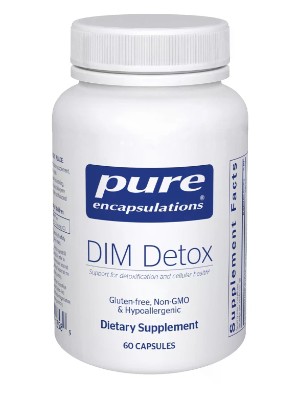

$58.00 $1.93 per serving


Product analysis
DIM Detox combines milk thistle with other ingredients aimed at liver support. An incompletely described proprietary blend makes the contents harder to judge, and routine toxin-removal benefits remain uncertain.
AI assessment of the formula, label and price. How scoring works
Nutrient Quality28
The quality of the ingredient preparations remains uncertain. The proprietary blend does not identify its individual components clearly, and most other preparations are unspecified.
Ingredient Transparency59
The listed quantities are stated, but most preparation details are missing. The proprietary blend and spruce ingredients also lack composition details, limiting precise comparisons.
Value For Money21
The serving looks expensive when considered for milk thistle, methionine or glycine. Price information for the other ingredients is insufficient to establish the value of the full blend.
Customer Satisfaction74
Customer feedback is very positive but comes from a small number of ratings. The limited history cannot establish a broad satisfaction picture.
Product Focus36
Milk thistle provides the clearest connection to liver support, with mixed findings for particular preparations. The blend does not establish routine toxin removal.
- Format
Capsule - Container
- 60 Capsule(s)
- Per serving
- $1.93
- Customer rating
- 4.9 · 66 ratings
Goals

Impact
High effect
Milk Thistle · 150 mgTaurine · 100 mgGlycine · 100 mg
Ingredients
| Ingredient | Amount per serving | Score |
|---|---|---|
BioResponse DIM Diindolylmethane Complex | 100 mg | |
Calcium-D-Glucarate | 100 mg | |
Broccoli (Brassica oleracea italica) sprout concentrate | 100 mg | |
HMRlignan (7-Hydroxymatairesinol, Norway Spruce) | 10 mg | |
Alpha Lipoic Acid | 200 mg | |
N-Acetyl-L-Cysteine | 200 mg | |
Milk Thistle (Silybum marianum) extract (Silymarin) | 150 mg | |
L-Methionine | 200 mg | |
Glycine | 100 mg | |
Taurine | 100 mg |
Methionine · 200 mg OverallScore58
DIM Detox supplies 200 mg of L-Methionine per serving, at a high cost per serving. The amount is disclosed. No specific purity grade or testing claim is available.
How this ingredient is rated
Active Ingredient Quality & Bioavailability60
The form is L-Methionine, the biologically active form. No grade or purity-testing claim is specified in the available details.
Methionine Isomer Form
The form is L-Methionine, the biologically active form.
Purity and Source Standards
No grade or purity-testing claim is specified in the available details.
Dose, Safety & Label Transparency79
The individually stated amount is 200 mg per serving, a moderate amount.
Methionine Dosage Potency
Each serving supplies 200 mg, a moderate amount.
Transparency of Disclosure
The methionine amount is individually disclosed.
Value10
The cost per serving is high.
Price per Methionine Serving
The cost per serving is high.
Glycine · 100 mg OverallScore24
Each serving provides 100 mg of glycine, a small amount, and glycine is expensive per gram. Its grade and purity certification are not established in the available information. Ordinary capsule or tablet ingredients are reported.
How this ingredient is rated
Active Ingredient Quality & Bioavailability0
Its grade and purity certification are not established in the available information.
Glycine Sourcing and Purity Standards
Its grade and purity certification are not established in the available information.
Dose, Safety & Label Transparency46
The label gives the glycine amount per serving. Ordinary capsule or tablet ingredients are reported.
Clinically Relevant Dosage
A serving supplies 100 mg of glycine, a small amount.
Label Transparency and Yield Disclosure
The glycine amount is explicitly listed.
Clean Label and Excipient Quality
Ordinary capsule or tablet ingredients are reported.
Value30
The cost per gram of glycine is high.
Cost Efficiency per 1,000mg of Glycine
The cost per gram of glycine is high.
Milk Thistle (Silymarin) · 150 mg OverallScore60
The serving provides 150 mg of milk thistle seed extract with 80% silymarin, but the cost per serving is high. The silymarin weight is not stated.
How this ingredient is rated
Composition and Label Disclosure100
The seed extract declares 80% silymarin.
Declared Silymarin Concentration
The seed extract declares 80% silymarin.
Composition and Label Disclosure50
The extract weight and silymarin percentage are stated, but the silymarin weight is not.
Extract and Marker Amount Disclosure
The extract weight and silymarin percentage are stated, but the silymarin weight is not.
Commercial Price and Usability0
The cost per serving is high.
Selected-Serving Price Comparison
The cost per serving is high.
Alternative products
Report alternatives
Sources
Published studies used for the product analysis and the top-ranked studies for each ingredient and goal.
- The impact of obesity-associated glycine deficiency on the elimination of endogenous and exogenous metabolites via the glycine conjugation pathway.
- Metabolic impact of dietary glycine supplementation in individuals with severe obesity.
- Contribution towards a Metabolite Profile of the Detoxification of Benzoic Acid through Glycine Conjugation: An Intervention Study.
- Glycine conjugation of para-aminobenzoic acid (PABA): a quantitative test of liver function.
- The treatment of isovaleric acidemia with glycine supplement
- The effect of silymarin on liver enzymes in patients taking isotretinoin: A randomized clinical trial.
- A randomized double-blind, placebo-controlled study of therapeutic effects of silymarin in β-thalassemia major patients receiving desferrioxamine.
- Effect of aerobic training with silymarin consumption on glycemic indices and liver enzymes in men with type 2 diabetes.
- Impact of silymarin-supplemented cookies on liver enzyme and inflammatory markers in non-alcoholic fatty liver disease patients.
- Impact of Silymarin Supplements on Liver Enzyme Levels: A Systematic Review.
- Dietary amino acid taurine ameliorates liver injury in chronic hepatitis patients.
- Taurine status and response to intravenous taurine supplementation in adults with short-bowel syndrome undergoing long-term parenteral nutrition: a pilot study.