
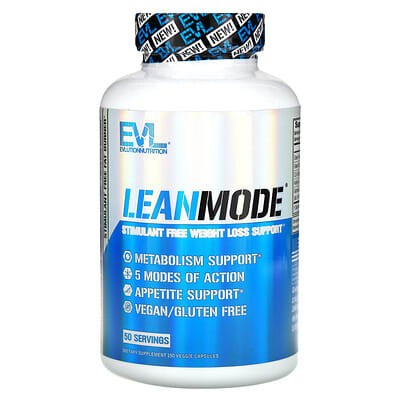

$19.70 $0.39 per serving


Product analysis
LEANMODE combines ingredients aimed at weight management and energy, but the evidence for these preparations leaves expected benefits uncertain. Undisclosed botanical details make it hard to compare the formula with preparations used in research.
AI assessment of the formula, label and price. How scoring works
Nutrient Quality21
Most ingredient forms are unspecified, so preparation quality is uncertain. The limited detail also prevents a clear comparison with the particular extracts behind the evidence.
Ingredient Transparency46
Most amounts are listed, but one ingredient amount is missing. Form details are sparse and an applicable composition breakdown is not disclosed.
Value For Money45
Acetyl L-carnitine appears reasonably priced, while CLA is costly for the amount provided. Value for green tea and green coffee remains uncertain, leaving an uneven value picture.
Customer Satisfaction82
Customers generally rate it positively across tens of thousands of ratings. The broad review base does not prove weight loss or improved focus.
Product Focus62
The formula spans many aims, but routine weight, energy and cognitive benefits remain uncertain. Unresolved caffeine and tea-compound amounts make those expectations harder to judge.
- Format
Capsule - Container
- 150 Capsule(s)
- Per serving
- $0.39
- Customer rating
- 4.3 · 22,165 ratings
Goals

Impact
Moderate effect
Acetyl L-Carnitine · 500 mgGreen Tea · 500 mg
Green tea can supply catechins and caffeine, which may modestly increase energy expenditure in a defined combination. Here, the extract weight doesn't tell you how much of either is present, so that effect is uncertain. Acetyl L-carnitine has a role in moving fatty acids for energy use, but extra intake isn't known to increase everyday calorie burning in people who already have enough.
How this product is rated for Metabolism Support
Ingredient fit73
The green tea extract has uncertain catechin and caffeine content.
Goal fit
The green tea extract has uncertain catechin and caffeine content.
Dose adequacy
Green Tea supplies 500 mg per serving.
Pathways17
The connection to stimulation depends on the caffeine content, which extract weight alone cannot resolve.
Depth
The connection to stimulation depends on the caffeine content, which extract weight alone cannot resolve.
Breadth
The ingredients do not demonstrate a broad range of calorie-burning effects.
Evidence23
The green tea extract has uncertain catechin and caffeine content.
Evidence strength
The green tea extract has uncertain catechin and caffeine content.
Studied preparation
The green tea preparation and its active-component amounts are not sufficiently defined to transfer a specific metabolic effect.
Formulation logic100
No particular ingredient conflict or missing required partner is identified.
Partner coverage
No additional required partner is missing for the ingredients described.
Conflicts
No particular ingredient conflict is identified.
Effective doses
Green Tea supplies 500 mg per serving.

Impact
Moderate effect
Acetyl L-Carnitine · 500 mg
Acetyl L-carnitine at 500 mg provides a biological connection to cellular energy handling, but the supplied fatigue evidence comes from selected older adults with clinical fatigue. A routine energy boost in healthy adults is therefore uncertain. Caffeine-bearing botanicals have no resolved caffeine amount, so an alertness effect is not inferred.
How this product is rated for Energy
Ingredient fit50
The saved assessment identifies 1 goal-related ingredients alongside 2 other actives, so the formula serves a broader purpose than energy support alone. The saved amount assessment considers 1 ingredients; undisclosed individual amounts limit the contribution that can be assigned.
Goal fit
The saved assessment identifies 1 goal-related ingredients alongside 2 other actives, so the formula serves a broader purpose than energy support alone.
Dose adequacy
The saved amount assessment considers 1 ingredients; undisclosed individual amounts limit the contribution that can be assigned.
Pathways40
The strongest saved connection concerns mitochondrial energy production. One reviewed energy mechanism reaches the saved level for substantial coverage.
Depth
The strongest saved connection concerns mitochondrial energy production.
Breadth
One reviewed energy mechanism reaches the saved level for substantial coverage.
Evidence95
The saved evidence finding is led by Acetyl L-Carnitine, among ingredients meeting the assessment’s amount requirement; this does not imply uniform energy benefit. The saved assessment recognizes preparation matches for the ingredients meeting its amount requirement, within the limitations of their underlying evidence.
Evidence strength
The saved evidence finding is led by Acetyl L-Carnitine, among ingredients meeting the assessment’s amount requirement; this does not imply uniform energy benefit.
Studied preparation
The saved assessment recognizes preparation matches for the ingredients meeting its amount requirement, within the limitations of their underlying evidence.
Formulation logic100
The saved findings identify no missing required partner among the assessed ingredients. No configured ingredient conflict was identified in the saved assessment. 1 of 1 credited ingredients meet the saved minimum amount criterion.
Partner coverage
The saved findings identify no missing required partner among the assessed ingredients.
Conflicts
No configured ingredient conflict was identified in the saved assessment.
Effective doses
1 of 1 credited ingredients meet the saved minimum amount criterion.

Impact
High effect
Green Tea · 500 mgAcetyl L-Carnitine · 500 mg
Green tea contains constituents associated with antioxidant activity, and acetyl L-carnitine has been studied for cognitive purposes. However, antioxidant activity alone does not demonstrate improved cognition, and the supplied carnitine evidence comes from disease cohorts. Neither the green tea nor green coffee amount establishes caffeine or theanine exposure, so an alertness benefit cannot be inferred.
How this product is rated for Cognitive Support
Ingredient fit67
The saved findings recognize green tea and acetyl L-carnitine within a broader formula.
Goal fit
The saved findings recognize green tea and acetyl L-carnitine within a broader formula.
Dose adequacy
Green tea reaches its saved comparison range; acetyl L-carnitine provides a partial amount comparison.
Pathways79
The saved findings cover oxidative protection and cerebral energy buffering.
Depth
The saved findings cover oxidative protection and cerebral energy buffering.
Breadth
Two routes receive substantial contributions in the saved findings.
Evidence81
Green tea leads the saved evidence finding, while the supplied context limits cognitive claims.
Evidence strength
Green tea leads the saved evidence finding, while the supplied context limits cognitive claims.
Studied preparation
The saved preparation finding recognizes both ingredients, without resolving the population limitations.
Formulation logic100
The included ingredients need no missing partner, and no configured ingredient conflict was found.
Partner coverage
The included ingredients can contribute independently; no required partner is missing.
Conflicts
No configured caffeine, melatonin or stimulant-amine conflict was found.
Effective doses
All ingredients included in this finding meet its minimum amount comparison; that threshold does not establish clinical effectiveness.

Impact
High effect
Green Tea · 500 mg
Green tea has mixed, preparation-dependent weight findings; its extract mass does not identify an equivalent active EGCG exposure. Acetyl L-carnitine cannot inherit weight findings for L-carnitine. The small CLA serving and the garcinia preparation do not establish a reliable contribution to weight loss.
How this product is rated for Weight Loss
Ingredient fit75
Several declared amounts provide only partial coverage of the saved comparisons, limiting their attributed contribution.
Goal fit
The identified ingredients are concentrated in the roles considered relevant to weight loss.
Dose adequacy
Several declared amounts provide only partial coverage of the saved comparisons, limiting their attributed contribution.
Pathways45
The strongest identified connection concerns heat production and energy use.
Depth
The strongest identified connection concerns heat production and energy use.
Breadth
The identified connections cover heat production and energy use.
Evidence72
Green Tea leads the saved evidence findings, while the supplied context limits what can be claimed for weight loss.
Evidence strength
Green Tea leads the saved evidence findings, while the supplied context limits what can be claimed for weight loss.
Studied preparation
Preparation matching is incomplete for Acetyl L-Carnitine, limiting transfer of preparation-specific findings.
Formulation logic100
The evaluated ingredients have no unmet partner requirement in the supplied findings.
Partner coverage
The evaluated ingredients have no unmet partner requirement in the supplied findings.
Conflicts
No configured ingredient conflict was identified.
Effective doses
The evaluated ingredients meet the saved minimum amount comparison; this is not a proven threshold for weight-loss benefit.
Acetyl L-Carnitine Not classified
No linked studies yet.

Impact
Moderate effect
Acetyl L-Carnitine · 500 mg
Acetyl L-carnitine at 500 mg relates to cellular energy and acetylcholine processes. The supplied evidence does not establish routine acute focus improvement in healthy adults, so its contribution should be viewed cautiously; botanical sources without a declared caffeine amount do not imply a stimulant effect.
How this product is rated for Mental Focus
Ingredient fit50
Acetyl L-carnitine provides the focus-related relevance within a formula with other purposes. The 500 mg amount provides a partial exposure comparison.
Goal fit
Acetyl L-carnitine provides the focus-related relevance within a formula with other purposes.
Dose adequacy
The 500 mg amount provides a partial exposure comparison.
Pathways40
Brain energy supply is the main assessed route. Only brain energy supply reaches the saved coverage level.
Depth
Brain energy supply is the main assessed route.
Breadth
Only brain energy supply reaches the saved coverage level.
Evidence83
Acetyl L-carnitine provides the strongest saved evidence contribution at a counted amount; the scope and limitations of its evidence still apply. Acetyl L-carnitine matches the accepted preparation category.
Evidence strength
Acetyl L-carnitine provides the strongest saved evidence contribution at a counted amount; the scope and limitations of its evidence still apply.
Studied preparation
Acetyl L-carnitine matches the accepted preparation category.
Formulation logic100
The counted ingredients can contribute independently or have their required partner. The counted ingredient meets the saved minimum exposure comparison.
Partner coverage
The counted ingredients can contribute independently or have their required partner.
Conflicts
No configured ingredient conflict was identified in the saved assessment.
Effective doses
The counted ingredient meets the saved minimum exposure comparison.

Impact
High effect
Green Tea · 500 mg
Green tea has been investigated for skin responses to ultraviolet exposure, but the supplied findings are mixed. A generic extract amount does not disclose the catechin exposure used in trials, and the supplied context does not establish a preparation-equivalent amount for routine skin benefit. This limits expectations of improved skin or ultraviolet protection from this product.
How this product is rated for Skin Health
Ingredient fit63
The formula’s skin connection depends on its relevant ingredients and their declared amounts; normal nutrient roles do not by themselves establish cosmetic improvement.
Goal fit
Skin-related nutrients sit within a broader formula, so only part of its ingredient range relates to this goal.
Dose adequacy
The counted amounts meet the saved comparison levels; those levels do not establish extra benefit or a daily regimen.
Pathways60
The saved findings identify selected skin mechanisms, with broader limitations on translating those connections into visible benefits.
Depth
The strongest saved connection is to uv antioxidant defence, without proving a corresponding improvement in skin.
Breadth
One selected skin mechanism reached the saved coverage requirement; support across other aspects remains limited.
Evidence89
The evidence comparison reflects the saved ingredient findings; preparation-specific results and deficiency-related nutrient roles constrain the benefits that can be described.
Evidence strength
Green Tea leads the saved evidence comparison, but its specific population and preparation limitations still apply.
Studied preparation
The counted preparations meet the saved preparation comparison; this does not resolve the scientific limitations of their skin effects.
Formulation logic100
The saved findings identify no missing required partner or configured conflict, while the amount findings remain specific to the supplied serving.
Partner coverage
No missing partner reduced the counted ingredients’ contributions; this does not establish an added benefit from combining them.
Conflicts
No configured ingredient conflict was found in the supplied calculation.
Effective doses
All counted ingredients reach the saved minimum contribution level, which is not a proven effective skin dose.
Ingredients
| Ingredient | Amount per serving | Score |
|---|---|---|
Green Tea leaf extract | 500 mg | |
Green Coffee bean extract | 500 mg | |
CLA | 500 mg | |
Acetyl-L-Carnitine | 500 mg | |
Garcinia cambogia extract (HCA) | 250 mg |
Acetyl L-Carnitine · 500 mg OverallScore89
A serving supplies 500 mg of acetyl L-carnitine. Its cost is about $0.39 per 500 mg of acetyl L-carnitine, among the lower costs in the comparison.
How this ingredient is rated
Active Ingredient Quality & Bioavailability85
Acetyl L-carnitine is the recorded carnitine form. The saved facts do not identify a specific salt form; a purity or manufacturing claim is recorded but not independently verified.
ALCAR vs. Standard Carnitine Form
Acetyl L-carnitine is the recorded carnitine form.
Advanced Sourcing and Salt Specificity
The saved facts do not identify a specific salt form; a purity or manufacturing claim is recorded but not independently verified.
Dose, Safety & Label Transparency100
A serving supplies 500 mg of acetyl L-carnitine. Its individual amount is recorded.
Clinical Dosage Efficacy
A serving supplies 500 mg of acetyl L-carnitine.
Label Transparency and Proprietary Blends
The individual amount of acetyl L-carnitine is recorded as 500 mg per serving.
Value75
The cost is about $0.39 per 500 mg of acetyl L-carnitine, among the lower costs in the comparison.
Price per 500mg Acetyl L-Carnitine
The cost is about $0.39 per 500 mg of acetyl L-carnitine, among the lower costs in the comparison.
Conjugated Linoleic Acid · 500 mg OverallScore20
Each serving provides 500 mg of CLA, while the source oil is unresolved in the saved facts. The whole-product price works out to about $0.79 per gram of CLA.
How this ingredient is rated
Active Ingredient Quality & Bioavailability0
The source oil is unresolved in the saved facts.
Source Quality and Isomer Standardization
The saved facts identify CLA but do not identify its source oil.
Dose, Safety & Label Transparency51
A serving provides 500 mg of CLA.
Active CLA Dosage and Label Transparency
A serving provides 500 mg of CLA.
Additive Purity and Excipient Quality
The label review did not flag artificial colors, soybean oil or flavoring.
Value0
A whole-product serving costs about $0.39 and provides 500 mg of CLA.
Price per Gram of Active CLA
Based on the whole-product price, the comparison is about $0.79 per gram of CLA.
Green Tea · 500 mg OverallScore8
The serving provides 500 mg of green tea extract, with no marker concentration recorded in the saved facts. The EGCG amount is unavailable, so its cost cannot be compared.
How this ingredient is rated
Composition and Label Disclosure20
The serving has 500 mg of green tea extract; no EGCG, catechin or polyphenol concentration is recorded in the saved facts.
Declared Green Tea Marker Concentration
The serving has 500 mg of green tea extract; no EGCG, catechin or polyphenol concentration is recorded in the saved facts.
Composition and Label Disclosure0
No caffeine information is recorded in the saved facts, leaving the whole-product caffeine amount unknown.
Whole-Product Caffeine Disclosure
No caffeine information is recorded in the saved facts, leaving the whole-product caffeine amount unknown.
Commercial Price and Usability0
The EGCG amount is unavailable, so its cost cannot be compared.
Cost per 200 mg Declared EGCG
The whole-product serving costs about $0.39, but its cost per EGCG cannot be determined from the saved facts.
Alternative products
Report alternatives
Sources
Published studies used for the product analysis and the top-ranked studies for each ingredient and goal.
- Acetyl-L-carnitine treatment in minimal hepatic encephalopathy.
- Long-term acetyl-L-carnitine treatment in Alzheimer's disease.
- Pharmaco-electroencephalographic and clinical effects of the cholinergic substance--acetyl-L-carnitine--in patients with organic brain syndrome.
- Acetyl-L-carnitine improves cognitive functions in severe hepatic encephalopathy: a randomized and controlled clinical trial.
- Acetyl-L-carnitine in the treatment of mildly demented elderly patients.
- A double-blind, parallel, multicenter comparison of L-acetylcarnitine with placebo on the attention deficit hyperactivity disorder in fragile X syndrome boys.
- Acetyl L-carnitine (ALC) treatment in elderly patients with fatigue.
- Safety and efficacy of cognitive training plus epigallocatechin-3-gallate in young adults with Down's syndrome (TESDAD): a double-blind, randomised, placebo-controlled, phase 2 trial.
- Association between tea consumption and risk of cognitive disorders: A dose-response meta-analysis of observational studies.
- Investigating the Impact of Tea Consumption on Cognitive Function and Exploring Tea-Genetic Interactions in Older Adults Aged 65-105 Years: Findings from the 2002-2018 CLHLS Data.
- Consumption of green tea, but not black tea or coffee, is associated with reduced risk of cognitive decline.
- Green Tea Consumption and the Risk of Incident Dementia in Elderly Japanese: The Ohsaki Cohort 2006 Study.
- Oral acetyl-L-carnitine therapy reduces fatigue in overt hepatic encephalopathy: a randomized, double-blind, placebo-controlled study.
- The supplementation of acetyl-L-carnitine decreases fatigue and increases quality of life in patients with hepatitis C treated with pegylated interferon-α 2b plus ribavirin.
- Acetyl-L-carnitine reduces depression and improves quality of life in patients with minimal hepatic encephalopathy.
- A prospective study to evaluate the efficacy and safety of oral acetyl-L-carnitine for the treatment of chemotherapy-induced peripheral neuropathy.
- Metabolomic biomarkers for (R, S)-ketamine and (S)-ketamine in treatment-resistant depression and healthy controls: A systematic review.
- Acetyl-L-carnitine Slows the Progression from Prefrailty to Frailty in Older Subjects: A Randomized Interventional Clinical Trial.
- Green tea and coffee intake and risk of cognitive decline in older adults: the National Institute for Longevity Sciences, Longitudinal Study of Aging.
- Associations of green tea, coffee, and soft drink consumption with longitudinal changes in leukocyte telomere length.