


Vitamin A Supportive
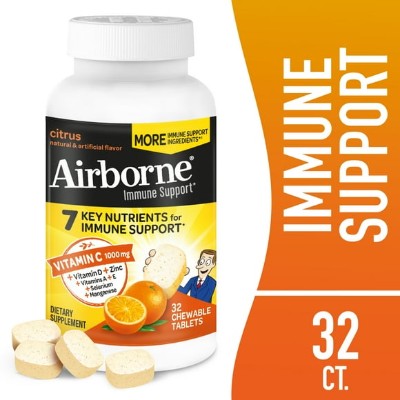
$6.97 $0.87 per serving
Product analysis
Airborne Original Citrus offers immune support in a chewable format, providing 1,000 mg of vitamin C and 8 mg of zinc in four tablets. Both nutrients support normal immune-cell function, and the 600 mcg of vitamin A helps maintain the body's protective barriers.
AI assessment of the formula, label and price. How scoring works
Nutrient Quality31
The chewables use synthetic vitamin E and forms of zinc and magnesium with limited absorption potential. The manganese comes in a favorable form.
Ingredient Transparency69
The serving totals are clearly listed, with forms named for most of the vitamins and minerals. The label leaves you without a breakdown of the herbal blend or the paired forms of vitamin C and magnesium.
Value For Money36
The amount of vitamin C is economical for the main purpose of these chewables. Zinc and vitamin E cost more for the amounts provided than they typically do in comparable supplements.
Customer Satisfaction80
Buyers give the citrus chewables a favorable average of 4.6 out of 5. That average reflects feedback from 1,250 ratings.
Product Focus35
Immune support is the clearest fit for the pairing of vitamin C and zinc. The supporting nutrients give the formula some everyday nutrition value, and the part played by the herbs remains unclear.
- Format
Tablet - Container
- 32 Tablet(s)
- Per serving
- $0.87
- Also available
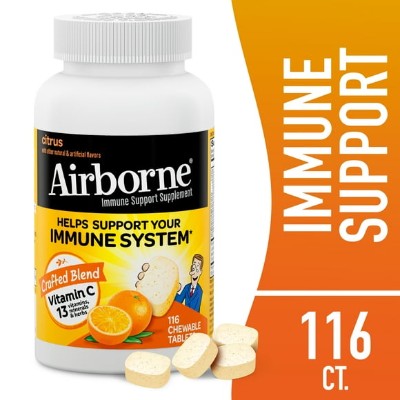 Airborne Original Citrus$21.99
- Customer rating
- 4.6 · 1,527 ratings
Goals

Impact
Highest effect
Magnesium · 40 mgVitamin C · 1000 mgZinc · 8 mgVitamin A · 600 mcgSelenium · 15 mcg
Airborne Citrus offers vitamin C-led immune support, with a possible modest reduction in cold duration during regular use. Vitamin C at 1000 mg per serving supports normal immune-cell activity. Zinc at 8 mg supports normal immune function, while vitamin A at 600 mcg RAE supports protective barriers.
Zinc Supportive
Vitamin C Supportive
Selenium Mixed
Vitamin E Supportive
Magnesium Supportive

Impact
High effect
Magnesium · 40 mgSelenium · 15 mcgZinc · 8 mgVitamin C · 1000 mg
Airborne Citrus offers targeted nutritional support for everyday health through vitamin C and zinc. Vitamin C at 1,000 mg supplies an antioxidant and immune-function nutrient that can help fill a dietary gap. Zinc at 8 mg adds a supporting nutrient contribution for normal immune function.
Magnesium Supportive
Selenium Supportive
Zinc Supportive
Vitamin C Supportive
Impact
High effect
Zinc · 8 mgVitamin C · 1000 mgSelenium · 15 mcgVitamin E · 13.5 mg
Airborne Citrus offers a narrow skin-health fit through nutritional support. Its 1,000 mg of vitamin C supports collagen formation and can help restore skin function when intake is deficient. Vitamin A at 600 mcg supports normal skin-cell development, while 8 mg of zinc supports repair when zinc intake is inadequate.
Vitamin A Supportive
Zinc Supportive
Vitamin C Supportive
Vitamin E Supportive
Selenium Supportive

Impact
High effect
Vitamin E · 13.5 mgVitamin C · 1000 mg
Airborne Citrus offers a narrow, conditional fit for inflammation support. Vitamin C at 1000 mg is the main contributor, with a signal for lower inflammatory markers confined to people starting with elevated markers. Zinc at 8 mg adds support mainly when intake or status is low. Ginger presence and dose remain unresolved, so it cannot support the choice.
Zinc Supportive
Vitamin C Supportive
Magnesium Supportive
Selenium Supportive
Vitamin E Supportive
Ingredients
| Ingredient | Amount per serving | Score |
|---|---|---|
Calories | 15 Calorie(s) | |
Total Carbohydrates | 3 Gram(s) | |
Vitamin A (Retinyl Acetate) | 600 mcg | |
Vitamin C (Ascorbic Acid, Sodium Ascorbate) | 1000 mg | |
Vitamin E (DL-Alpha-Tocopheryl Acetate) | 13.5 mg | |
Magnesium (Magnesium Oxide, Magnesium Sulfate) | 40 mg | |
Zinc (Zinc Sulfate) | 8 mg | |
Selenium (Selenium Amino Acid Chelate) | 15 mcg | |
Manganese (Manganese Gluconate) | 3 mg | |
Sodium | 40 mg | |
Proprietary Herbal Blend | 35.5 mg |
Manganese (Manganese Gluconate) · 3 mg OverallScore79
Airborne Original Airborne Citrus is a useful manganese choice with 3 mg per serving as Manganese Gluconate. That amount may support nutritional maintenance, though it may be less suited to targeted bone support. Manganese gluconate is an organic salt with good solubility. It is reasonably priced at $0.66 per 2 mg of manganese; a serving costs $1.00 for the full product.
Vitamin C (Ascorbic Acid, Sodium Ascorbate) · 1000 mg OverallScore77
Airborne Original Airborne Citrus offers 1000 mg of vitamin C per serving from Sodium Ascorbate, at a somewhat low comparison price of $1.00 per 1,000 mg of vitamin C, also the $1.00 serving price. Sodium Ascorbate is a buffered mineral form. Sweeteners are present.
Alternative products
Report alternatives
Sources
Published studies used for the product analysis and the top-ranked studies for each ingredient and goal.
- Perioperative systemic magnesium to minimize postoperative pain: a meta-analysis of randomized controlled trials.
- Long-term outcome after intravenous magnesium sulphate in suspected acute myocardial infarction: the second Leicester Intravenous Magnesium Intervention Trial (LIMIT-2).
- Association of magnesium sulfate use with mortality in critically ill patients with sepsis: a retrospective propensity score-matched cohort study.
- Hypomagnesemia and Mortality in Incident Hemodialysis Patients.
- The effects of magnesium supplementation on abnormal uterine bleeding, alopecia, quality of life, and acne in women with polycystic ovary syndrome: a randomized clinical trial.
- Associations of selenium status with all-cause and cause-specific mortality: a systematic review and meta-analysis of cohort studies.
- Dietary Antioxidants, Circulating Antioxidant Concentrations, Total Antioxidant Capacity, and Risk of All-Cause Mortality: A Systematic Review and Dose-Response Meta-Analysis of Prospective Observational Studies.
- The efficacy and safety of selenium supplementation versus placebo in the treatment of Graves' orbitopathy: A systematic review and meta-analysis of randomised controlled trials.
- Associations of plasma metal concentrations with the risks of all-cause and cardiovascular disease mortality in Chinese adults.
- Updates on clinical studies of selenium supplementation in radiotherapy.
- Dietary intake and blood concentrations of antioxidants and the risk of cardiovascular disease, total cancer, and all-cause mortality: a systematic review and dose-response meta-analysis of prospective studies.
- Scientific Opinion on the substantiation of a health claim related to vitamin C and increasing non haem iron absorption pursuant to Article 14 of Regulation (EC) No 1924/2006.
- Vitamin C Depletion and All-Cause Mortality in Renal Transplant Recipients.
- Associations of Serum Biomarkers of Fruit and Vegetable Intake With the Risk of Cause-Specific Mortality and All-Cause Mortality: A National Prospective Cohort Study.
- Relation between plasma ascorbic acid and mortality in men and women in EPIC-Norfolk prospective study: a prospective population study. European Prospective Investigation into Cancer and Nutrition.
- Effectiveness of sodium bicarbonate and zinc chloride mouthwashes in the treatment of oral mucositis and quality of life in patients with cancer under chemotherapy.
- Zinc supplementation in young children with acute diarrhea in India.
- Associations of mortality with ocular disorders and an intervention of high-dose antioxidants and zinc in the Age-Related Eye Disease Study: AREDS Report No. 13.
- Effects of zinc and probiotic co-supplementation on inflammation, gastrointestinal symptoms, quality of life, and mood in irritable bowel syndrome patients.
- Effect of zinc sulfate supplementation on premenstrual syndrome and health-related quality of life: Clinical randomized controlled trial.