
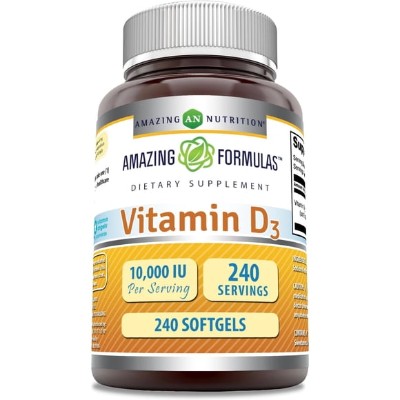
Vitamin D3 10000 IU

Goals
$9.99 $0.04 per serving

Product analysis
Vitamin D3 10000 IU offers an inexpensive way to supplement vitamin D, which supports normal immune, bone and muscle functions when intake is inadequate.
AI assessment of the formula, label and price. How scoring works
Nutrient Quality100
The D3 form is a strength of the formula. It offers a favorable choice of vitamin D form, although that does not establish the right dose for an individual.
Ingredient Transparency100
The vitamin D amount and D3 form are clearly identified. That makes the serving straightforward to compare with other vitamin D supplements.
Value For Money100
The cost relative to the vitamin D amount is favorable. The concentrated serving explains the low cost for a given amount, rather than establishing a need for the full dose.
Customer Satisfaction74
Customer ratings are very positive, but they come from a relatively small group. The pattern is encouraging while remaining less dependable than a larger body of feedback.
Product Focus80
The single-ingredient formula has a clear nutritional purpose, especially when vitamin D intake or status is low. The high serving amount does not establish extra benefit or individual suitability.
- Format
Softgel - Container
- 240 Softgel(s)
- Per serving
- $0.04
- Customer rating
- 4.9 · 52 ratings
Goals

Impact
High effect
Vitamin D · 10000 IU
Vitamin D supports nutritional sufficiency, but hormone findings are mixed and do not establish a testosterone increase in people with adequate vitamin D. The declared 250 mcg per serving exceeds the comparison range; retained dose recognition does not establish suitability at that exposure.
How this product is rated for Testosterone Support
Ingredient fit93
Vitamin D account for the relevant known ingredients. Their amount recognition does not establish a testosterone increase.
Goal fit
The relevant ingredient focus comes from Vitamin D.
Dose adequacy
The vitamin D amount exceeds the comparison range; the saved endpoint recognition does not establish suitability.
Pathways0
No direct hormone pathway contribution was recorded; the nutrient contribution is separate.
Depth
No direct hormone pathway contribution was recorded; the nutrient contribution is separate.
Breadth
No hormone pathway reaches the saved coverage threshold.
Evidence81
Vitamin D supplies the strongest retained evidence connection, although controlled hormone findings are mixed.
Evidence strength
Vitamin D supplies the strongest retained evidence connection, although controlled hormone findings are mixed.
Studied preparation
The eligible ingredients meet the saved preparation criteria; that does not establish hormone benefit from this exact product.
Formulation logic100
The supplied findings identify no unmet ingredient partner or configured conflict. Amount thresholds do not prove combined hormone effects.
Partner coverage
The recognized ingredients have no unmet required partner in the supplied findings; this does not demonstrate added benefit from combining them.
Conflicts
No configured ingredient conflict was identified from the supplied facts.
Effective doses
The eligible ingredients meet the saved amount threshold, which is a comparison finding rather than proof of hormone efficacy.

Impact
Highest effect
Vitamin D · 10000 IU
Vitamin D contributes to normal immune function, without establishing extra protection when intake is adequate. The serving amount is compared with the saved reference, which does not establish an optimal dose or greater benefit at higher exposure.
How this product is rated for Immunity
Ingredient fit93
The counted amounts reach the saved comparison levels, without establishing an optimal intake or additional benefit above them.
Goal fit
The counted ingredients are focused on immunity, although the product may also relate to other goals.
Dose adequacy
The counted amounts reach the saved comparison levels, without establishing an optimal intake or additional benefit above them.
Pathways60
The strongest saved connection is lymphocyte function and immune regulation, rather than a direct measure of infection protection.
Depth
The strongest saved connection is lymphocyte function and immune regulation, rather than a direct measure of infection protection.
Breadth
The saved findings cover lymphocyte function and immune regulation.
Evidence100
Vitamin D provides the leading saved contribution; its supported role does not establish infection prevention.
Evidence strength
Vitamin D provides the leading saved contribution; its supported role does not establish infection prevention.
Studied preparation
The saved findings accept the preparations with sufficient amounts; this does not establish testing of the complete formula.
Formulation logic100
All counted ingredients reach the saved minimum amount threshold, which is not proof of clinical effectiveness.
Partner coverage
The counted ingredients can contribute without an additional partner; this does not establish synergy.
Conflicts
No configured ingredient conflict was identified.
Effective doses
All counted ingredients reach the saved minimum amount threshold, which is not proof of clinical effectiveness.

Impact
Highest effect
Vitamin D · 10000 IU
Vitamin D contributes toward nutritional needs related to bone and mineral metabolism when intake is inadequate. The declared serving is a nutritional contribution, not evidence of greater benefit above adequate intake.
How this product is rated for Everyday Health
Ingredient fit93
Vitamin D provides the recorded nutritional connection. The counted amounts fully match the comparison references.
Goal fit
The identified nutritional ingredients provide a focused connection to general health, while the product is also linked to other goals.
Dose adequacy
The counted amounts reach their comparison references; larger amounts do not establish additional benefit.
Pathways57
The strongest connection is to bone and mineral metabolism. Recorded coverage also depends on the amounts available for each function.
Depth
The strongest recorded coverage concerns bone and mineral metabolism, reflecting ingredient availability rather than a measured health improvement.
Breadth
The recorded coverage includes bone and mineral metabolism.
Evidence82
Vitamin D anchors the recorded evidence finding. Benefits remain conditional on nutritional need rather than proving improved general health in adequately nourished adults.
Evidence strength
Vitamin D provides the strongest recorded evidence finding; the supplied context supports conditional nutritional usefulness rather than broad disease prevention.
Studied preparation
The counted preparations match those recognized in the saved findings, without establishing that any chemical form or delivery method is superior.
Formulation logic100
No missing partners or configured conflicts were identified. The counted amounts meet the minimum comparison threshold.
Partner coverage
No required ingredient partner is missing from the counted contributions; this does not imply extra benefit from combining nutrients.
Conflicts
No configured ingredient conflict was identified in the supplied findings.
Effective doses
All counted ingredients meet the comparison’s amount threshold; that threshold is not a proven clinical dose.

Impact
Highest effect
Vitamin D · 10000 IU
Vitamin D has a limited connection to inflammatory markers: a reduction in CRP appeared at two years in older adults but did not persist at four years, and other cytokines were unchanged. This single-ingredient product is focused on vitamin D. The saved result recognizes its amount fully; that does not establish lasting or broad anti-inflammatory effects.
How this product is rated for Inflammation
Ingredient fit93
Vitamin D provide the counted connection to this goal. The formula has few competing active ingredients.
Goal fit
The recognized ingredients are relatively focused on this goal, though the product is also linked to other goals.
Dose adequacy
The vitamin D amount receives full recognition.
Pathways57
Inflammatory gene signalling is the strongest represented route in the saved findings. One route reaches the saved breadth threshold; the other routes remain limited.
Depth
Inflammatory gene signalling is the strongest represented route in the saved findings.
Breadth
One route reaches the saved breadth threshold; the other routes remain limited.
Evidence93
Vitamin D leads the saved evidence finding, although supplied clinical findings are transient and inconsistent.
Evidence strength
Vitamin D leads the saved evidence finding, although supplied clinical findings are transient and inconsistent.
Studied preparation
The ingredients counted at recognized amounts match preparations accepted by the saved calculation; this does not expand their clinical benefits.
Formulation logic100
The counted ingredients have no missing partner or matched conflict and meet the saved amount threshold.
Partner coverage
The counted ingredients work independently or have their required partner.
Conflicts
No ingredient conflict was identified in the supplied calculation.
Effective doses
All counted ingredients reach the saved amount threshold; this threshold does not prove a clinical benefit.

Impact
High effect
Vitamin D · 10000 IU
Vitamin D helps preserve muscle function when deficiency causes weakness; supplementation has not shown the same benefit in replete older adults. Its declared 250 mcg per serving receives full amount recognition in the saved findings, but a larger amount does not establish greater preservation of function. The nutritional contribution does not demonstrate general slowing of aging or life extension.
How this product is rated for Longevity
Ingredient fit93
Vitamin D gives the formula a focused connection to the goal. The relevant amount receives full recognition; matching an amount does not establish larger or broader anti-aging effects.
Goal fit
Vitamin D gives the formula a focused connection to the goal.
Dose adequacy
The relevant amount receives full recognition; matching an amount does not establish larger or broader anti-aging effects.
Pathways0
No configured pathway receives coverage from vitamin D, despite its separate nutritional contribution. No pathway reaches the saved breadth threshold.
Depth
No configured pathway receives coverage from vitamin D, despite its separate nutritional contribution.
Breadth
No pathway reaches the saved breadth threshold.
Evidence83
The strongest saved evidence finding does not establish broad anti-aging benefit; nutrient effects depend on low intake or deficiency. Preparation recognition is favorable.
Evidence strength
The strongest saved evidence finding does not establish broad anti-aging benefit; nutrient effects depend on low intake or deficiency.
Studied preparation
The saved finding accepts the counted preparation; this does not extend evidence beyond the specific studied outcomes.
Formulation logic100
No required partner is missing among the counted ingredients, and no configured conflict was identified. All counted ingredients pass the saved amount threshold, which is not proof of clinical effectiveness.
Partner coverage
The counted ingredients work independently or have their required partner; no added combination benefit is established.
Conflicts
No configured ingredient conflict was identified; this does not assess every possible interaction.
Effective doses
All counted ingredients pass the saved amount threshold, which is not proof of clinical effectiveness.

Impact
High effect
Vitamin D · 10000 IU
Vitamin D’s fatigue evidence in the supplied context comes from vitamin-D-deficient adults treated with a specific large-dose regimen. This does not establish routine energy benefit in adults whose vitamin D status is adequate. The declared 250 mcg serving is counted in the saved amount comparison, but a high amount does not establish greater fatigue relief or reproduce that clinical treatment.
How this product is rated for Energy
Ingredient fit93
Vitamin D anchors the relevant saved findings. The counted serving amounts meet their comparisons.
Goal fit
Vitamin D gives the formula a clear connection to this goal, while its links to other goals reduce exclusive focus.
Dose adequacy
Vitamin D meets the saved serving-amount comparison; this does not establish an optimal intake or greater benefit from larger amounts.
Pathways0
The nutrient findings do not establish coverage of specific alertness or exercise-energy processes.
Depth
No specific alertness or exercise-energy process receives coverage; nutrient-related fatigue support remains distinct from these processes.
Breadth
No process reaches the coverage comparison; this does not rule out conditional nutrient-related fatigue support.
Evidence95
Vitamin D leads the saved finding, although the supplied fatigue trial concerns deficient adults and a distinct treatment regimen.
Evidence strength
Vitamin D leads the saved finding, although the supplied fatigue trial concerns deficient adults and a distinct treatment regimen.
Studied preparation
The counted declarations meet the saved preparation comparison, without establishing superiority of their particular forms or a completed clinical regimen.
Formulation logic100
No missing required partner or listed sedating conflict is identified. Counted ingredients meet the minimum amount comparison.
Partner coverage
No counted ingredient lacks a required partner under the supplied findings; this does not establish extra benefit from combining ingredients.
Conflicts
No valerian, kava or qualifying tryptophan conflict is triggered, and the melatonin condition does not apply; this is a limited conflict check.
Effective doses
All counted ingredients meet the saved minimum amount comparison; smaller or unresolved ingredients remain excluded from this finding.
Ingredients
| Ingredient | Amount per serving | Score |
|---|---|---|
Vitamin D3 (Cholecalciferol) | 10000 IU |
Vitamin D (Cholecalciferol) · 10000 IU OverallScore78
Alternative products
Report alternatives
Sources
Published studies used for the product analysis and the top-ranked studies for each ingredient and goal.
- Effect of Vitamin D Supplementation on Fatigue in Multiple Sclerosis: A Systematic Review and Meta-Analysis.
- Vitamin D Supplementation in Adolescents and Young Adults With Juvenile Systemic Lupus Erythematosus for Improvement in Disease Activity and Fatigue Scores: A Randomized, Double-Blind, Placebo-Controlled Trial.
- Vitamin D in Myalgic Encephalomyelitis/Chronic Fatigue Syndrome After COVID-19 or Vaccination: A Randomized Controlled Trial.
- The effects of vitamin D supplementation on disease activity and fatigue in Libyan rheumatoid arthritis patients.
- The effect of home-based aerobic training and vitamin D supplementation on fatigue and quality of life in patients with multiple sclerosis during COVID-19 outbreak.
- Vitamin D supplementation for prevention of mortality in adults.
- Effect of vitamin D on gastrointestinal symptoms and health-related quality of life in irritable bowel syndrome patients: a randomized double-blind clinical trial.
- The impact of vitamin D administration on mortality in COVID-19 patients: a systematic review and meta-analysis of randomized controlled trials.
- Vitamin D Status and Mortality: A Systematic Review of Observational Studies.
- Meta-analysis of long-term vitamin D supplementation on overall mortality.
- Vitamin D supplementation to prevent acute respiratory infections: individual participant data meta-analysis.
- Association Between Vitamin D and Influenza: Meta-Analysis and Systematic Review of Randomized Controlled Trials.
- Vitamin D3 and deconvoluting a rash.
- Effect of vitamin D3 supplementation on cellular immunity and inflammatory markers in COVID-19 patients admitted to the ICU.
- Current opinion on the role of vitamin D supplementation in respiratory infections and asthma/COPD exacerbations: A need to establish publication guidelines for overcoming the unpublished data.
- Vitamin D deficiency and C-reactive protein: a bidirectional Mendelian randomization study.
- Vitamin D in Children With Inflammatory Bowel Disease: A Randomized Controlled Clinical Trial.
- Vitamin D supplementation reduces infection rate and promotes wound healing in patients with diabetic foot ulcers.
- Associations of C-reactive Protein with 25-hydroxyvitamin D in 24 Specific Diseases: A Cross-sectional Study from NHANES.
- Combined effects of vitamin D deficiency and systemic inflammation on all-cause mortality and cause-specific mortality in older adults.