
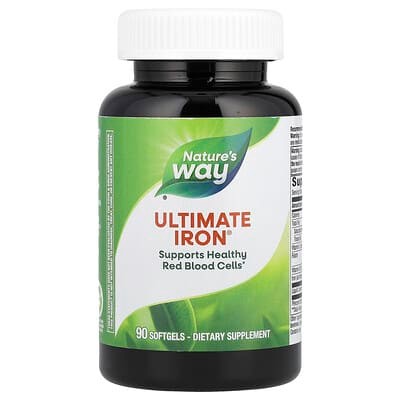

$20.81 $0.46 per serving


Product analysis
Ultimate Iron may help tiredness when low iron or related nutrient shortages contribute.
AI assessment of the formula, label and price. How scoring works
Nutrient Quality33
Iron and several vitamin forms are named, but their absorption quality remains uncertain. Folate and liver lack precise forms, limiting a fuller quality comparison.
Ingredient Transparency79
Ingredient amounts are disclosed, making serving sizes easier to compare. Several forms remain unspecified, including folate and liver.
Value For Money43
The serving price offers middling value for its iron content. Value for the accompanying ingredients remains uncertain.
Customer Satisfaction82
Customers give strongly favorable ratings across a substantial feedback base. Satisfaction does not establish who needs an iron supplement.
Product Focus66
Iron and the accompanying vitamins share a clear role in nutrient needs linked to fatigue and concentration. The iron serving is above ordinary adult requirements, making a relevant nutritional need especially important.
- Format
Softgel - Container
- 90 Softgel(s)
- Per serving
- $0.46
- Customer rating
- 4.7 · 1,524 ratings
Goals

Impact
High effect
Iron · 50 mgVitamin C · 120 mg
Iron can help address diffuse shedding associated with iron deficiency. Its relevance depends on that cause of shedding, and larger amounts do not establish extra regrowth in people with adequate iron. Folate and B12 supply nutritional support, but their cell-division and blood-cell roles do not establish independent hair regrowth. Vitamin C is below the saved amount comparison and does not establish an added hair benefit from combining it with iron.
How this product is rated for Hair Health
Ingredient fit82
The relevant ingredient amounts support the saved comparison, with focus reduced where the product covers many other goals.
Goal fit
The relevant ingredients sit within a broader formula with ingredients aimed at other goals.
Dose adequacy
The declared quantities provide the saved amount comparison; meeting its endpoints does not establish hair regrowth or a suitable individual regimen.
Pathways0
No reviewed hair route receives a contribution. Nutrient amount findings remain separate from a demonstrated hair mechanism or outcome.
Depth
No contribution is assigned to the reviewed hair routes despite the retained nutrient amount findings.
Breadth
No reviewed route reaches the saved coverage threshold.
Evidence78
Iron leads the evidence comparison. Practical expectations remain limited by deficiency conditions, clinical populations and preparation-specific findings.
Evidence strength
Iron leads the comparison, with hair relevance tied to iron-deficiency-related shedding.
Studied preparation
The saved findings accept the counted preparations; this does not demonstrate an independent hair outcome for each nutrient.
Formulation logic100
No missing required partner or listed ingredient conflict limits the formula. The counted ingredients meet the minimum amount comparison.
Partner coverage
No missing required partner limits the counted ingredients; this does not establish extra benefit from combining them.
Conflicts
No combination matched the supplied ingredient conflict checks.
Effective doses
The counted ingredients meet the saved minimum amount comparison, which does not establish a clinically effective hair dose.

Impact
High effect
Vitamin B12 · 200 mcgIron · 50 mg
Iron can help reduce fatigue associated with iron deficiency, including selected low-ferritin situations. Folate and B12 support blood-cell functions, while vitamin C can address tiredness from low intake. These nutritional roles do not establish extra energy when nutrient status is adequate. The 50 mg iron serving earns no extra contribution beyond the saved amount plateau and does not reproduce the selected fatigue-treatment evidence.
How this product is rated for Energy
Ingredient fit81
The relevant ingredients provide a mixed connection to energy. Their declared amounts only partly meet the saved amount references.
Goal fit
The saved energy fit is diluted by broader product aims or ingredients outside the credited energy roles.
Dose adequacy
Several amounts provide partial contributions against the saved references rather than full amount coverage.
Pathways0
The supplied findings center on nutrient support; none of the five assessed alertness, exercise or fatigue pathways received coverage.
Depth
The supplied findings center on nutrient support; none of the five assessed alertness, exercise or fatigue pathways received coverage..
Breadth
None of the assessed pathways reaches the saved breadth threshold.
Evidence98
Iron provides the leading evidence contribution in the saved findings. The included preparations met the saved preparation check, which does not establish unconditional fatigue relief.
Evidence strength
Iron supplies the leading evidence contribution; its specific population and outcome limitations still apply.
Studied preparation
The included ingredients meet the saved preparation check; this does not prove finished-product efficacy.
Formulation logic100
The included ingredients have no missing required partners, and no configured conflict was matched. Each included amount clears the saved minimum comparison threshold.
Partner coverage
No required partner is missing from the included contributions.
Conflicts
No configured ingredient conflict was matched; this is not a comprehensive safety assessment.
Effective doses
All included ingredients clear the saved minimum amount threshold; this is a comparison cutoff, not proof of effective fatigue treatment.

Impact
Moderate effect
Iron · 50 mgVitamin B12 · 200 mcgVitamin B12 · 200 mcg
Iron at 50 mg and folate support nutrition relevant to fatigue and concentration when a deficiency is corrected. B12 also contributes to nutritional support, without evidence that a higher intake boosts productivity in an adequately nourished adult.
How this product is rated for Productivity Boost
Ingredient fit80
Several ingredients align with the goal, within a broader range of uses. The assessed amount fully aligns with the saved exposure comparison.
Goal fit
Several ingredients align with the goal, within a broader range of uses.
Dose adequacy
The assessed amount fully aligns with the saved exposure comparison.
Pathways0
No specific productivity mechanism has meaningful coverage in the saved findings. The findings show limited breadth across the assessed mechanisms.
Depth
No specific productivity mechanism has meaningful coverage in the saved findings.
Breadth
The findings show limited breadth across the assessed mechanisms.
Evidence69
Iron provides the strongest assessed evidence contribution at its amount. The ingredients counted at adequate amounts match the saved preparation criteria.
Evidence strength
Iron provides the strongest assessed evidence contribution at its amount.
Studied preparation
The ingredients counted at adequate amounts match the saved preparation criteria.
Formulation logic100
All 2 assessed ingredients meet the saved minimum amount comparison. No conflict was identified by the supplied ingredient checks.
Partner coverage
The assessed ingredients work independently or have their required partner.
Conflicts
No conflict was identified by the supplied ingredient checks.
Effective doses
All 2 assessed ingredients meet the saved minimum amount comparison.

Impact
Moderate effect
Iron may help endurance when low iron status limits exercise capacity. The 50 mg amount meets the saved exposure comparison, but the larger dose does not earn an additional performance expectation over adequate intake.
How this product is rated for Fitness
Ingredient fit69
Many ingredients serve broader needs, limiting the formula's focus on the assessed fitness functions. The counted amounts meet the saved exposure comparison.
Goal fit
Many ingredients serve broader needs, limiting the formula's focus on the assessed fitness functions.
Dose adequacy
The counted amounts meet the saved exposure comparison.
Pathways0
No direct performance mechanism received a contribution in the saved findings. No performance mechanism reaches the saved coverage target.
Depth
No direct performance mechanism received a contribution in the saved findings.
Breadth
No performance mechanism reaches the saved coverage target.
Evidence51
Iron provides the strongest evidence contribution among ingredients counted at a sufficient amount, within the specific supplied outcomes. The counted ingredients at sufficient amounts match the preparations recognized by the saved assessment.
Evidence strength
Iron provides the strongest evidence contribution among ingredients counted at a sufficient amount, within the specific supplied outcomes.
Studied preparation
The counted ingredients at sufficient amounts match the preparations recognized by the saved assessment.
Formulation logic100
The counted ingredients can contribute independently or have their required partner. No configured ingredient conflict was identified in the supplied findings. 1 of 1 counted ingredients meet the saved minimum exposure threshold.
Partner coverage
The counted ingredients can contribute independently or have their required partner.
Conflicts
No configured ingredient conflict was identified in the supplied findings.
Effective doses
1 of 1 counted ingredients meet the saved minimum exposure threshold.
Ingredients
| Ingredient | Amount per serving | Score |
|---|---|---|
Calories | 10 Calorie(s) | |
Total Fat | 1 Gram(s) | |
Vitamin C (Ascorbic Acid) | 120 mg | |
Folate | 666 mcg DFE | |
Vitamin B12 (Cyanocobalamin) | 200 mcg | |
Iron (Ferrous Succinate) | 50 mg | |
Liquid Liver Fractions | 500 mg |
Iron (Ferrous Succinate) · 50 mg OverallScore72
Each serving supplies 50 mg of iron as ferrous succinate. Vitamin C may help iron absorption, and B12 and folate are also listed.
How this ingredient is rated
Active Ingredient Quality & Bioavailability69
The recorded iron form is ferrous succinate. The serving lists 120 mg of vitamin C, which may help iron absorption, along with B12 and folate.
Iron Chemical Form & Bioavailability
The recorded iron form is ferrous succinate.
Absorption Support & Blocker Avoidance
The serving lists 120 mg of vitamin C, which may help iron absorption, along with B12 and folate.
Dose, Safety & Label Transparency85
Each serving supplies 50 mg of iron, a relatively high amount.
Elemental Iron Label Clarity
The saved information identifies 50 mg of iron per serving.
Dosage Effectiveness & Safety Range
Each serving supplies 50 mg of iron, a relatively high amount.
Value50
A whole-product serving costs about $0.46 and supplies 50 mg of iron.
Price per Effective Serving
A whole-product serving costs about $0.46 and supplies 50 mg of iron.
Vitamin B12 (Cyanocobalamin) · 200 mcg OverallScore21
Each serving provides 200 mcg of vitamin B12 as cyanocobalamin. The whole-product cost works out to about $2.31 per 1,000 mcg of B12.
How this ingredient is rated
Active Ingredient Quality & Bioavailability10
The B12 is identified as cyanocobalamin.
Bioactive B12 Form Selection
The B12 is identified as cyanocobalamin.
Dose, Safety & Label Transparency37
The serving lists 200 mcg of B12 as cyanocobalamin.
Therapeutic Dosage Level
The serving provides 200 mcg of B12, a smaller amount than higher-dose options.
Label and Form Transparency
The serving identifies both the cyanocobalamin form and its 200 mcg amount.
Value10
Based on the cost of whole-product servings, 1,000 mcg of B12 works out to about $2.31.
Price per 1,000 mcg B12
Based on the cost of whole-product servings, 1,000 mcg of B12 works out to about $2.31.
Alternative products
Report alternatives
Sources
Published studies used for the product analysis and the top-ranked studies for each ingredient and goal.
- Large-dose intravenous ferric carboxymaltose injection for iron deficiency anemia in heavy uterine bleeding: a randomized, controlled trial.
- The Effect of Parenteral or Oral Iron Supplementation on Fatigue, Sleep, Quality of Life and Restless Legs Syndrome in Iron-Deficient Blood Donors: A Secondary Analysis of the IronWoMan RCT.
- Ferric carboxymaltose vs. oral iron in the treatment of pregnant women with iron deficiency anemia: an international, open-label, randomized controlled trial (FER-ASAP).
- Effect of iron therapy on fatigue symptoms in non-anaemic iron deficient women of reproductive age- A Randomized Controlled Trial.
- Intravenous iron isomaltoside treatment of women suffering from severe fatigue after postpartum hemorrhage.
- A new perspective on vitamin B12 deficiency in rheumatology: a case-based review.
- Effects of Vitamin B12 Supplementation on Cognitive Function, Depressive Symptoms, and Fatigue: A Systematic Review, Meta-Analysis, and Meta-Regression.
- Patients' experiences with methylcobalamin injections in amyotrophic lateral sclerosis.
- Cobalamin deficiency: clinical picture and radiological findings.
- Vitamin B12 Deficiency: Common Questions and Answers.
- Ferric carboxymaltose in patients with heart failure and iron deficiency.
- Marginal iron deficiency without anemia impairs aerobic adaptation among previously untrained women.
- Ferric Carboxymaltose Versus Ferrous Fumarate in Anemic Children with Inflammatory Bowel Disease: The POPEYE Randomized Controlled Clinical Trial.
- Daily iron supplementation for improving anaemia, iron status and health in menstruating women.
- Altered metabolic response of iron-depleted nonanemic women during a 15-km time trial.
- Inter-individual variability in redox and performance responses after antioxidant supplementation: A randomized double blind crossover study.
- Antioxidant supplementation, redox deficiencies and exercise performance: A falsification design.
- A significant relationship between plasma vitamin C concentration and physical performance among Japanese elderly women.
- Low vitamin C values are linked with decreased physical performance and increased oxidative stress: reversal by vitamin C supplementation.
- Low dietary vitamin C intake is associated with low muscle strength among elderly Korean women.