
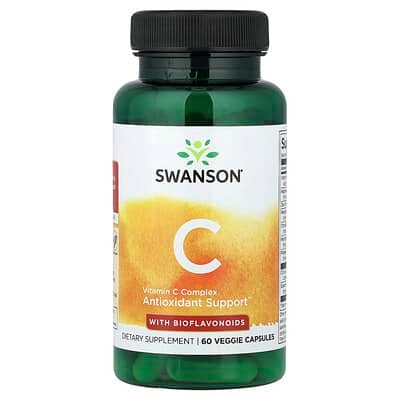
Ultimate Vitamin C Formula Mineral Ascorbate Complex with Bioflavonoids

Goals
$6.49 $0.10 per serving

Product analysis
Ultimate Vitamin C Formula Mineral Ascorbate Complex with Bioflavonoids centers on vitamin C for normal immune function and collagen formation. The smaller mineral contributions and added plant compounds do not establish a broader benefit.
AI assessment of the formula, label and price. How scoring works
Nutrient Quality41
The ingredient sources are named, but most do not have enough detail to establish a form advantage. Sodium molybdate is a favorable form choice, while the vitamin C mixture proportions remain unclear.
Ingredient Transparency80
Amounts and ingredient forms are disclosed throughout. The vitamin C mixture lacks proportions, limiting a precise comparison of its components.
Value For Money57
Vitamin C and molybdenum compare favorably on cost. Value for the remaining ingredients is uncertain, so their presence does not establish a broader price advantage.
Customer Satisfaction79
Customer feedback is generally favorable. A moderate number of ratings provides some perspective, without proving health benefits.
Product Focus58
Vitamin C provides a clear central purpose despite the additional minerals and plant compounds. Its clearest benefits concern normal nutrient functions, with added benefit depending on dietary needs.
- Format
Capsule - Container
- 60 Capsule(s)
- Per serving
- $0.10
- Customer rating
- 4.7 · 672 ratings
Goals

Impact
Moderate effect
Magnesium · 17 mgVitamin C · 500 mgZinc · 3 mg
Vitamin C at 500 mg is the main immune-related contribution, supporting antioxidant protection and normal immune-cell function. Regular supplementation may modestly shorten colds in some settings, while the small zinc amount and accompanying bioflavonoids add little basis for expecting a broader effect.
How this product is rated for Immunity
Ingredient fit46
The formula serves several needs, so only part of it is focused on immunity. The relevant amounts provide a partial match to the supplied dose comparisons.
Goal fit
The formula serves several needs, so only part of it is focused on immunity.
Dose adequacy
The relevant amounts provide a partial match to the supplied dose comparisons.
Pathways40
Innate immune cell activity is the strongest area of support in the saved findings. The saved findings show meaningful coverage of 1 aspect of immune support, with less coverage elsewhere.
Depth
Innate immune cell activity is the strongest area of support in the saved findings.
Breadth
The saved findings show meaningful coverage of 1 aspect of immune support, with less coverage elsewhere.
Evidence100
Vitamin C provides the strongest relevant evidence at the assessed amount; normal nutritional function is distinct from preventing infections. The qualifying ingredients match preparations represented in the supplied evidence.
Evidence strength
Vitamin C provides the strongest relevant evidence at the assessed amount; normal nutritional function is distinct from preventing infections.
Studied preparation
The qualifying ingredients match preparations represented in the supplied evidence.
Formulation logic100
The assessed ingredients can contribute on their own or have their required partner present. No ingredient conflicts were identified in the saved assessment. All assessed ingredients met the saved minimum amount criterion.
Partner coverage
The assessed ingredients can contribute on their own or have their required partner present.
Conflicts
No ingredient conflicts were identified in the saved assessment.
Effective doses
All assessed ingredients met the saved minimum amount criterion.

Impact
Moderate effect
Magnesium · 17 mgZinc · 3 mgVitamin C · 500 mg
Vitamin C at 500 mg provides the main nutritional contribution related to normal immune and antioxidant functions. The smaller magnesium and zinc amounts add modest mineral intake, alongside trace nutrients. Benefits depend on dietary needs rather than the number of minerals included.
How this product is rated for Everyday Health
Ingredient fit53
The relevant ingredients share the formula with ingredients aimed at other uses, giving it a broader focus. The declared amounts provide partial coverage of the amounts used in the saved assessment.
Goal fit
The relevant ingredients share the formula with ingredients aimed at other uses, giving it a broader focus.
Dose adequacy
The declared amounts provide partial coverage of the amounts used in the saved assessment.
Pathways17
The strongest saved contribution concerns antioxidant and immune defence, with partial coverage. No pathway reaches the saved threshold for substantial coverage.
Depth
The strongest saved contribution concerns antioxidant and immune defence, with partial coverage.
Breadth
No pathway reaches the saved threshold for substantial coverage.
Evidence74
Vitamin C supplies the strongest saved evidence among ingredients at an assessed effective amount, while relevance to broad everyday health remains conditional. The saved findings recognize the assessed effective ingredients as studied preparations.
Evidence strength
Vitamin C supplies the strongest saved evidence among ingredients at an assessed effective amount, while relevance to broad everyday health remains conditional.
Studied preparation
The saved findings recognize the assessed effective ingredients as studied preparations.
Formulation logic100
The credited ingredients can contribute independently or have their required partners. No configured ingredient conflicts were recorded in the saved findings. All credited ingredients meet the saved minimum amount.
Partner coverage
The credited ingredients can contribute independently or have their required partners.
Conflicts
No configured ingredient conflicts were recorded in the saved findings.
Effective doses
All credited ingredients meet the saved minimum amount.

Impact
Moderate effect
Vitamin C · 500 mg
Vitamin C may lower an inflammation-related blood marker when it is already elevated, but that doesn’t imply a general anti-inflammatory effect for everyone. Changes in a blood marker also don’t guarantee relief from symptoms. A buffered or other named vitamin C form doesn’t by itself provide a greater anti-inflammatory benefit.
How this product is rated for Inflammation
Ingredient fit44
Vitamin C’s inflammation-related benefit appears conditional rather than routine.
Goal fit
Vitamin C’s inflammation-related benefit appears conditional rather than routine.
Dose adequacy
Quercetin 7.5 mg; Zinc 3 mg. The serving amount alone doesn’t predict symptom relief.
Pathways17
Antioxidant or inflammatory-signalling effects don’t automatically translate into relief from symptoms.
Depth
Antioxidant or inflammatory-signalling effects don’t automatically translate into relief from symptoms.
Breadth
The ingredients don’t demonstrate broad relief through several distinct inflammatory processes.
Evidence87
Vitamin C’s inflammation-related benefit appears conditional rather than routine.
Evidence strength
Vitamin C’s inflammation-related benefit appears conditional rather than routine.
Studied preparation
Effects depend on the particular ingredient preparation; matching a name alone doesn’t guarantee symptom relief.
Formulation logic100
No particular conflict or missing ingredient partner is identified. A combination doesn’t automatically provide an additional anti-inflammatory effect.
Partner coverage
No required ingredient partner is identified as missing.
Conflicts
No particular ingredient conflict is identified.
Effective doses
Quercetin 7.5 mg; Zinc 3 mg. These amounts don’t by themselves establish routine symptom relief.

Impact
Moderate effect
Zinc · 3 mgVitamin C · 500 mg
Vitamin C at 500 mg supports normal collagen formation and helps maintain healthy skin when intake is inadequate. The supplied evidence does not show a dependable added cosmetic benefit in well-nourished adults, and buffered ascorbate forms have no established separate cosmetic advantage.
How this product is rated for Skin Health
Ingredient fit61
The saved assessment identifies 1 relevant ingredients, alongside 7 other actives. The product is linked to 5 goals. The counted amounts fully meet the saved comparison benchmarks.
Goal fit
The saved assessment identifies 1 relevant ingredients, alongside 7 other actives. The product is linked to 5 goals.
Dose adequacy
The counted amounts fully meet the saved comparison benchmarks.
Pathways0
No coverage was recorded in the assessed skin mechanisms. 0 of 3 target areas reaches the saved coverage threshold.
Depth
No coverage was recorded in the assessed skin mechanisms.
Breadth
0 of 3 target areas reaches the saved coverage threshold.
Evidence100
Vitamin C provides the strongest saved evidence contribution at a counted amount. The supplied evidence retains its population and preparation limits. The counted preparations match the saved research criteria.
Evidence strength
Vitamin C provides the strongest saved evidence contribution at a counted amount. The supplied evidence retains its population and preparation limits.
Studied preparation
The counted preparations match the saved research criteria.
Formulation logic100
The counted ingredients can contribute independently or have their required partner present. No configured ingredient conflict was found. 1 of 1 counted ingredients reach the saved minimum amount benchmark.
Partner coverage
The counted ingredients can contribute independently or have their required partner present.
Conflicts
No configured ingredient conflict was found.
Effective doses
1 of 1 counted ingredients reach the saved minimum amount benchmark.

Impact
High effect
Zinc · 3 mgVitamin C · 500 mg
Vitamin C contributes to antioxidant functions associated with the retina and lens. The supplied vision findings come from a defined combination used in selected people with age-related macular degeneration, so they do not establish improved everyday vision or disease prevention from vitamin C alone. The declared serving amount meets the comparison reference without proving a larger visual benefit.
How this product is rated for Eye Health
Ingredient fit61
The usable amount fully meets the comparison reference; this does not establish a clinically effective vision dose.
Goal fit
Vision-related ingredients share this formula with ingredients aimed at other purposes, limiting its specific focus on vision.
Dose adequacy
The usable amount fully meets the comparison reference; this does not establish a clinically effective vision dose.
Pathways47
Retinal and lens antioxidant roles provide the main recognized connection, without establishing a direct improvement in vision.
Depth
Retinal and lens antioxidant roles provide the main recognized connection, without establishing a direct improvement in vision.
Breadth
Only one route reaches the comparison reference, so the recognized vision connection remains concentrated.
Evidence68
Vitamin C provides the recognized evidence contribution, but combination findings in selected AMD populations do not establish standalone visual improvement.
Evidence strength
Vitamin C provides the recognized evidence contribution, but combination findings in selected AMD populations do not establish standalone visual improvement.
Studied preparation
The qualifying ingredients meet the preparation criteria; this does not establish that the complete product reproduces a studied clinical regimen.
Formulation logic100
The retained ingredients meet partner requirements; no evaluated ingredient conflict is triggered.
Partner coverage
No recognized ingredient is reduced for a missing required partner; this does not demonstrate extra benefit from combining ingredients.
Conflicts
None of the evaluated ingredient combinations triggers a listed conflict; that finding does not establish overall suitability.
Effective doses
All ingredients retained for the amount comparison meet its minimum reference, without establishing an effective dose for routine vision improvement.
Ingredients
| Ingredient | Amount per serving | Score |
|---|---|---|
Vitamin C (Ascorbic Acid, Chromium Ascorbate, Zinc Ascorbate) | 500 mg | |
Magnesium (Magnesium Carbonate) | 17 mg | |
Zinc (Zinc Ascorbate) | 3 mg | |
Manganese (Manganese Carbonate) | 0.25 mg | |
Chromium (Chromium Ascorbate) | 30 mcg | |
Molybdenum (Sodium Molybdate) | 25 mcg | |
Potassium (Potassium Bicarbonate) | 37.5 mg | |
Citrus Bioflavonoid Complex (Orange) | 100 mg | |
Quercetin (Sophora japonica) | 7.5 mg |
Each serving supplies 500 mg of vitamin C from chromium ascorbate and zinc ascorbate. Their individual proportions are not established in the saved facts.
How this ingredient is rated
Active Ingredient Quality & Bioavailability30
The recorded forms are chromium ascorbate and zinc ascorbate, with their proportions unknown. The evaluation does not establish buffering.
Vitamin C Chemical Form & Delivery System
The recorded form is chromium ascorbate and zinc ascorbate. The proportions are unknown.
Gastric Comfort & pH Balance
The saved evaluation does not establish buffering or a stomach-friendly claim.
Dose, Safety & Label Transparency83
The serving provides 500 mg of vitamin C.
Optimal Dosage Targeting
The serving provides 500 mg of vitamin C.
Purity & Excipient Quality
The available ingredient evidence did not trigger the evaluation’s listed additive concerns.
Mineral & Source Transparency
The total amount and both forms are recorded, but their proportions are unknown; neither form fits the evaluation’s named mineral-disclosure cases.
Value80
The whole-product price works out to about $0.22 per gram of vitamin C.
Price per Gram of Vitamin C
The whole-product price works out to about $0.22 per gram of vitamin C.
Molybdenum (Sodium Molybdate) · 25 mcg OverallScore64
Each serving supplies 25 mcg of molybdenum from sodium molybdate. The whole-product serving costs about $0.11.
How this ingredient is rated
Active Ingredient Quality & Bioavailability56
The named source is sodium molybdate, a soluble molybdenum salt. The saved facts do not identify a branded molybdenum source.
Molybdenum Chemical Form
Sodium molybdate is the identified form of molybdenum.
Branded or Patented Source
The saved facts do not identify a branded molybdenum source.
Dose, Safety & Label Transparency64
The serving provides 25 mcg of molybdenum, a relatively small amount in this comparison. The serving is below the upper limit used by the evaluation, which does not include intake from other sources.
Elemental Dose Optimization
The serving provides 25 mcg of molybdenum, a relatively small amount in this comparison.
Upper Limit (UL) Safety Compliance
The serving is below the upper limit used by the evaluation, which does not include intake from other sources.
Value80
The whole-product serving costs about $0.11.
Price per Effective Serving
The selected whole-product serving costs about $0.11.
Alternative products
Report alternatives
Sources
Published studies used for the product analysis and the top-ranked studies for each ingredient and goal.
- Perioperative systemic magnesium to minimize postoperative pain: a meta-analysis of randomized controlled trials.
- Long-term outcome after intravenous magnesium sulphate in suspected acute myocardial infarction: the second Leicester Intravenous Magnesium Intervention Trial (LIMIT-2).
- Association of magnesium sulfate use with mortality in critically ill patients with sepsis: a retrospective propensity score-matched cohort study.
- Hypomagnesemia and Mortality in Incident Hemodialysis Patients.
- The effects of magnesium supplementation on abnormal uterine bleeding, alopecia, quality of life, and acne in women with polycystic ovary syndrome: a randomized clinical trial.
- Dietary intake and blood concentrations of antioxidants and the risk of cardiovascular disease, total cancer, and all-cause mortality: a systematic review and dose-response meta-analysis of prospective studies.
- Scientific Opinion on the substantiation of a health claim related to vitamin C and increasing non haem iron absorption pursuant to Article 14 of Regulation (EC) No 1924/2006.
- Vitamin C Depletion and All-Cause Mortality in Renal Transplant Recipients.
- Associations of Serum Biomarkers of Fruit and Vegetable Intake With the Risk of Cause-Specific Mortality and All-Cause Mortality: A National Prospective Cohort Study.
- Relation between plasma ascorbic acid and mortality in men and women in EPIC-Norfolk prospective study: a prospective population study. European Prospective Investigation into Cancer and Nutrition.
- Effectiveness of sodium bicarbonate and zinc chloride mouthwashes in the treatment of oral mucositis and quality of life in patients with cancer under chemotherapy.
- Zinc supplementation in young children with acute diarrhea in India.
- Associations of mortality with ocular disorders and an intervention of high-dose antioxidants and zinc in the Age-Related Eye Disease Study: AREDS Report No. 13.
- Effects of zinc and probiotic co-supplementation on inflammation, gastrointestinal symptoms, quality of life, and mood in irritable bowel syndrome patients.
- Effect of zinc sulfate supplementation on premenstrual syndrome and health-related quality of life: Clinical randomized controlled trial.
- Role of Oral Vitamin 'C' on Astigmatic Errors in Phacoemulsification.
- Ascorbic acid metabolites are involved in intraocular pressure control in the general population.
- Nutritional modulation of cataract.
- Dietary n-3 Fatty Acid, α-Tocopherol, Zinc, vitamin D, vitamin C, and β-carotene are Associated with Age-Related Macular Degeneration in Japan.
- Adherence to a Mediterranean diet, lifestyle and age-related macular degeneration: the Coimbra Eye Study - report 3.