
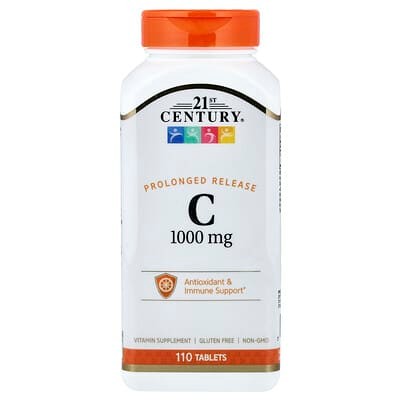

$9.99 $0.09 per serving


Product analysis
C 1000 mg offers a simple vitamin C supplement at a favorable cost for the amount supplied.
AI assessment of the formula, label and price. How scoring works
Nutrient Quality40
Ascorbic acid is clearly identified as the vitamin C form. Its comparative quality cannot be judged more closely from the available detail.
Ingredient Transparency100
Amounts and ingredient forms or sources are disclosed throughout. Those details make serving and ingredient comparisons easier.
Value For Money100
The vitamin C is inexpensive for the amount supplied. The single-ingredient formula keeps the comparison straightforward.
Customer Satisfaction92
Customer feedback is very positive across a substantial number of ratings. The ratings reflect satisfaction and do not establish effectiveness or safety.
Product Focus79
A single nutrient appears well aligned with the intended uses. A limited range of uses keeps the formula reasonably focused.
- Format
Tablet - Container
- 110 Tablet(s)
- Per serving
- $0.09
- Customer rating
- 4.8 · 7,767 ratings
Goals

Impact
Highest effect
Vitamin C · 1000 mg
Vitamin C supports normal immune nutrition and may modestly shorten colds when taken regularly. That finding does not establish prevention of infection or treatment of an established cold, and a single serving does not establish the studied regimen. The declared amount does not establish extra benefit from higher exposure.
How this product is rated for Immunity
Ingredient fit94
The declared ingredients provide the immune connection; the strength and transferability of their clinical evidence remain distinct from their presence.
Goal fit
The counted ingredients align with immune support, while links to other purposes make the formula's focus less exclusive.
Dose adequacy
Declared amounts make varying contributions; larger quantities do not establish an optimal prevention or treatment dose.
Pathways60
The saved findings concentrate on innate immune cell activity. These ingredient associations do not establish clinical immune protection.
Depth
The strongest saved association is innate immune cell activity, without establishing a measured immune or infection outcome.
Breadth
One immune-related area meets the saved coverage threshold; other areas receive less or no contribution.
Evidence100
Vitamin C leads the counted contribution. Normal nutrient roles and any regular-use cold findings retain their specific limitations.
Evidence strength
Vitamin C provides the strongest counted contribution, retaining its nutritional or regular-use respiratory-evidence limitations.
Studied preparation
The counted preparations are accepted in the saved comparison; this does not independently establish clinical equivalence or product superiority.
Formulation logic100
No required partner or configured conflict was found. Counted amounts meet the saved inclusion threshold, without establishing an extra combination benefit.
Partner coverage
No required partner is missing for the counted ingredients; this does not establish an added immune benefit from combining them.
Conflicts
No configured formulation conflict was found at the supplied amounts and partner declarations.
Effective doses
All counted ingredients meet the saved amount inclusion threshold, without proving a dose that prevents or treats infection.

Impact
High effect
Vitamin C · 1000 mg
Vitamin C provides a nutritional contribution rather than evidence of extra protection from illness at high intake. Higher amounts do not establish extra benefit once intake is adequate.
How this product is rated for Everyday Health
Ingredient fit94
The known ingredients have a focused relationship to the retained nutritional functions. Amounts meet the comparison references.
Goal fit
The retained ingredients closely match the comparison focus; this describes nutritional relevance rather than comprehensive health improvement.
Dose adequacy
The retained amounts meet the saved comparison references; higher amounts do not establish extra benefit above nutritional adequacy.
Pathways54
The strongest retained connection is antioxidant and immune defence. Coverage of other functions is narrower.
Depth
The strongest retained connection is antioxidant and immune defence, based on the known ingredient amounts.
Breadth
The contribution is concentrated in antioxidant and immune defence, with limited coverage of other retained functions.
Evidence74
Vitamin C provides the strongest retained evidence. The supplied context supports nutritional availability or limited population-specific findings, without establishing broad health improvements beyond adequate intake.
Evidence strength
Vitamin C supplies the strongest retained evidence. Its supplied context limits expectations to nutritional or population-specific outcomes.
Studied preparation
The retained preparations match the saved criteria; no superiority of chemical form or delivery is established.
Formulation logic100
The supplied checks identify no configured conflict or missing required partner. The retained amount thresholds remain comparison references rather than treatment doses.
Partner coverage
The retained ingredients have no missing required partner under the saved criteria; this does not establish an added combination benefit.
Conflicts
No configured ingredient conflict was identified from the supplied amounts.
Effective doses
The retained amounts meet the saved minimum comparison threshold, which is not proof of a clinical effective dose.

Impact
High effect
Vitamin C · 1000 mg
Vitamin C supports collagen formation and wound healing when intake is low. Its disclosed serving amount meets the saved amount reference, but higher intake does not establish extra skin improvement when vitamin C status is adequate. Hydration, barrier and UV-related outcomes are not established by this ingredient alone.
How this product is rated for Skin Health
Ingredient fit94
The relevant ingredients primarily provide nutritional support. Their saved amount findings do not establish extra cosmetic benefit.
Goal fit
Vitamin C is the main relevant ingredient; its use across other goals limits the formula’s skin focus.
Dose adequacy
The credited amounts meet the saved reference; this does not establish extra benefit above nutritional needs.
Pathways0
The saved findings identify no coverage of the four targeted skin pathways. Nutrient sufficiency is considered separately.
Depth
No targeted pathway receives a contribution from the disclosed ingredients.
Breadth
None of the targeted pathways reaches the saved coverage threshold.
Evidence100
Vitamin C leads the saved evidence finding. The supplied scientific context limits claims to the relevant nutritional role or preparation-specific outcomes.
Evidence strength
Vitamin C provides the strongest saved evidence contribution; this does not establish broad cosmetic improvement.
Studied preparation
The credited preparations meet the saved preparation checks, while the supplied evidence still limits transfer to routine skin outcomes.
Formulation logic100
The credited ingredients need no missing partner, and no configured conflicts were identified. Those findings do not establish added benefit from combining ingredients.
Partner coverage
The credited ingredients can contribute without an additional required partner.
Conflicts
No configured ingredient conflict was identified in the supplied findings.
Effective doses
All credited ingredients meet the saved minimum amount threshold; that threshold is not a proven effective skin dose.

Impact
High effect
Vitamin C · 1000 mg
Vitamin C has an antioxidant role relevant to eye tissues. Its supplied vision evidence comes from a defined multi-ingredient regimen in selected people with macular degeneration, which does not establish vitamin C-alone improvement in routine visual performance. The declared serving meets the saved amount comparison, but neither its amount nor form establishes the same clinical benefit.
How this product is rated for Eye Health
Ingredient fit94
Vitamin C supplies the main eye-related connection.
Goal fit
Vitamin C supplies the main eye-related connection.
Dose adequacy
Vitamin C meets the saved amount comparison; this does not establish a standalone dose that improves vision.
Pathways47
The saved findings concentrate on retinal and lens antioxidant defence.
Depth
The saved findings concentrate on retinal and lens antioxidant defence.
Breadth
One route reaches substantial coverage; broader coverage of other vision-related routes is limited.
Evidence68
Vitamin C's supplied evidence concerns a defined combination in selected macular-degeneration populations.
Evidence strength
Vitamin C's supplied evidence concerns a defined combination in selected macular-degeneration populations.
Studied preparation
The declared vitamin C form is recognized, without establishing a form-specific visual advantage.
Formulation logic100
The included ingredients need no missing partner, and no configured ingredient conflict was found.
Partner coverage
The included ingredients work independently or have their required partner.
Conflicts
No configured ingredient conflict was found.
Effective doses
All included ingredients meet the saved minimum amount comparison; this threshold does not establish clinical effectiveness.

Impact
Highest effect
Vitamin C · 1000 mg
Vitamin C supports antioxidant defenses. The supplied trial was null overall, with lower CRP confined to people starting with elevated CRP, so routine anti-inflammatory benefit is uncertain. The 1000 mg serving supplies the amount fully recognized in the saved result.
How this product is rated for Inflammation
Ingredient fit94
Vitamin C provide the counted connection to this goal. The formula has few competing active ingredients.
Goal fit
The recognized ingredients are relatively focused on this goal, though the product is also linked to other goals.
Dose adequacy
The vitamin C amount receives full recognition.
Pathways55
Oxidative and mitochondrial stress is the strongest represented route in the saved findings. One route reaches the saved breadth threshold; the other routes remain limited.
Depth
Oxidative and mitochondrial stress is the strongest represented route in the saved findings.
Breadth
One route reaches the saved breadth threshold; the other routes remain limited.
Evidence87
Vitamin C leads the saved evidence finding, with the relevant trial signal limited to elevated baseline CRP.
Evidence strength
Vitamin C leads the saved evidence finding, with the relevant trial signal limited to elevated baseline CRP.
Studied preparation
The ingredients counted at recognized amounts match preparations accepted by the saved calculation; this does not expand their clinical benefits.
Formulation logic100
The counted ingredients have no missing partner or matched conflict and meet the saved amount threshold.
Partner coverage
The counted ingredients work independently or have their required partner.
Conflicts
No ingredient conflict was identified in the supplied calculation.
Effective doses
All counted ingredients reach the saved amount threshold; this threshold does not prove a clinical benefit.
Ingredients
| Ingredient | Amount per serving | Score |
|---|---|---|
Vitamin C (Ascorbic Acid) | 1000 mg |
Vitamin C (Ascorbic Acid) · 1000 mg OverallScore68
A serving provides 1000 mg of vitamin C as ascorbic acid. Based on the whole-product serving price, that works out to about $0.09 per gram of vitamin C.
How this ingredient is rated
Active Ingredient Quality & Bioavailability30
Vitamin C comes as ascorbic acid, an acidic form without an established buffering claim in the saved facts.
Vitamin C Chemical Form & Delivery System
Ascorbic acid is the recorded form of vitamin C.
Gastric Comfort & pH Balance
Ascorbic acid is acidic, and the saved facts do not establish vitamin C buffering or a stomach-friendly claim.
Dose, Safety & Label Transparency91
The serving provides 1000 mg of vitamin C and identifies its ascorbic acid source.
Optimal Dosage Targeting
Each serving provides 1000 mg of vitamin C, a substantial amount.
Purity & Excipient Quality
The evaluation records standard excipients and no flagged sweeteners or artificial colors.
Mineral & Source Transparency
The vitamin C amount and ascorbic acid source are recorded; a matching mineral amount is not applicable to this source.
Value100
On a vitamin C basis, the whole-product price is about $0.09 per gram.
Price per Gram of Vitamin C
The whole-product serving price works out to about $0.09 per gram of vitamin C.
Alternative products
Report alternatives
Sources
Published studies used for the product analysis and the top-ranked studies for each ingredient and goal.
- Dietary intake and blood concentrations of antioxidants and the risk of cardiovascular disease, total cancer, and all-cause mortality: a systematic review and dose-response meta-analysis of prospective studies.
- Scientific Opinion on the substantiation of a health claim related to vitamin C and increasing non haem iron absorption pursuant to Article 14 of Regulation (EC) No 1924/2006.
- Vitamin C Depletion and All-Cause Mortality in Renal Transplant Recipients.
- Associations of Serum Biomarkers of Fruit and Vegetable Intake With the Risk of Cause-Specific Mortality and All-Cause Mortality: A National Prospective Cohort Study.
- Relation between plasma ascorbic acid and mortality in men and women in EPIC-Norfolk prospective study: a prospective population study. European Prospective Investigation into Cancer and Nutrition.
- Role of Oral Vitamin 'C' on Astigmatic Errors in Phacoemulsification.
- Ascorbic acid metabolites are involved in intraocular pressure control in the general population.
- Nutritional modulation of cataract.
- Dietary n-3 Fatty Acid, α-Tocopherol, Zinc, vitamin D, vitamin C, and β-carotene are Associated with Age-Related Macular Degeneration in Japan.
- Adherence to a Mediterranean diet, lifestyle and age-related macular degeneration: the Coimbra Eye Study - report 3.
- Vitamin C and contribution to the normal function of the immune system: evaluation of a health claim pursuant to Article 14 of Regulation (EC) No 1924/2006.
- Therapeutic effects of high-dose vitamin C supplementation in patients with COVID-19: a meta-analysis.
- Effect of micronutrient supplements on influenza and other respiratory tract infections among adults: a systematic review and meta-analysis.
- New evidence for antioxidant properties of vitamin C.
- Enhanced Vitamin C Delivery: A Systematic Literature Review Assessing the Efficacy and Safety of Alternative Supplement Forms in Healthy Adults.
- Efficacy of Vitamin C as Glucocorticoid Substitute for Reducing Pain and Inflammation After Total Hip Arthroplasty: A Randomized Controlled Trial.
- The Impact of Vitamin C on Analgesic, Anti-inflammatory, and Hemostatic Outcomes After Total Hip and Knee Arthroplasty: A Systematic Review and Meta-Analysis.
- The impact of vitamin C supplementation on the perioperative outcomes after total hip and knee arthroplasty: a systematic review and meta-analysis.
- Therapeutic Impact of Ascorbic Acid on Oral and Periodontal Tissues: A Systematic Literature Review.
- Oral vitamin C administration reduces early recurrence rates after electrical cardioversion of persistent atrial fibrillation and attenuates associated inflammation.