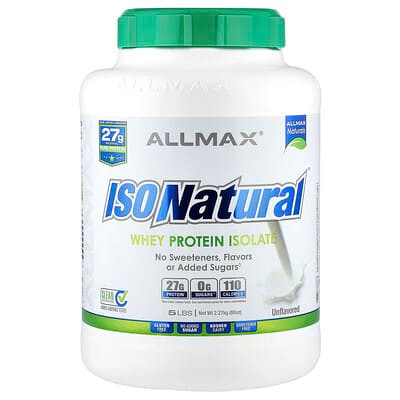
Product Image

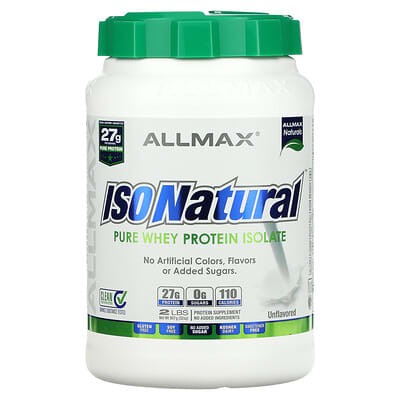
IsoNatural Pure Whey Protein Isolate Unflavored

ALLMAX
4.8
★ ★ ★ ★ ★
(1450 ratings)
Potassium 170 mg
Protein 27 Gram(s)
Product Image
Score81
A concentrated whey serving supports daily protein intake with a generally lean nutrition profile. Potassium reaches only 170 mg and the chemical source is not identified, so direct heart support remains limited.
How scoring works
Quantity:2 lb(s) • (31 servings)
Goals:

Score 81

A concentrated whey serving supports daily protein intake with a generally lean nutrition profile. Potassium reaches only 170 mg and the chemical source is not identified, so direct heart support remains limited.
How scoring works
$59.99($1.93 per serving)
Vitacost
$ 59.99
iHerb
$ 68.46
Report prices

Analysis

The unflavored isolate supplies 27 g of protein with no listed fat or carbohydrate. Its 45 mg sodium amount is low, supporting use in a wide range of protein-focused diets.

Protein can support general nutrition and lean-mass maintenance, but it is not a targeted cardiovascular active. Potassium reaches only 170 mg and the chemical source is not identified, so direct heart support remains limited.

The two-pound package offers thirty-one servings at a relatively high serving cost. A dedicated potassium or heart-health product would be more suitable when cardiovascular support is the main reason for purchase.

Who is it for
  • Adults who need a convenient complete-protein supplement
  • People building meals or shakes around whey protein
  • Users treating potassium as a minor dietary contribution rather than the main benefit
Best for
  • Increasing daily protein intake
  • Supporting muscle maintenance alongside exercise
  • Convenient shakes and mixed meals

Pros

  • Provides 27 g of protein per serving
  • Includes 170 mg of naturally occurring potassium
  • 45 mg of sodium is clearly disclosed
  • Its 45 mg sodium amount is low, supporting use in a wide range of protein-focused diets.

Cons

  • Not formulated around heart-specific active ingredients
  • Potassium source form is not identified
  • Potassium reaches only 170 mg and the chemical source is not identified, so direct heart support remains limited.

Warnings

  • Whey is milk-derived and is not suitable for people with a milk-protein allergy.
  • People with chronic kidney disease may need an individualized protein and potassium limit before using a concentrated whey powder.
  • The naturally occurring potassium should be included in daily totals when using potassium-retaining medicines or following a potassium-restricted diet.

Nutrient quality

90 Highest impact

Whey isolate provides a substantial lean protein serving, while potassium makes only a modest contribution. The main protein amount is meaningful, though potassium remains modest.

Ingredient transparency

79 High impact

Active nutrient amounts are clearly shown on the supplied nutrition panel. The potassium compound and complete non-active ingredient list are not identified.

Customer satisfaction

90 Highest impact

The aggregate rating is strong and is supported by substantial review volume. No specific review comments are supplied, so repeated complaints and purpose alignment cannot be assessed directly.

Value for money

64 Moderate impact

Value is limited for the formula quality and effective serving. The price largely pays for protein rather than meaningful potassium delivery.

Report analysis

Ingredients

IngredientAmount per serving
Calories
110 Calorie(s)
Total Fat
0 Gram(s)
Cholesterol
0 mg
Total Carbohydrates
0 Gram(s)
Protein
27 Gram(s)
Calcium
109 mg
Iron
0 mg
Sodium
45 mg
Potassium
170 mg
Gluten Free Adults 18–50 Kosher
Report overview
Potassium · 170 mg OverallScore39
F Active Ingredient Quality & BioavailabilityC Dose, Safety & Label TransparencyF Value

The potassium appears naturally associated with whey protein, but its chemical form is unknown. The 170 mg serving offers moderate potency and the label gives only one potassium value. A near-median serving cost is relatively high for potassium delivery alone.

Loading alternative details
Report alternatives

Sources

Published studies used for the product analysis and the top-ranked studies for each ingredient and goal.

  1. Oral potassium supplementation for management of essential hypertension: A meta-analysis of randomized controlled trials.
    Poorolajal J; Zeraati F; Soltanian AR; Sheikh V; Hooshmand E; Maleki A · PloS one · 2017
    Meta-analysis1,213 participants23 studies pooledHeart Health forPotassium
  2. Potassium intake, stroke, and cardiovascular disease a meta-analysis of prospective studies.
    D'Elia L; Barba G; Cappuccio FP; Strazzullo P · Journal of the American College of Cardiology · 2011
    Meta-analysis247,510 participants11 studies pooledHeart Health forPotassium
  3. Effect of Potassium Supplementation on Endothelial Function: A Systematic Review and Meta-Analysis of Intervention Studies.
    D'Elia L; Cappuccio FP; Masulli M; La Fata E; Rendina D; Galletti F · Nutrients · 2023
    Meta-analysis332 participants5 studies pooledHeart Health forPotassium
  4. Magnesium and Potassium Supplementation for Systolic Blood Pressure Reduction in the General Normotensive Population: A Systematic Review and Subgroup Meta-Analysis for Optimal Dosage and Treatment Length.
    Behers BJ; Behers BM; Stephenson-Moe CA; Vargas IA; Meng Z; Thompson AJ; Melchor J; Wojtas CN; Rosario MA; Baker JF; Deevers AC; Mouratidis RW; Sweeney MJ · Nutrients · 2024
    Meta-analysisHeart Health forPotassium
  5. Potassium intake and risk of stroke in women with hypertension and nonhypertension in the Women's Health Initiative.
    Seth A; Mossavar-Rahmani Y; Kamensky V; Silver B; Lakshminarayan K; Prentice R; Van Horn L; Wassertheil-Smoller S · Stroke · 2015
    Cohort study90,137 participantsHeart Health forPotassium
  6. Effect of high potassium diet on endothelial function.
    Blanch N; Clifton PM; Petersen KS; Willoughby SR; Keogh JB · Nutrition, metabolism, and cardiovascular diseases : NMCD · 2015
    Randomized trial35 participantsHeart Health forPotassium
  7. Associations between sodium, potassium, and blood pressure: results from the Hispanic Community Health Study/Study of Latinos, a prospective cohort study.
    Swift SL; Sotres-Alvarez D; Raij L; Wassertheil-Smoller S; Schneiderman N; Llabre M; Zeki Al Hazzouri A; Rundek T; Van Horn L; Daviglus M; Castaneda S; Youngblood M; Mossavar-Rahmani Y; Elfassy T · The American journal of clinical nutrition · 2024
    Cohort study11,429 participantsHeart Health forPotassium
  8. Long-Term Potassium Monitoring and Dynamics in Heart Failure and Risk of Mortality.
    Núñez J; Bayés-Genís A; Zannad F; Rossignol P; Núñez E; Bodí V; Miñana G; Santas E; Chorro FJ; Mollar A; Carratalá A; Navarro J; Górriz JL; Lupón J; Husser O; Metra M; Sanchis J · Circulation · 2019
    Cohort study2,164 participantsHeart Health forPotassium
  9. Serum potassium levels provide prognostic information in symptomatic heart failure beyond traditional clinical variables.
    Toledo CC; Vellosa Schwartzmann P; Miguel Silva L; da Silva Ferreira G; Bianchini Cardoso F; Citelli Ribeiro V; Paim LR; Antunes-Correa LM; Carvalho Sposito A; Matos Souza JR; Modolo R; Nadruz W; Fernandes de Carvalho LS; Coelho-Filho OR · ESC heart failure · 2021
    Cohort study178 participantsHeart Health forPotassium
  10. Finerenone, Serum Potassium, and Clinical Outcomes in Heart Failure With Mildly Reduced or Preserved Ejection Fraction.
    Vardeny O; Vaduganathan M; Claggett BL; Desai AS; Jhund PS; Lam CSP; Senni M; Shah SJ; Voors AA; Zannad F; Pitt B; Matsumoto S; Merkely B; Zieroth S; Yilmaz MB; Lay-Flurrie J; Viswanathan P; Horvat-Broecker A; Scalise A; McMurray JJV; Solomon SD · JAMA cardiology · 2025
    Randomized trial6,001 participantsHeart Health forPotassium