
Nutrient quality
Bromelain has a meaningful weight, but enzyme activity and several blend components are undisclosed. Trace botanicals and unquantified probiotics weaken dose confidence despite a coherent digestive purpose.
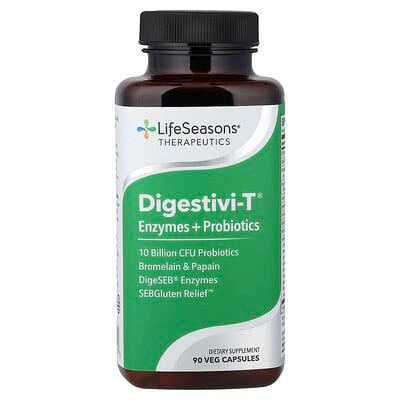
 iHerb iHerb | $ 39.99 |
The gluten-relief and digestive-enzyme blends carry most of the serving, with bromelain adding a separately stated proteolytic enzyme. Chamomile, fennel, beet, ginger, and nettle are small supporting ingredients rather than meaningful standalone doses.
Digestive support is the clearest purpose even though the stated goals emphasize anti-inflammatory and testosterone support. The probiotic strains are named, but zero or unavailable potency entries prevent any useful assessment of viable counts.
Blend totals and several ingredient weights are disclosed, yet enzyme activity units, probiotic counts, complete blend composition, and meal timing are absent. A premium serving cost is difficult to defend with these central gaps.
Bromelain has a meaningful weight, but enzyme activity and several blend components are undisclosed. Trace botanicals and unquantified probiotics weaken dose confidence despite a coherent digestive purpose.
Several named actives have amounts, but blends hide important component doses or activity. Complete use directions and a full other-ingredients list are not included in the supplied facts.
The supplied average rating is strong, and the small review sample limits confidence. No detailed comments are provided to assess repeated complaints or whether experiences match the intended use.
Weak dose efficiency, safety concerns, or a high recurring cost limit practical value. Hidden blend components make it difficult to see how much of the cost supports meaningful ingredients.

Bromelain, ginger, and nettle provide several situational pathways relevant to digestive or acute inflammatory discomfort. Bromelain is present at 150 mg, while ginger and nettle appear in much smaller amounts.
The digestive-enzyme context is coherent, but missing bromelain activity units and botanical standardization make practical potency uncertain. The formula is better suited to digestive support than broad systemic inflammatory balance.
| Ingredient | Amount per serving |
|---|---|
SEB Gluten Relief | 600 mg |
DigeSEB Enzyme Blend | 150 mg |
Bromelain (Ananas comosus) | 150 mg |
Papain (Carica papaya) | 0 NP |
Chamomile | 60 mg |
Beet | 45 mg |
Fennel | 45 mg |
Ginger | 45 mg |
Nettle | 45 mg |
Bifidobacterium lactis Bl-04 | 0 NP |
Lactobacillus acidophilus La-14 | 0 NP |
Lactobacillus paracasei Lpc-37 | 0 NP |
Lactobacillus plantarum Lp-115 | 0 NP |
Lactobacillus casei Lc-11 | 0 NP |
Lactobacillus rhamnosus Lr-32 | 0 NP |
Lactobacillus salivarius Ls-33 | 0 NP |
Saccharomyces boulardii 0-B03i | 0 NP |
Lactobacillus bulgaricus Lb-87 | 0 NP |
The digestive formula provides a meaningful bromelain amount in an appropriate capsule format. It identifies Ananas comosus, but omits the pineapple part and enzyme activity. Generic daily directions do not explain meal timing, and bromelain-specific cost efficiency is weak.
Generic ginger is a small part of a broad digestive formula without form or potency details. Its low amount falls short of the preferred daily range. Premium serving cost makes it inefficient for targeted ginger support.
Nettle appears as a very small supporting ingredient in a digestive blend. Missing plant-part and form information prevent a meaningful quality or potency assessment. The high serving cost cannot be justified by the nettle contribution.
Published studies used for the product analysis and the top-ranked studies for each ingredient and goal.