
Nutrient quality
Curcumin and Boswellia provide a relevant anti-inflammatory foundation. Weak supporting doses and missing potency details reduce balance.
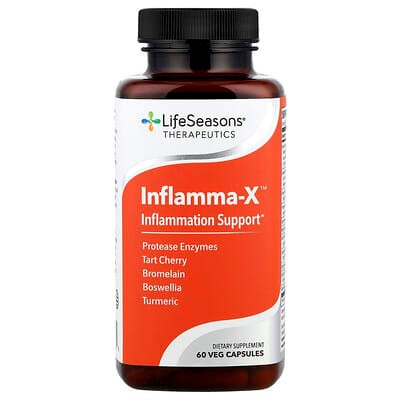
Turmeric and Boswellia provide a sensible core, but most additions are lightly dosed or poorly standardized. Multiple clotting-relevant ingredients also complicate safe use.
Turmeric and Boswellia provide a sensible core, but most additions are lightly dosed or poorly standardized. Multiple clotting-relevant ingredients also complicate safe use.
 iHerb iHerb | $ 38.99 | |
 Amazon Amazon | $ 38.99 |
Turmeric extract at 500 mg and Boswellia at 150 mg lead the formula. Bromelain, quercetin, nettle, tart cherry, ginger, hops, skullcap, and white willow add breadth mostly at small amounts.
The label names curcuminoids, boswellic acids, and gingerols but does not quantify their percentages or active yields. Bromelain and acid protease also lack usable activity units.
Two capsules are convenient, but the formula spreads attention across many secondary ingredients. It aligns with inflammation support and fits testosterone support poorly despite that listed goal.
Curcumin and Boswellia provide a relevant anti-inflammatory foundation. Weak supporting doses and missing potency details reduce balance.
Nearly every ingredient has an individual amount. Unusable enzyme data, missing active yields, directions, and inactive ingredients limit clarity.
The aggregate rating is mixed and the evidence base is large. Specific experience details are unavailable, so complaint patterns and purpose fit remain uncertain.
A substantial curcumin amount provides some formula value. High cost and shallow supporting doses make competitiveness weak.

Curcumin and boswellia directly target important inflammatory pathways, with bromelain, quercetin, tart cherry, ginger, and willow adding breadth. Curcumin has a substantial amount, while most supporting ingredients are below stronger stand-alone targets.
Marker classes are named for several extracts, but active percentages, bromelain activity units, and an absorption system are missing. White willow, bromelain, turmeric, and ginger may increase bleeding risk with anticoagulant or antiplatelet medicines.
| Ingredient | Amount per serving |
|---|---|
Acid Protease (Aspergillus oryzae) | 0 NP |
Turmeric rhizome extract (Total Curcuminoids) | 500 mg |
Boswellia leaf extract (Boswellic Acids) | 150 mg |
Bromelain (Ananas comosus) | 50 mg |
Quercetin (Fava d'anta) | 50 mg |
Nettle leaf extract | 25 mg |
Tart Cherry | 25 mg |
Ginger root extract (Gingerols) | 20 mg |
Hops | 20 mg |
Skullcap root extract | 20 mg |
White Willow | 20 mg |
Leaf extract fits the inflammation-focused use, though no concentration ratio or active marker is stated. The 25 mg amount is too small for targeted support despite clear weight disclosure. The high serving cost makes value poor for the disclosed nettle contribution.
Gingerols are named as an active marker, but neither their percentage nor exact active amount is disclosed. The 20 mg ginger amount is very low for meaningful daily support. The ginger ingredient is listed outside a proprietary blend with a clear 20 mg amount. Missing species, extraction-method, and additive details limit confidence in botanical quality. The low ginger amount is priced at a premium without enough potency to justify it.
The 150 mg leaf extract names boswellic acids but does not state their concentration or identify AKBA. Its dose falls between a clearly negligible amount and the usual standard-extract range, while the plain capsule offers no absorption aid. A high serving cost and incomplete marker disclosure make it a weak Boswellia-focused value.
Published studies used for the product analysis and the top-ranked studies for each ingredient and goal.