Product Image

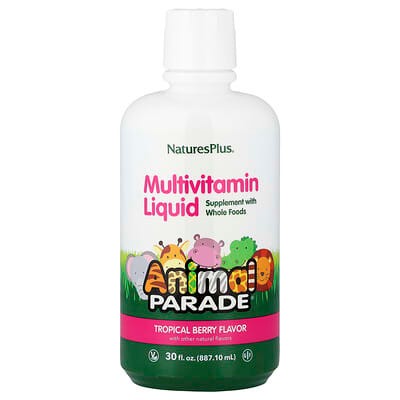
Liquid Children's Multi-Vitamin Natural Tropical Berry Flavor

Natures Plus Source of Life Animal Parade
4.8
★ ★ ★ ★ ★
(10805 ratings)
Vitamin A 5000 IU
Vitamin E 30 IU
Iron 2.5 mg
Vitamin D 400 IU
Product Image
Score72
A child-friendly liquid with several good vitamin forms, balanced by shallow mineral support and the need to track total vitamin A and iron intake.
How scoring works
Quantity:30 Fluid Ounce(s) • (60 servings)
Goals:
Vision Support
Skin Health

Score 72

A child-friendly liquid with several good vitamin forms, balanced by shallow mineral support and the need to track total vitamin A and iron intake.
How scoring works
$25.46($0.42 per serving)
Vitacost
$ 28.03
iHerb
$ 25.46
Vitacost
$ 28.03
Report prices

Analysis

The liquid format may suit children who cannot chew tablets, and the formula supplies broad vitamin coverage. Vitamin D3, natural vitamin E, methylfolate, methylcobalamin, citrate minerals, and iron gluconate are clearly identified.

Calcium, magnesium, zinc, choline, and inositol are modest, so the product is not a substitute for focused mineral support. The vitamin A listing combines beta-carotene and retinyl palmitate, making total intake from other products important.

Measured liquid dosing offers flexibility but also requires careful use of the supplied serving device. The formula contains iron and therefore needs secure storage despite its child-friendly flavor.

Who is it for
  • Children who prefer liquid supplements
  • Families wanting flexible measured dosing
Best for
  • Broad daily vitamin coverage
  • Children unable to use tablets
  • Active folate and vitamin B12 forms

Pros

  • Liquid format
  • Uses vitamin D3 and natural vitamin E
  • Includes methylfolate and methylcobalamin
  • Several mineral forms are identified

Cons

  • Calcium and magnesium are low
  • Choline and inositol are token additions
  • Total vitamin A requires careful interpretation
  • More expensive than basic children's tablets

Warnings

  • Track total preformed vitamin A when combining with fortified foods or other supplements.
  • Iron can be dangerous in accidental excess, so keep the bottle securely out of children's reach.
  • Measure each serving carefully rather than estimating the liquid amount.

Nutrient quality

71 High impact

Several favorable vitamin and mineral forms provide good maintenance coverage. Ambiguous duplicate vitamin A entries and lightly dosed supporting nutrients limit confidence in age-specific balance.
Ingredient transparency

76 High impact

Most active forms and amounts are stated without a proprietary blend. Duplicate vitamin A entries, complete age-specific directions, and non-active liquid ingredients remain unclear.

Customer satisfaction

74 High impact

The supplied satisfaction metric is strong and response volume is very large. Specific firsthand feedback was not supplied, so recurring complaints and purpose alignment remain uncertain.

Value for money

68 High impact

Good forms and liquid convenience support fair value, but the serving cost is above basic chewables. The product is reasonably competitive, although simpler alternatives may offer better value.

Report analysis

Goals

Vision Support
Impact
High effect
B- Goal FitB- Strength of SupportC CoverageC- Formula Quality
Zinc · 3 mgVitamin E · 30 IUCopper · 0.05 mgVitamin A · 5000 IU

Vitamin A supports visual-pigment formation, while vitamin E and other nutrients add antioxidant coverage. The children's multivitamin lacks lutein, zeaxanthin, and omega-3s, so its eye support remains foundational rather than targeted.

Beta-carotene and preformed vitamin A are clearly split, but the combined amount is high and includes a substantial palmitate portion. Avoid stacking it with other preformed vitamin A products because excess intake can accumulate, especially in a child-focused formula.

Study evidence
Vitamin A Supportive 65 studies
Vitamin E Disputed 35 studies
Skin Health
Impact
Moderate effect
C Goal FitC+ Strength of SupportC CoverageC Formula Quality
Zinc · 3 mgCopper · 0.05 mgVitamin E · 30 IU

Vitamins A, C, and E plus zinc offer general antioxidant and tissue-support roles for skin. The vitamins and zinc have established skin biology, but the multivitamin lacks direct skin-outcome evidence.

The antioxidant vitamins and zinc provide maintenance amounts rather than targeted skin-active doses. Preformed vitamin A from other sources should be considered before combining products.

Study evidence
Vitamin A Supportive 106 studies
Vitamin E Supportive 38 studies
Zinc Supportive 66 studies

Ingredients

IngredientAmount per serving
Calories
15 Calorie(s)
Total Carbohydrates
5 Gram(s)
Vitamin A (Beta-Carotene, Vitamin A Palmitate)
5000 IU
Vitamin D3 (Cholecalciferol)
400 IU
Vitamin E (D-Alpha-Tocopheryl Acetate)
30 IU
Thiamine (Thiamine Hydrochloride, Vitamin B1)
1.4 mg
Riboflavin (Vitamin B2)
1.7 mg
Niacin (Niacinamide)
20 mg
Vitamin B6 (Pyridoxine Hydrochloride)
2 mg
Folate (Calcium L-5-Methyltetrahydrofolate)
10 mcg
Vitamin B12 (Methylcobalamin)
6 mcg
Biotin
50 mcg
Pantothenic Acid (Calcium Pantothenate)
4 mg
Calcium (Calcium Citrate)
20 mg
Iron (Iron Gluconate)
2.5 mg
Iodine (Potassium Iodide)
100 mcg
Magnesium (Magnesium Citrate Complex)
10 mg
Zinc (Zinc Gluconate)
3 mg
Copper (Copper Aminoate Complex)
0.05 mg
Manganese (Manganese Gluconate)
0.05 mg
Potassium (Potassium Iodide)
1 mg
Choline (Choline Bitartrate)
10 mcg
Inositol
10 mcg
Gluten Free Children 4+ Children 1–4 Vegetarian
Report overview
C- Active Ingredient Quality & BioavailabilityB+ Dose, Safety & Label TransparencyB+ Value

The blend combines beta-carotene with preformed vitamin A and clearly states equal amounts of each. The total supply reaches the upper end of the acceptable range, while the liquid lacks a stated lipid carrier for absorption. Its concentrated dose and added nutrients provide reasonable value, but the palmitate portion deserves attention when combining it with other preformed vitamin A sources.

D Active Ingredient Quality & BioavailabilityB- Dose, Safety & Label TransparencyA+ Value

The natural vitamin E form and child-focused maintenance amount suit a daily liquid multivitamin. The formula lacks mixed tocopherols and tocotrienols, limiting vitamin E diversity. Its serving cost remains favorable for the natural form provided.

D Active Ingredient Quality & BioavailabilityB Dose, Safety & Label TransparencyD+ Value

Liquid delivery supports easy titration, while iron gluconate provides a standard rather than premium source. The 2.5 mg serving is very low for focused iron support. Folate and vitamin B12 are present, but no qualifying vitamin C is listed and zinc may compete with iron.

Loading alternative details
Report alternatives

Sources

Published studies used for the product analysis and the top-ranked studies for each ingredient and goal.

  1. Efficacy and Tolerability of Topical 0.1% Stabilized Bioactive Retinol for Photoaging: A Vehicle-Controlled Integrated Analysis.
    Farris P; Berson D; Bhatia N; Goldberg D; Lain E; Mariwalla K; Zeichner J; Miller D; McGuire T; Kizoulis M · Journal of drugs in dermatology : JDD · 2024
    Meta-analysis471 participants6 studies pooledSkin Health forVitamin A
  2. Tensile properties and contours of aging facial skin. A controlled double-blind comparative study of the effects of retinol, melibiose-lactose and their association.
    Piérard-Franchimont C; Castelli D; Cromphaut IV; Bertin C; Ries G; Cauwenbergh G; Piérard GE · Skin research and technology : official journal of International Society for Bioengineering and the Skin (ISBS) [and] International Society for Digital Imaging of Skin (ISDIS) [and] International Society for Skin Imaging (ISSI) · 2016
    Randomized trial120 participantsSkin Health forVitamin A
  3. Antiaging action of retinol: from molecular to clinical.
    Bellemère G; Stamatas GN; Bruère V; Bertin C; Issachar N; Oddos T · Skin pharmacology and physiology · 2009
    Randomized trial48 participantsSkin Health forVitamin A
  4. An Updated Review of Topical Tretinoin in Dermatology: From Acne and Photoaging to Skin Cancer.
    Balado-Simó P; Morgado-Carrasco D; Gómez-Armayones S; López-Ferrer A; Barco D; Ferrándiz-Pulido C; Podlipnik S · Journal of clinical medicine · 2025
    Narrative reviewSkin Health forVitamin A
  5. Novel Cyclized Hexapeptide-9 Outperforms Retinol Against Skin Aging: A Randomized, Double-Blinded, Active- and Vehicle-Controlled Clinical Trial.
    Chang H; Tao K; Yang Y; Wang Y; Ge M; Wang X; Tang S; Yu H · Journal of cosmetic dermatology · 2025
    Randomized trialSkin Health forVitamin A
  6. Randomized controlled trial using vitamins E and D supplementation in atopic dermatitis.
    Javanbakht MH; Keshavarz SA; Djalali M; Siassi F; Eshraghian MR; Firooz A; Seirafi H; Ehsani AH; Chamari M; Mirshafiey A · The Journal of dermatological treatment · 2011
    Randomized trial45 participantsSkin Health forVitamin E
  7. Serum vitamin E levels and chronic inflammatory skin diseases: A systematic review and meta-analysis.
    Liu X; Yang G; Luo M; Lan Q; Shi X; Deng H; Wang N; Xu X; Zhang C · PloS one · 2022
    Meta-analysis20 studies pooledSkin Health forVitamin E
  8. Evidence-Based Nutritional Interventions in Wound Care.
    Saeg F; Orazi R; Bowers GM; Janis JE · Plastic and reconstructive surgery · 2021
    Systematic review2,339 participants36 studies pooledSkin Health forVitamin E Skin Health forZinc
  9. Effects of tocotrienol on aging skin: A systematic review.
    Ghazali NI; Mohd Rais RZ; Makpol S; Chin KY; Yap WN; Goon JA · Frontiers in pharmacology · 2022
    Systematic reviewSkin Health forVitamin E
  10. Carotenoids and carotenoids plus vitamin E protect against ultraviolet light-induced erythema in humans.
    Stahl W; Heinrich U; Jungmann H; Sies H; Tronnier H · The American journal of clinical nutrition · 2000
    Randomized trialSkin Health forVitamin E
  11. Sex-related differences in response to zinc pyrithione shampoo vs. non-anti-dandruff shampoo.
    Collins LZ; Baines FL; Matheson JR; Turner GA; Diao Y; Li Y; Pi Y · International journal of cosmetic science · 2019
    Meta-analysis2,088 participants20 studies pooledSkin Health forZinc
  12. Maintenance of an Acidic Skin Surface with a Novel Zinc Lactobionate Emollient Preparation Improves Skin Barrier Function in Patients with Atopic Dermatitis.
    Andrew PV; Pinnock A; Poyner A; Brown K; Chittock J; Kay LJ; Cork MJ; Danby SG · Dermatology and therapy · 2024
    Cohort study23 participantsSkin Health forZinc
  13. Spatial expression of metallothionein, matrix metalloproteinase-1 and Ki-67 in human epidermal wounds treated with zinc and determined by quantitative immunohistochemistry: A randomised double-blind trial.
    Ågren MS; Chafranska L; Eriksen JO; Forman JL; Bjerrum MJ; Schjerling P; Larsen HF; Cottarelli E; Jorgensen LN; Gjerdrum LMR · European journal of cell biology · 2021
    Randomized trial30 participantsSkin Health forZinc
  14. A pilot trial using topical regular crystalline insulin vs. aqueous zinc solution for uncomplicated cutaneous wound healing: Impact on quality of life.
    Attia EA; Belal DM; El Samahy MH; El Hamamsy MH · Wound repair and regeneration : official publication of the Wound Healing Society [and] the European Tissue Repair Society · 2014
    Randomized trial90 participantsSkin Health forZinc
  15. A randomized trial of vitamin A and vitamin E supplementation for retinitis pigmentosa.
    Berson EL; Rosner B; Sandberg MA; Hayes KC; Nicholson BW; Weigel-DiFranco C; Willett W · Archives of ophthalmology (Chicago, Ill. : 1960) · 1993
    Randomized trial601 participantsVision Support forVitamin A
  16. Efficacy and safety of retinol palmitate ophthalmic solution in the treatment of dry eye: a Japanese Phase II clinical trial.
    Toshida H; Funaki T; Ono K; Tabuchi N; Watanabe S; Seki T; Otake H; Kato T; Ebihara N; Murakami A · Drug design, development and therapy · 2018
    Randomized trial66 participantsVision Support forVitamin A
  17. Vitamin A supplementation for preventing morbidity and mortality in children from six months to five years of age.
    Imdad A; Mayo-Wilson E; Haykal MR; Regan A; Sidhu J; Smith A; Bhutta ZA · The Cochrane database of systematic reviews · 2022
    Meta-analysis1,223,856 participants47 studies pooledVision Support forVitamin A
  18. Vitamin A supplementation improves retinal function in infants at risk of retinopathy of prematurity.
    Mactier H; McCulloch DL; Hamilton R; Galloway P; Bradnam MS; Young D; Lavy T; Farrell L; Weaver LT · The Journal of pediatrics · 2012
    Randomized trial89 participantsVision Support forVitamin A
  19. Effect of short-term, high-dose retinol on dark adaptation in aging and early age-related maculopathy.
    Owsley C; McGwin G; Jackson GR; Heimburger DC; Piyathilake CJ; Klein R; White MF; Kallies K · Investigative ophthalmology & visual science · 2006
    Randomized trial104 participantsVision Support forVitamin A
  20. Antioxidant vitamin and mineral supplements for preventing age-related macular degeneration.
    Evans JR; Lawrenson JG · The Cochrane database of systematic reviews · 2018
    Meta-analysis55,614 participants4 studies pooledVision Support forVitamin E
  21. Dietary n-3 Fatty Acid, α-Tocopherol, Zinc, vitamin D, vitamin C, and β-carotene are Associated with Age-Related Macular Degeneration in Japan.
    Aoki A; Inoue M; Nguyen E; Obata R; Kadonosono K; Shinkai S; Hashimoto H; Sasaki S; Yanagi Y · Scientific reports · 2017
    Case-control study530 participantsVision Support forVitamin E
  22. Dietary carotenoids, vitamins C and E, and risk of cataract in women: a prospective study.
    Christen WG; Liu S; Glynn RJ; Gaziano JM; Buring JE · Archives of ophthalmology (Chicago, Ill. : 1960) · 2008
    Cohort study35,551 participantsVision Support forVitamin E
  23. Long-term nutrient intake and 5-year change in nuclear lens opacities.
    Jacques PF; Taylor A; Moeller S; Hankinson SE; Rogers G; Tung W; Ludovico J; Willett WC; Chylack LT · Archives of ophthalmology (Chicago, Ill. : 1960) · 2005
    Cohort study408 participantsVision Support forVitamin E
  24. Dietary intake of antioxidants and risk of age-related macular degeneration.
    van Leeuwen R; Boekhoorn S; Vingerling JR; Witteman JC; Klaver CC; Hofman A; de Jong PT · JAMA · 2005
    Cohort study4,765 participantsVision Support forVitamin E