Product Image

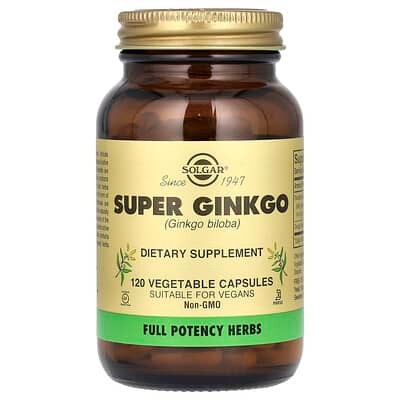
Super Ginkgo

Solgar
4.7
★ ★ ★ ★ ★
(1420 ratings)
Ginkgo
Product Image
Score75
A modest standardized ginkgo extract backed by whole-leaf powder. It is convenient for maintenance but under-specified for targeted vision support.
How scoring works
Quantity:120 Capsule(s) • (120 servings)
Goals:
Vision Support

Score 75

A modest standardized ginkgo extract backed by whole-leaf powder. It is convenient for maintenance but under-specified for targeted vision support.
How scoring works
$15.00($0.12 per serving)
Daily Vita
$ 28.04
Vitacost
$ 25.55
Pure Formulas
$ 25.49
iHerb
$ 23.94
Amazon
$ 23.77
Daily Vita
$ 15.00
Report prices

Analysis

The formula combines 60 mg of standardized extract with 30 mg of whole-leaf powder. Naming flavonol glycosides provides some quality context, but terpene-lactone content and marker percentages remain unknown.

Ginkgo has a plausible role in supporting small-vessel circulation, including circulation relevant to the eye. Evidence for broader vision outcomes is less direct than for established carotenoids and antioxidant combinations.

The one-capsule serving works for someone who wants a gentle daily ginkgo product. It is less suitable for users seeking a clinical-range standardized extract or complete eye support.

Who is it for
  • Adults seeking low-dose ginkgo maintenance
  • People who prefer extract plus whole herb
  • Users interested in circulation support
Best for
  • Simple daily ginkgo use
  • Mild maintenance routines
  • Capsule users who want a compact formula

Pros

  • Explicitly identifies a standardized extract
  • Separates extract and leaf-powder amounts
  • Convenient single-capsule serving

Cons

  • Standardized extract amount is modest
  • Terpene-lactone information is absent
  • No direct macular or retinal nutrients

Warnings

  • Ginkgo may increase bleeding risk with anticoagulant or antiplatelet medicines.
  • Headache, dizziness, or digestive discomfort can occur with ginkgo.
  • Use near surgery should be coordinated with the surgical team because of possible bleeding effects.

Nutrient quality

73 High impact

The key ginkgo marker groups are named, but their percentages and a purity limit are not fully disclosed. The formula supplies a maintenance-level extract amount, with no obvious overdosing.

.
Ingredient transparency

79 High impact

The main active amounts are clearly listed, and no proprietary blend hides them. Intake directions, non-active ingredients, and some extract-quality details are absent from the supplied data.

.

Customer satisfaction

69 High impact

The supplied average is very strong and the response volume is substantial. No detailed feedback is provided to assess recurring complaints or fit with the intended purpose.

.

Value for money

76 High impact

The serving cost is appealing, but incomplete extract verification limits confidence in value. A fully standardized extract would provide a more dependable comparison.

.

Report analysis

Goals

Vision Support
Impact
Moderate effect
D Goal FitD+ Strength of SupportF CoverageC+ Formula Quality

Ginkgo may support ocular microcirculation, making it situationally relevant rather than broadly protective. Human ocular evidence is limited compared with lutein, zeaxanthin, and validated nutrient combinations.

The standardized extract amount is below the usual daily range, and leaf powder cannot fully compensate. Extract and powder amounts are separate, but active-marker percentages and terpene-lactone details are absent.

Study evidence
Ginkgo Supportive 11 studies

Ingredients

IngredientAmount per serving
standardized Ginkgo biloba extract (Ginkgo Flavonol Glycosides)
60 mg
Ginkgo biloba powder
30 mg
Gluten Free Adults 18–50 Vegan Kosher Dairy Free Sugar Free Vegetarian
Report overview
F Active Ingredient Quality & BioavailabilityB+ Dose, Safety & Label TransparencyA+ Value

The formula provides 60 mg of an explicitly standardized extract plus 30 mg of leaf powder. Only the flavonol glycoside marker is named, with no percentage or terpene lactone detail, so active quality remains partly unclear. Its transparent dose and low cost support value, but the standardized portion is below the usual daily range.

Loading alternative details
Report alternatives

Sources

Published studies used for the product analysis and the top-ranked studies for each ingredient and goal.

  1. Effect of Ginkgo biloba extracts in the prevention of posterior capsule opacification after cataract surgery: A randomized clinical trial.
    Amiri AA; Jafari R; Amiri AA; Rad HA; Daneshvar F; Charati JY; Amiri AA · Oman journal of ophthalmology · 2025
    Randomized trial144 participantsVision Support forGinkgo
  2. Electrophysiological analysis of the effects of ginkgo biloba on visual processing in older healthy adults.
    Page JW; Findley J; Crognale MA · The journals of gerontology. Series A, Biological sciences and medical sciences · 2006
    Clinical trialVision Support forGinkgo
  3. Ginkgo biloba--an appraisal.
    Dubey AK; Shankar PR; Upadhyaya D; Deshpande VY · Kathmandu University medical journal (KUMJ) · 2007
    Narrative reviewVision Support forGinkgo
  4. [Ginkgo extract in impaired vision--treatment with special extract EGb 761 of impaired vision due to dry senile macular degeneration].
    Fies P; Dienel A · Wiener medizinische Wochenschrift (1946) · 2002
    Randomized trial99 participantsVision Support forGinkgo
  5. Effect of Ginkgo biloba extract on preexisting visual field damage in normal tension glaucoma.
    Quaranta L; Bettelli S; Uva MG; Semeraro F; Turano R; Gandolfo E · Ophthalmology · 2003
    Randomized trial27 participantsVision Support forGinkgo
  6. Short-term effects of Ginkgo biloba extract on peripapillary retinal blood flow in normal tension glaucoma.
    Park JW; Kwon HJ; Chung WS; Kim CY; Seong GJ · Korean journal of ophthalmology : KJO · 2012
    Randomized trial30 participantsVision Support forGinkgo
  7. [The course of color vision in early diabetic retinopathy treated with Ginkgo biloba extract. A preliminary double-blind versus placebo study].
    Lanthony P; Cosson JP · Journal francais d'ophtalmologie · 1989
    Randomized trial29 participantsVision Support forGinkgo