Product Image

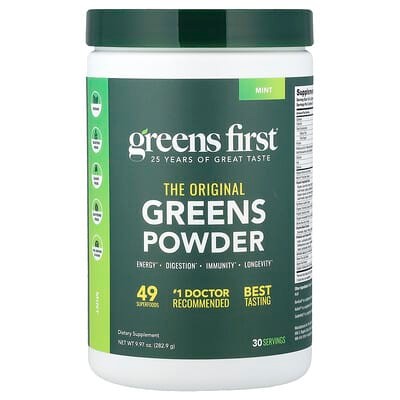
Greens First

Ceautamed Worldwide
4.6
★ ★ ★ ★ ★
(2625 ratings)
Aloe 50 mg
Milk Thistle 75 mg
Green Tea 100 mg
Kelp 15 mg
Protein (unspecified) 1 Gram(s)
Product Image
Score41
Broad digestive coverage is appealing, but hidden blend amounts and missing probiotic, enzyme, and botanical potency details sharply reduce confidence.
How scoring works
Quantity:9 Liquid(s) • (30 servings)
Goals:
Digestive Health

Score 41

Broad digestive coverage is appealing, but hidden blend amounts and missing probiotic, enzyme, and botanical potency details sharply reduce confidence.
How scoring works
$46.99($1.56 per serving)
iHerb
$ 54.99
Amazon
$ 53.99
Vitacost
$ 54.99
Vitacost
$ 46.99
iHerb
$ 54.99
Report prices

Analysis

Fiber, digestive enzymes, probiotics, and aloe address several parts of digestive support in one mixable powder. Green and vegetable blends add dietary variety, while the disclosed lecithin may help the powder disperse.

Most major blends do not show their individual ingredients or amounts. Probiotic strains and viable counts are absent, enzyme activity is not stated, and the aloe label does not confirm inner-leaf material or aloin removal.

Green tea and milk thistle extracts are individually listed but lack active-marker yields needed to judge potency. The product fits someone who values broad ingredient coverage, though its recurring cost is hard to justify from the verifiable doses.

Who is it for
  • Adults who want a broad greens-and-digestion powder
  • People who prefer a mixable product over capsules
Best for
  • Combining fiber, enzymes, and probiotic ingredients
  • Adding a broad greens blend to a daily routine

Pros

  • Covers fiber, enzyme, probiotic, and aloe pathways
  • Lists separate amounts for several botanicals
  • Uses standardized forms for quercetin and turmeric
  • Low sodium and no listed cholesterol

Cons

  • Proprietary blends hide important ingredient amounts
  • Probiotic strains and viable counts are not provided
  • Enzyme activity units are missing
  • Green tea and milk thistle active yields are unclear
  • Value is weak for the disclosed potency

Warnings

  • Aloe leaf powder without aloin-removal details may cause cramping or loose stools in sensitive users
  • Licorice can raise blood pressure or lower potassium, especially with potassium-depleting diuretics
  • Green tea extract has no caffeine declaration, which matters for caffeine-sensitive users
  • Soy lecithin makes the product unsuitable for some people with soy allergy

Nutrient quality

45 Lower impact

Several ingredient classes cover relevant digestive pathways. Hidden composition and uncertain active strength make practical nutrient quality weak.
Ingredient transparency

34 Situational impact

A few individual botanical amounts are visible. Multiple hidden blends, incomplete usage guidance, and missing inactive ingredients sharply reduce transparency.

Customer satisfaction

70 High impact

The aggregate rating is strong and supported by a large evidence base. Specific experience details are unavailable, so complaint patterns and purpose fit remain uncertain.

Value for money

19 Limited impact

Broad pathway coverage provides limited theoretical value. High cost, hidden doses, and extensive padding make competitiveness poor.

Report analysis

Goals

Digestive Health
Impact
Moderate effect
B- Goal FitF Strength of SupportB- CoverageF Formula Quality

Fiber, digestive enzymes, probiotics, and aloe give the powder unusually broad digestive coverage. The mixable serving also provides food and greens components.

Most blends hide individual ingredients, enzyme activities, probiotic strains, and viable counts, while the aloe amount is small and lacks aloin-removal details. The kitchen-sink design creates impressive breadth but weak and uncertain depth across most gut pathways.

Study evidence
Aloe Supportive 7 studies

Ingredients

IngredientAmount per serving
Calories
40 Calorie(s)
Total Fat
1 Gram(s)
Cholesterol
0 Gram(s)
Sodium
15 mg
Total Carbohydrates
6 Gram(s)
Protein
1 Gram(s)
Greens Blend-Proprietary
2500 mg
Vegetable Blend-Proprietary
1500 mg
OxiSure Blend-Proprietary
0 mg
Fiber Blend-Proprietary
1950 mg
Lecithin (Non GMO Soy)
1800 mg
Enzyme Blend
200 mg
Probiotics
200 mg
sprouted Barley
200 mg
ResveraMax Blend-Proprietary
100 mg
Green Tea extract (Polyphenols)
100 mg
Quercetin (Quercetin Dihydrate)
100 mg
Milk Thistle seed extract (Silymarin)
75 mg
Red Beet
50 mg
Cinnamon powder
50 mg
Aloe leaf powder
50 mg
Turmeric rhizome extract (Curcuminoids)
20 mg
Atlantic Kelp powder
15 mg
Licorice root extract
5 mg
Adults 18–50 Dairy Free
Report overview
Aloe · 50 mg OverallScore47
F Active Ingredient Quality & BioavailabilityC+ Dose, Safety & Label TransparencyD- Value
The mixable format suits direct digestive contact, and the aloe leaf powder has its own disclosed weight rather than being hidden in a blend. The label does not specify inner-leaf material, purification, aloin removal, or active standardization, leaving quality and soothing potential uncertain. Its moderate raw-powder dose and relatively high cost make it a weak aloe-focused value within this broad greens formula.
D- Active Ingredient Quality & BioavailabilityF Dose, Safety & Label TransparencyF Value

The seed source is appropriate, but no silymarin percentage or active yield is provided. Lecithin and a mixed liquid serving may help dispersal, though no phytosome is identified. Its high per-serving cost is not justified by verifiable milk thistle potency.

F Active Ingredient Quality & BioavailabilityF Dose, Safety & Label TransparencyF Value

The extract names polyphenols but gives no standardization percentage or EGCG yield. Green tea is one small part of a large blend-heavy powder, with no stated absorption support or caffeine information. The missing active amount makes its green tea value impossible to verify.

Loading alternative details
Report alternatives

Sources

Published studies used for the product analysis and the top-ranked studies for each ingredient and goal.

  1. A Pilot Study of the Effect of Aloe barbadensis Mill. Extract (AVH200®) in Patients with Irritable Bowel Syndrome: a Randomized, Double-Blind, Placebo-Controlled Study.
    Størsrud S; Pontén I; Simrén M · Journal of gastrointestinal and liver diseases : JGLD · 2016
    Randomized trial68 participantsDigestive Health forAloe
  2. A Randomised, Cross-Over, Placebo-Controlled Study of Aloe vera in Patients with Irritable Bowel Syndrome: Effects on Patient Quality of Life.
    Hutchings HA; Wareham K; Baxter JN; Atherton P; Kingham JG; Duane P; Thomas L; Thomas M; Ch'ng CL; Williams JG · ISRN gastroenterology · 2011
    Randomized trial110 participantsDigestive Health forAloe
  3. Prevention of acute radiation-induced Proctitis by Aloe vera: a prospective randomized, double-blind, placebo controlled clinical trial in Pelvic Cancer patients.
    Sahebnasagh A; Ghasemi A; Akbari J; Alipour A; Lashkardoost H; Ala S; Hosseinimehr SJ; Salehifar E · BMC complementary medicine and therapies · 2020
    Randomized trial42 participantsDigestive Health forAloe
  4. Successful Treatment of Acute Radiation Proctitis with Aloe Vera: A Preliminary Randomized Controlled Clinical Trial.
    Sahebnasagh A; Ghasemi A; Akbari J; Alipour A; Lashkardoost H; Ala S; Salehifar E · Journal of alternative and complementary medicine (New York, N.Y.) · 2017
    Randomized trial20 participantsDigestive Health forAloe
  5. Aloe vera for Prevention of Acute Radiation Proctitis in Colorectal Cancer a Preliminary Randomized, Placebo-Controlled Clinical Trial.
    Sahebnasagh A; Saghafi F; Ghasemi A; Akbari J; Alipour A; Habtemariam S; Safdari M; Ghaleno HR; Salehifar E · Journal of gastrointestinal cancer · 2022
    Randomized trial20 participantsDigestive Health forAloe