
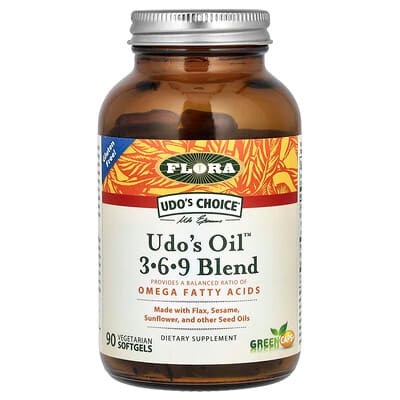

$26.49 $0.58 per serving


Product analysis
Udo's Oil 3-6-9 Blend brings together several omega fats in a formula that appears well aligned with its intended use. Unspecified oil forms limit a direct comparison of ingredient quality.
AI assessment of the formula, label and price. How scoring works
Nutrient Quality20
Oil forms are unspecified throughout the ingredient disclosure. Their relative quality therefore remains difficult to compare.
Ingredient Transparency63
The listed amounts are disclosed. Missing oil-form details limit a full comparison of what each serving contains.
Value For Money58
Omega-6 and omega-9 compare favorably on price. Omega-3 value remains uncertain, leaving the complete blend harder to judge.
Customer Satisfaction75
Customer feedback is generally positive across several hundred ratings. Those ratings describe satisfaction rather than proving health benefits.
Product Focus78
The formula remains concentrated on one intended goal. Its alignment with that purpose appears encouraging.
- Format
Softgel - Container
- 90 Softgel(s)
- Per serving
- $0.58
- Also available
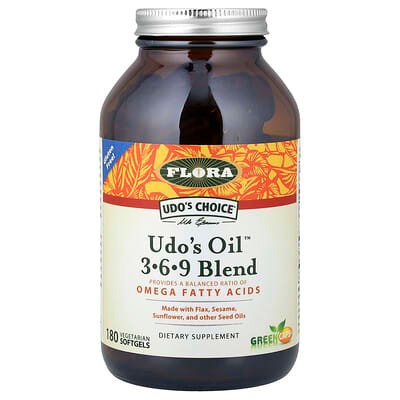 Udo's Oil 3-6-9 Blend$52.18
- Customer rating
- 4.6 · 576 ratings
Goals

Impact
High effect
Omega-3 · 840 mg
Omega-3 is counted toward skin-barrier lipids in the saved findings. The supplied human evidence concerns a specific purified EPA preparation and UV-response measures, rather than a general skin benefit from mixed omega-3. The declared amount contributes to the saved comparison, but unresolved composition and preparation limit transfer of those results. Flax's presence remains unresolved, so flaxseed-oil trial findings cannot be assigned to this serving.
How this product is rated for Skin Health
Ingredient fit94
Omega-3 is the focused counted ingredient, with a declared amount.
Goal fit
Omega-3 supplies the counted contribution without unrelated actives diluting it.
Dose adequacy
The declared amount meets part of the saved comparison; this is not a measured percentage of skin benefit.
Pathways45
The saved contribution is concentrated in epidermal barrier lipids.
Depth
Epidermal barrier lipids is the strongest tracked area.
Breadth
Only epidermal barrier lipids reaches the breadth comparison.
Evidence78
The supplied EPA evidence uses a specific preparation and UV-response measures, limiting transfer to generic omega-3.
Evidence strength
The supplied EPA evidence uses a specific preparation and UV-response measures, limiting transfer to generic omega-3.
Studied preparation
The saved findings accept the preparation, but the generic declaration does not establish equivalence to the specific purified EPA intervention.
Formulation logic100
The counted ingredients need no additional partner for their saved contributions. No configured ingredient conflict was matched.
Partner coverage
The counted ingredients work alone or have the required partner in the saved findings.
Conflicts
No configured ingredient conflict was matched.
Effective doses
All counted ingredients reach the saved minimum amount comparison.
Omega-9 Not classified
No linked studies yet.
Ingredients
| Ingredient | Amount per serving | Score |
|---|---|---|
Calories | 20 Calorie(s) | |
Total Fat | 2 Gram(s) | |
Omega-3 Fatty Acids | 840 mg | |
Omega-6 Fatty Acids | 420 mg | |
Omega-9 Fatty Acids | 350 mg |
Omega-9 · 350 mg OverallScore82
Each serving lists 350 mg of omega-9. The price is about $0.17 per 100 mg of omega-9.
How this ingredient is rated
Active Ingredient Quality & Bioavailability85
A specific oil source is recorded. An antioxidant is recorded, while a processing method is not.
Oil Source & Form Quality
A specific oil source is recorded, though the omega-9 molecular form is not identified in the saved facts.
Extraction & Processing Method
No qualifying extraction or processing method is recorded in the available information.
Oxidation & Stability Protection
The saved information records an antioxidant used for protection; it does not measure the oil’s oxidation.
Dose, Safety & Label Transparency85
The omega-9 amount is clearly listed as 350 mg per serving.
Omega-9 Potency per Serving
A serving provides 350 mg of omega-9.
Label Transparency & Disclosure
The label gives an exact omega-9 amount of 350 mg per serving.
Value70
The whole-product price works out to about $0.17 per 100 mg of omega-9.
Price per 100mg Omega-9
The whole-product price works out to about $0.17 per 100 mg of omega-9.
Omega-6 · 420 mg OverallScore40
A serving provides 420 mg of omega-6, with no specific source or fatty-acid breakdown in the saved facts. A whole-product serving costs about $0.59.
How this ingredient is rated
Active Ingredient Quality & Bioavailability4
The saved facts do not identify the omega-6 source or a separate GLA amount. No extraction method is recorded in the saved facts.
Omega-6 Source & GLA Content
The saved facts do not identify the omega-6 source or a separate GLA amount.
Extraction Method & Purity
No extraction method is recorded in the saved facts.
Dose, Safety & Label Transparency57
A serving contains 420 mg of omega-6; the saved facts do not break it down by fatty acid.
Omega-6 Potency vs. Median
A serving contains 420 mg of omega-6.
Fatty Acid Profile Transparency
The total omega-6 amount is recorded, but individual fatty-acid amounts are not available in the saved facts.
Value80
A whole-product serving costs about $0.59.
Price Per Serving Efficiency
A whole-product serving costs about $0.59.
Omega-3 · 840 mg OverallScore16
Each serving supplies 840 mg of omega-3. The saved facts lack separate EPA and DHA amounts, so their concentration and cost cannot be established.
How this ingredient is rated
Active Ingredient Quality & Bioavailability24
The omega-3 molecular form is not available in the saved facts. An antioxidant is recorded, but the source does not meet the evaluation’s preferred criteria.
Molecular Form & Absorption Potential
The omega-3 molecular form is not available in the saved facts.
Source Purity & Oxidative Protection
An antioxidant is recorded, but the source does not meet the evaluation’s preferred criteria.
Dose, Safety & Label Transparency15
840 mg total omega-3 is recorded per serving, but the available facts do not establish the EPA and DHA breakdown or concentration.
EPA & DHA Label Specificity
The saved facts list 840 mg total omega-3 per serving, but not separate EPA and DHA amounts.
Active Ingredient Concentration
The EPA and DHA share of the oil cannot be determined from the available amounts.
Third-Party Purity Verification
No qualifying product purity certification or testing claim is recorded in the saved facts.
Value0
The cost per gram of EPA and DHA cannot be determined from the saved facts.
Price per 1000mg of EPA+DHA
The cost per gram of EPA and DHA cannot be determined from the saved facts.
Alternative products
Report alternatives
Sources
Published studies used for the product analysis and the top-ranked studies for each ingredient and goal.
- Dietetic intervention in psoriatic arthritis: the DIETA trial.
- Omega-3 fatty acid supplement skin cancer prophylaxis in lung transplant recipients: A randomized, controlled pilot trial.
- Clinical and metabolic response to flaxseed oil omega-3 fatty acids supplementation in patients with diabetic foot ulcer: A randomized, double-blind, placebo-controlled trial.
- Treatment of hard-to-heal wounds in ischaemic lower extremities with a novel fish skin-derived matrix.
- Effect of eicosapentaenoic acid, an omega-3 polyunsaturated fatty acid, on UVR-related cancer risk in humans. An assessment of early genotoxic markers.
- Psychosocial Burden in People with Atopic Dermatitis: Effects of a Substance-Free Basic Skincare in a Randomized Health Care Study.
- Abnormalities in epidermal lipid metabolism in patients with atopic dermatitis.
- Maternal plasma phosphatidylcholine fatty acids and atopy and wheeze in the offspring at age of 6 years.
- Plasma omega-3 and omega-6 concentrations and risk of cutaneous basal and squamous cell carcinomas in Australian adults.
- Maternal PUFA status and offspring allergic diseases up to the age of 18 months.