
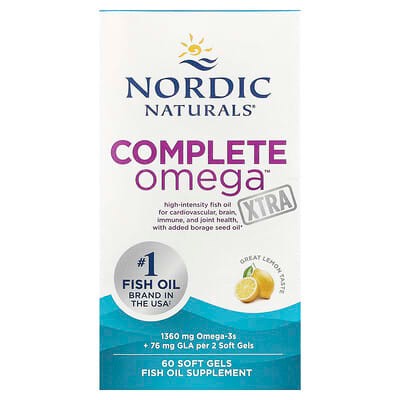

$28.86 $0.96 per serving


Product analysis
Complete Omega Xtra Lemon combines omega-3, omega-6 and omega-9 in a lemon-flavored supplement. Omega-3 offers favorable value, while the other oils are more expensive relative to the amounts provided.
AI assessment of the formula, label and price. How scoring works
Nutrient Quality20
Associated fish oil information identifies the triglyceride form for omega-3, supporting a favorable view of absorption potential. The main ingredient listing does not specify the oil forms, and omega-6 and omega-9 quality remains uncertain.
Ingredient Transparency63
Amounts are disclosed, so serving contents can be compared. The ingredient listing omits the forms, limiting a closer comparison of sources and absorption.
Value For Money50
The omega-3 contribution offers favorable value for the EPA and DHA provided. Omega-6 is relatively costly per serving, and omega-9 is particularly expensive for the amount supplied.
Customer Satisfaction75
Customer feedback is very positive, although the review base is relatively limited. The ratings describe satisfaction, rather than proving effectiveness or safety.
Product Focus73
The oil combination appears reasonably aligned with its stated uses. A limited range of intended uses gives the mixture a reasonably clear focus.
- Format
Softgel - Container
- 60 Softgel(s)
- Per serving
- $0.96
- Also available
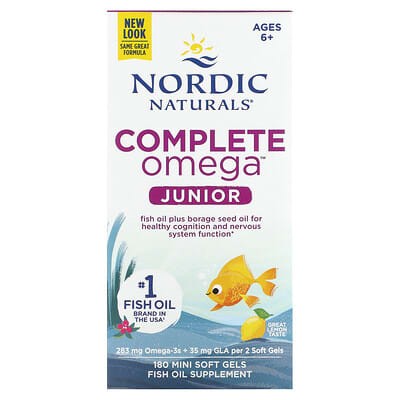 Complete Omega Jr. Lemon$31.41
- Customer rating
- 4.8 · 178 ratings
Goals

Impact
High effect
Omega-3 · 1360 mg
Omega-9 Not classified
No linked studies yet.

Impact
High effect
Omega-3 · 1360 mg
Ingredients
| Ingredient | Amount per serving | Score |
|---|---|---|
Calories | 25 Calorie(s) | |
Total Fat | 2.5 Gram(s) | |
Total Omega-3 Fatty Acids | 1360 mg | |
Omega-6 Fatty Acids | 285 mg | |
Omega-9 Fatty Acids | 160 mg |
Omega-9 · 160 mg OverallScore64
Each serving provides 160 mg of omega-9 at a high cost for that amount. Some is oleic acid; the rest is unspecified. An antioxidant is indicated.
How this ingredient is rated
Active Ingredient Quality & Bioavailability85
The total includes 120 mg of oleic acid; the remaining omega-9 form is unspecified. The extraction method is not specified. An antioxidant is indicated, though its identity is not specified.
Oil Source & Form Quality
The total includes 120 mg of oleic acid; the remaining omega-9 form is unspecified.
Extraction & Processing Method
The extraction method is not specified.
Oxidation & Stability Protection
An antioxidant is indicated, though its identity is not specified.
Dose, Safety & Label Transparency70
Each serving provides 160 mg of omega-9. The amount is stated clearly.
Omega-9 Potency per Serving
Each serving provides 160 mg of omega-9.
Label Transparency & Disclosure
The omega-9 amount is stated.
Value10
The cost for the omega-9 amount is high.
Price per 100mg Omega-9
The cost for the omega-9 amount is high.
Omega-3 · 1360 mg OverallScore80
A serving provides 1170 mg of EPA and DHA at a moderate cost per gram. The oil concentration is unclear because the total oil amount is unavailable. The omega-3s are in triglyceride form.
How this ingredient is rated
Active Ingredient Quality & Bioavailability100
The omega-3s are in triglyceride form. An antioxidant is included to help protect the oil from oxidation.
Molecular Form & Absorption Potential
The omega-3s are in triglyceride form.
Source Purity & Oxidative Protection
An antioxidant is included to help protect the oil from oxidation.
Dose, Safety & Label Transparency61
The label lists 780 mg EPA and 390 mg DHA per serving. The share of the oil made up by EPA and DHA is unclear because the total oil amount is unavailable.
EPA & DHA Label Specificity
The label lists 780 mg EPA and 390 mg DHA per serving.
Active Ingredient Concentration
The share of the oil made up by EPA and DHA is unclear because the total oil amount is unavailable.
Third-Party Purity Verification
Third-party testing and an available certificate of analysis are claimed.
Value80
The cost per gram of EPA and DHA is moderate.
Price per 1000mg of EPA+DHA
The cost per gram of EPA and DHA is moderate.
Omega-6 · 285 mg OverallScore66
The serving provides 285 mg of omega-6 at a high cost per serving. It includes 76 mg of gamma-linolenic acid (GLA); the rest is unspecified. The extraction method is not specified.
How this ingredient is rated
Active Ingredient Quality & Bioavailability64
It includes 76 mg of gamma-linolenic acid (GLA); the rest is unspecified. The extraction method is not specified.
Omega-6 Source & GLA Content
It includes 76 mg of gamma-linolenic acid (GLA); the rest is unspecified.
Extraction Method & Purity
The extraction method is not specified.
Dose, Safety & Label Transparency85
A serving supplies 285 mg of omega-6. The breakdown lists 76 mg of gamma-linolenic acid (GLA) per serving.
Omega-6 Potency vs. Median
The serving contains 285 mg of omega-6.
Fatty Acid Profile Transparency
The breakdown lists 76 mg of gamma-linolenic acid (GLA) per serving.
Value30
The cost per serving is high.
Price Per Serving Efficiency
The cost per serving is high.
Alternative products
Report alternatives
Sources
Published studies used for the product analysis and the top-ranked studies for each ingredient and goal.
- Supplementation of fish oil and olive oil in patients with rheumatoid arthritis.
- Krill oil improved osteoarthritic knee pain in adults with mild to moderate knee osteoarthritis: a 6-month multicenter, randomized, double-blind, placebo-controlled trial.
- Effects of omega-3 supplementation on lipid metabolism, inflammation, and disease activity in rheumatoid arthritis: a meta-analysis of randomized controlled trials.
- Impact of type and dose of oral polyunsaturated fatty acid supplementation on disease activity in inflammatory rheumatic diseases: a systematic literature review and meta-analysis.
- A meta-analysis of the analgesic effects of omega-3 polyunsaturated fatty acid supplementation for inflammatory joint pain.
- Dietetic intervention in psoriatic arthritis: the DIETA trial.
- Omega-3 fatty acid supplement skin cancer prophylaxis in lung transplant recipients: A randomized, controlled pilot trial.
- Clinical and metabolic response to flaxseed oil omega-3 fatty acids supplementation in patients with diabetic foot ulcer: A randomized, double-blind, placebo-controlled trial.
- Treatment of hard-to-heal wounds in ischaemic lower extremities with a novel fish skin-derived matrix.
- Effect of eicosapentaenoic acid, an omega-3 polyunsaturated fatty acid, on UVR-related cancer risk in humans. An assessment of early genotoxic markers.
- Psychosocial Burden in People with Atopic Dermatitis: Effects of a Substance-Free Basic Skincare in a Randomized Health Care Study.
- Abnormalities in epidermal lipid metabolism in patients with atopic dermatitis.
- Maternal plasma phosphatidylcholine fatty acids and atopy and wheeze in the offspring at age of 6 years.
- Plasma omega-3 and omega-6 concentrations and risk of cutaneous basal and squamous cell carcinomas in Australian adults.
- Maternal PUFA status and offspring allergic diseases up to the age of 18 months.