
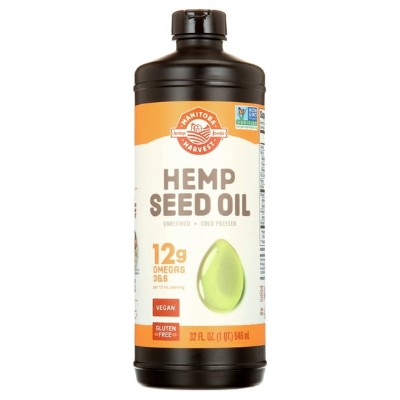

$22.19 $0.35 per serving

Product analysis
Hemp Oil supplies fatty acids that contribute to normal nutrition, with a possible but uncertain connection to skin moisture and joint comfort. Findings from specific oils cannot automatically be transferred to this preparation.
AI assessment of the formula, label and price. How scoring works
Nutrient Quality24
The omega-3 and omega-6 fatty-acid types are identified. Several other forms are unstated, and the fatty-acid names do not establish equivalence to specific oils associated with benefits.
Ingredient Transparency51
The main fatty-acid amounts are stated, but some other nutrient quantities are missing. Only two fatty-acid forms are named, limiting a full comparison of the oil.
Value For Money71
The omega-6 and GLA contributions offer very good value at the serving cost. Omega-3 value cannot be compared as though the oil provided a known amount of EPA and DHA.
Customer Satisfaction71
The small number of customer ratings is very positive. Satisfaction is less established than it would be with a much larger review history.
Product Focus69
The fatty-acid mix has a limited connection to skin and joint-related benefits. Evidence from specific oils and clinical populations does not establish the same effects for everyday use.
- Format
Liquid - Container
- 32 Liquid(s)
- Per serving
- $0.35
- Customer rating
- 4.7 · 84 ratings
Goals

Impact
Highest effect
Gamma Linolenic Acid · 420 mgOmega-3 · 2000 mg
Gamma-linolenic acid has limited support for skin moisture, water loss and texture from trials of defined evening-primrose and borage oils. The declared GLA amount is relevant, but the oil-specific evidence does not establish equivalent effects from every fatty-acid formula. ALA omega-3 and linoleic acid contribute to normal fatty-acid nutrition; their amounts do not establish the skin effects of purified EPA or flaxseed oil.
How this product is rated for Skin Health
Ingredient fit91
Gamma Linolenic Acid provides a relevant connection to this goal. Amounts and the wider ingredient mix limit how closely this formula matches the compared skin exposures.
Goal fit
The recognized ingredient content is concentrated on this goal, though it is also linked to other uses.
Dose adequacy
The recognized serving amounts only partly match the comparison exposures.
Pathways60
The strongest recorded connection concerns skin-barrier lipids. The mechanism profile is narrow.
Depth
The strongest recorded connection concerns skin-barrier lipids; ingredient-specific evidence limits how much benefit can be inferred.
Breadth
The recorded connection is concentrated on skin-barrier lipids, rather than broad coverage of skin structure and hydration.
Evidence87
Gamma Linolenic Acid leads the recognized evidence. Preparation-specific evidence limits transfer to this formula.
Evidence strength
Gamma Linolenic Acid leads the recognized evidence. Preparation and population differences limit transfer to this product.
Studied preparation
The saved finding recognizes the eligible preparations; this does not establish that the finished product reproduces trial effects.
Formulation logic100
No required partner is missing and no configured conflict was identified. Recognized ingredients meet the exposure threshold, without establishing synergy.
Partner coverage
No required partner is missing for the recognized ingredients. Their presence does not establish an extra combined benefit.
Conflicts
No configured ingredient conflict was identified in the supplied facts; the finding is limited to the interactions evaluated.
Effective doses
All ingredients included in this finding meet the saved exposure threshold; this does not establish a proven effective cosmetic dose.

Impact
High effect
Gamma Linolenic Acid · 420 mg
GLA contributes to fatty-acid pathways involved in inflammation. Small trials found joint symptom improvements in active rheumatoid arthritis, using 1400–2800 mg daily over months; the 420 mg serving here is lower despite reaching the saved amount benchmark. Fish oil is listed without a usable combined EPA+DHA amount, so its contribution remains unresolved. Fat-panel rows cannot substitute for active fatty-acid amounts.
How this product is rated for Inflammation
Ingredient fit78
GLA is the usable fatty-acid contribution; fish oil lacks a confirmed combined EPA+DHA amount.
Goal fit
GLA is the usable fatty-acid contribution; fish oil lacks a confirmed combined EPA+DHA amount.
Dose adequacy
GLA reaches the saved amount benchmark, although the serving is below the supplied rheumatoid-arthritis study exposures.
Pathways49
Anti-inflammatory fatty-acid mediators is the main area represented. Coverage of other areas is limited.
Depth
Anti-inflammatory fatty-acid mediators is the strongest area in the saved findings; this mapping does not establish a clinical effect.
Breadth
Only anti-inflammatory fatty-acid mediators reaches the saved coverage threshold, so coverage is narrow.
Evidence75
Gamma Linolenic Acid leads the saved evidence finding. The preparation is recognized, while the clinical limitations described above still apply.
Evidence strength
Gamma Linolenic Acid leads the saved evidence finding; this does not establish routine clinical anti-inflammatory benefit.
Studied preparation
The saved findings recognize the preparations of all credited ingredients; this does not establish equivalence for every clinical outcome.
Formulation logic100
The credited ingredients have no unmet partner requirement or matched conflict in the saved findings. Their amounts clear the threshold used for inclusion.
Partner coverage
Each credited ingredient can contribute independently or has its required partner.
Conflicts
No configured conflict was matched; this is limited to the combinations evaluated.
Effective doses
All credited ingredients clear the amount threshold used for inclusion; this is not proof of an effective clinical dose.

Impact
Moderate effect
Omega-3 · 2000 mgGamma Linolenic Acid · 420 mg
Gamma-linolenic acid at 420 mg provides the main assessed link to inflammation-related joint comfort. Supporting trials are small and mainly concern rheumatoid arthritis, limiting how broadly the findings apply.
The 2 g omega-3 declaration is treated as oil mass, with no inferred EPA or DHA content or additional contribution.
How this product is rated for Joint Health
Ingredient fit50
Relevant ingredients sit within a broader formula, so its focus extends beyond joint health. The declared GLA amount provides partial support; the oil-mass entry adds no EPA+DHA contribution.
Goal fit
Relevant ingredients sit within a broader formula, so its focus extends beyond joint health.
Dose adequacy
The declared GLA amount provides partial support; the oil-mass entry adds no EPA+DHA contribution.
Pathways14
The assessed contribution centers on inflammation-related processes.
Depth
The main assessed contribution concerns inflammation-related processes, with partial coverage.
Breadth
The saved findings do not show strong coverage across several joint-related processes.
Evidence79
GLA leads the saved evidence finding, based on small studies in specific inflammatory-joint populations.
Evidence strength
GLA leads the saved evidence finding, based on small studies in specific inflammatory-joint populations.
Studied preparation
The saved assessment recognizes the preparations included in this finding.
Formulation logic100
The included ingredients need no additional partner, and no configured conflicts were found.
Partner coverage
The assessed ingredients can contribute without an additional required partner.
Conflicts
No configured ingredient conflict was identified in the supplied assessment.
Effective doses
The ingredients included in this finding meet its saved amount threshold.

Impact
High effect
Omega-3 · 2000 mg
Omega-3 metabolism findings differ by population: a small trial in older women found increased resting metabolic rate, while a young-men trial did not. These findings do not establish a general-user boost, and total oil or broad omega-3 mass cannot be assumed to equal the studied EPA+DHA exposure. The hemp-oil declaration therefore cannot inherit a fish-oil trial's effect simply from its broad omega-3 amount.
How this product is rated for Metabolism Support
Ingredient fit69
Omega-3 provides the included connection alongside other declared fatty acids. The included amount reaches the saved plateau; that comparison does not establish an effective metabolic-rate dose.
Goal fit
Omega-3 provides the included connection alongside other declared fatty acids.
Dose adequacy
The included amount reaches the saved plateau; that comparison does not establish an effective metabolic-rate dose.
Pathways56
The strongest saved connection concerns insulin sensitivity and metabolic hormones; this category does not establish extra calorie expenditure. One biological category meets the saved breadth comparison, leaving narrow coverage across the goal.
Depth
The strongest saved connection concerns insulin sensitivity and metabolic hormones; this category does not establish extra calorie expenditure.
Breadth
One biological category meets the saved breadth comparison, leaving narrow coverage across the goal.
Evidence89
Omega-3 leads the saved evidence finding, with conflicting metabolic-rate results across different age and sex groups.
Evidence strength
Omega-3 leads the saved evidence finding, with conflicting metabolic-rate results across different age and sex groups.
Studied preparation
Eligible included preparations match the saved comparison; this does not establish product-specific thermogenesis.
Formulation logic100
No missing required partner or configured ingredient conflict was found.
Partner coverage
The included ingredients do not lack a required partner; this does not establish an added metabolism benefit from combining them.
Conflicts
No configured ingredient conflict was identified.
Effective doses
All included ingredients meet the saved minimum amount comparison, which is not a proven effective metabolism-boosting dose.
Ingredients
| Ingredient | Amount per serving | Score |
|---|---|---|
Calories | 121 Calorie(s) | |
Total Fat | 13 Gram(s) | |
Cholesterol | 0 mg | |
Sodium | 0 mg | |
Total Carbohydrates | 1 Gram(s) | |
Protein | 0 Gram(s) | |
Omega-3 (Alpha-Linolenic Acid) | 2000 mg | |
Omega-6 (Linoleic Acid) | 8000 mg | |
Gamma-Linolenic Acid | 420 mg | |
Stearidonic Acid | 140 mg |
Gamma Linolenic Acid · 420 mg OverallScore77
Each serving supplies 420 mg of GLA from hemp oil, a source the evaluation considers less concentrated. The whole-product price works out to about $0.08 per 100 mg of GLA.
How this ingredient is rated
Active Ingredient Quality & Bioavailability42
Hemp is the identified source, and the oil is pressed; the saved facts do not establish an added antioxidant.
Botanical Source & GLA Concentration
Hemp oil is the identified source, which the evaluation treats as less concentrated in GLA.
Extraction Method & Oxidative Stability
The oil is identified as pressed; the saved facts do not establish an added antioxidant.
Dose, Safety & Label Transparency100
The label specifies 420 mg of GLA per serving.
Active GLA Dosage Potency
Each serving provides 420 mg of GLA.
GLA Yield Disclosure
The GLA amount is separately disclosed in milligrams.
Value100
The whole-product serving price corresponds to about $0.08 per 100 mg of GLA.
Price per 100mg Active GLA
Based on the whole-product price, 100 mg of GLA corresponds to about $0.08.
Omega-6 (Linoleic Acid) · 8000 mg OverallScore86
The saved serving data lists 8,000 mg of linoleic acid and 420 mg of GLA, but their relationship to a whole omega-6 total is unclear. A qualifying extraction claim is recorded, and a whole-product serving costs about $0.35.
How this ingredient is rated
Active Ingredient Quality & Bioavailability64
The saved data identifies linoleic acid and GLA and records a qualifying extraction claim; the constituent amounts are not reconciled into a whole omega-6 total.
Omega-6 Source & GLA Content
Linoleic acid and GLA are identified, with 420 mg of GLA listed; their proportions of the whole omega-6 amount are unknown.
Extraction Method & Purity
The evaluation records a qualifying extraction claim, but the saved facts do not specify the method.
Dose, Safety & Label Transparency100
The serving data records 8,000 mg of linoleic acid and 420 mg of GLA, but does not reconcile these amounts into a whole omega-6 total.
Omega-6 Potency vs. Median
The evaluation uses 8,000 mg per serving, although the saved constituent amounts are not reconciled into a whole omega-6 total.
Fatty Acid Profile Transparency
Amounts are recorded for linoleic acid and GLA separately; they do not establish a reconciled whole omega-6 total.
Value100
A whole-product serving costs about $0.35.
Price Per Serving Efficiency
A whole-product serving costs about $0.35.
Omega-3 (Alpha-Linolenic Acid) · 2000 mg OverallScore16
Alternative products
Report alternatives
Sources
Published studies used for the product analysis and the top-ranked studies for each ingredient and goal.
- Dose-dependent effects of fish oil on cardio-metabolic biomarkers in healthy middle-aged and elderly Chinese people: a double-blind randomized controlled trial.
- Eicosapentaenoic acid supplementation alleviates pruritus, enhances skin moisture, and mitigates depression in maintenance hemodialysis patients.
- Lowering effects of fish oil supplementation on proinflammatory markers in hypertension: results from a randomized controlled trial.
- The effects of ω-3 fish oil emulsion-based parenteral nutrition plus combination treatment for acute paraquat poisoning.
- Effects of Omega-3 Fatty Acid Intake in Patients Undergoing Dialysis: A Systematic Review and Meta-Analysis of Randomized Controlled Trials.
- Effects of altering dietary essential fatty acids on requirements for non-steroidal anti-inflammatory drugs in patients with rheumatoid arthritis: a double blind placebo controlled study.
- Systemic immune inflammation mediates the association of serum omega-3 and omega-6 polyunsaturated fatty acids with biological aging: a national population-based study.
- Evidence of effectiveness of herbal medicinal products in the treatment of arthritis. Part 2: Rheumatoid arthritis.
- Evening primrose oil in patients with rheumatoid arthritis and side-effects of non-steroidal anti-inflammatory drugs.
- Prospective clinical trial examining the impact of genetic variation in FADS1 on the metabolism of linoleic acid- and ɣ-linolenic acid-containing botanical oils.
- Effectiveness of nonpharmacological and nonsurgical interventions for patients with rheumatoid arthritis: an overview of systematic reviews.
- Herbal therapy for treating rheumatoid arthritis.
- Herbal medicines for the treatment of rheumatoid arthritis: a systematic review.
- gamma-Linolenic acid treatment of rheumatoid arthritis. A randomized, placebo-controlled trial.
- Botanical lipids: effects on inflammation, immune responses, and rheumatoid arthritis.
- Supplementation of fish oil and olive oil in patients with rheumatoid arthritis.
- Krill oil improved osteoarthritic knee pain in adults with mild to moderate knee osteoarthritis: a 6-month multicenter, randomized, double-blind, placebo-controlled trial.
- Effects of omega-3 supplementation on lipid metabolism, inflammation, and disease activity in rheumatoid arthritis: a meta-analysis of randomized controlled trials.
- Impact of type and dose of oral polyunsaturated fatty acid supplementation on disease activity in inflammatory rheumatic diseases: a systematic literature review and meta-analysis.
- A meta-analysis of the analgesic effects of omega-3 polyunsaturated fatty acid supplementation for inflammatory joint pain.