
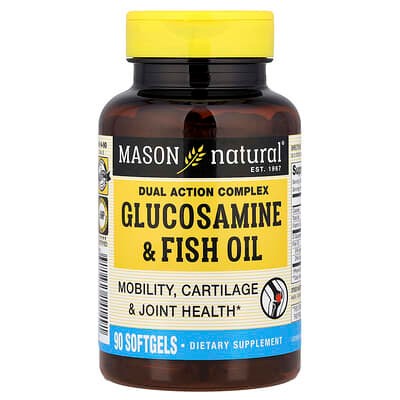

$13.85 $0.46 per serving


Product analysis
Glucosamine & Fish Oil provides omega-3 fats with a limited role in triglyceride support. The cost is relatively high for the amount of EPA and DHA, the main omega-3 fats of interest.
AI assessment of the formula, label and price. How scoring works
Nutrient Quality31
Vitamin E uses the identified natural form, while the fish oil and glucosamine declarations leave more detail unclear. Those missing details do not establish that either ingredient is poorly used by the body.
Ingredient Transparency59
Most amounts are stated, but the carbohydrate amount is omitted. Only vitamin E has a clearly identified form, making the main ingredients harder to compare precisely.
Value For Money48
The fish oil is relatively costly for its EPA and DHA content. Vitamin E is more economical, but that does not resolve the value of the main omega-3 contribution.
Customer Satisfaction68
The available customer feedback is favorable. Only 21 ratings support that impression, so a few additional opinions could change the picture considerably.
Product Focus42
The clearest supported role is omega-3 support related to triglycerides. Glucosamine has no established contribution to that particular goal.
- Format
Softgel - Container
- 90 Softgel(s)
- Per serving
- $0.46
- Customer rating
- 4.6 · 21 ratings
Goals

Impact
Moderate effect
Fish Oil · 1200 mgVitamin E · 15 IU
Glucosamine & Fish Oil supplies 180 mg EPA and 120 mg DHA per serving, but its cardiovascular link centers on triglyceride support. Glucosamine has no assigned role for this goal, and the usable vitamin E amount is unclear, so the serving has limited pathway breadth.
How this product is rated for Cardiovascular Support
Ingredient fit54
EPA and DHA relate to blood-fat support, while glucosamine is an extra active without a cardiovascular role in the supplied context.
Goal fit
EPA and DHA fit a triglyceride marker, but glucosamine does not relate to this goal and the product is linked elsewhere.
Dose adequacy
The serving lists 180 mg EPA and 120 mg DHA separately; vitamin E's usable amount is unclear, limiting its contribution.
Pathways14
EPA and DHA point mainly to triglyceride metabolism; the formula offers little support across other cardiovascular pathways.
Depth
Triglyceride metabolism is the clearest pathway; the other listed mechanisms have little coverage.
Breadth
Only one pathway has partial support; the other target routes are not covered enough for broader support.
Evidence83
EPA carries the clearest evidence for a specific blood-fat marker, while DHA contributes at a lower amount.
Evidence strength
EPA has the strongest applicable support here, for triglyceride levels rather than every cardiovascular outcome.
Studied preparation
EPA reaches a studied amount; DHA is below the effective comparison range.
Formulation logic88
The omega-3 ingredients need no special partner, and no listed conflict is triggered by the available serving facts.
Partner coverage
EPA and DHA can contribute on their own; no partner ingredient is needed.
Conflicts
No caffeine, stimulant, or high-sodium issue appears in the available ingredient facts.
Effective doses
EPA reaches a comparison threshold; the vitamin E declaration does not provide a usable amount.

Impact
Situational effect
Fish Oil · 1200 mgVitamin E · 15 IU
Ingredients
| Ingredient | Amount per serving | Score |
|---|---|---|
Calories | 21 {Calories} | |
Total Fat | 1.77 Gram(s) | |
Total Carbohydrates | 0 mg | |
Protein | 825 mg | |
Vitamin E (D-Alpha-Tocopherol) | 15 IU | |
D-Glucosamine Sulfate | 1500 mg | |
Fish Oil | 1200 mg |
Vitamin E (D-Alpha-Tocopherol) · 15 IU OverallScore57
The serving provides 15 IU of vitamin E as natural d-alpha-tocopherol. The whole-product serving costs about $0.46.
How this ingredient is rated
Active Ingredient Quality & Bioavailability46
Vitamin E is identified as natural d-alpha-tocopherol.
Natural (d-alpha) vs. Synthetic (dl-alpha)
The identified form, d-alpha-tocopherol, is natural.
Mixed Tocopherol Isomer Diversity
The saved facts do not establish a mixed-tocopherol complex or identify gamma and delta tocopherols.
Tocotrienol Complex Inclusion
The saved facts do not establish the presence of tocotrienols.
Dose, Safety & Label Transparency48
The recorded serving provides 15 IU of vitamin E. The recorded information identifies d-alpha-tocopherol and a total vitamin E amount; separate isomer amounts are not established.
Therapeutic Dosage Range
The recorded serving provides 15 IU of vitamin E.
Label Transparency and Isomer Specificity
The recorded information identifies d-alpha-tocopherol and a total vitamin E amount; separate isomer amounts are not established.
Value100
The whole-product serving costs about $0.46.
Cost per Natural-Form Therapeutic Serving
The whole-product serving costs about $0.46.
Fish Oil · 1200 mg OverallScore26
A serving provides 300 mg of EPA and DHA combined in 1,200 mg of fish oil. That is about 25% of the oil, and the whole-product price works out to about $1.54 per gram of EPA and DHA.
How this ingredient is rated
Active Ingredient Quality & Bioavailability8
The molecular form of the oil is not established in the saved facts. Independent testing is not established in the saved facts.
Omega-3 Molecular Form
The molecular form of the oil is not established in the saved facts.
Purification & Filtration Method
The saved evaluation does not establish a qualifying purification claim for the oil.
Third-Party Purity & Potency Verification
Independent testing is not established in the saved facts.
Source & Sustainability
The saved evaluation records no qualifying named-source or sustainability claim.
Dose, Safety & Label Transparency48
A serving provides 300 mg of EPA and DHA combined. EPA and DHA together account for about 25% of the 1,200 mg of fish oil per serving.
Total Active Omega-3 Dose (EPA + DHA)
A serving provides 300 mg of EPA and DHA combined.
Omega-3 Potency & Concentration
EPA and DHA together account for about 25% of the 1,200 mg of fish oil per serving.
EPA & DHA Individual Disclosure
The saved facts list EPA and DHA separately: 180 mg of EPA and 120 mg of DHA per serving.
Oxidation Protection (Stabilizers)
A qualifying antioxidant is recorded in the formula; its presence does not establish the oil’s oxidation status.
Value20
The whole-product price is about $1.54 per gram of combined EPA and DHA.
Cost Per Gram of Active EPA + DHA
The whole-product price is about $1.54 per gram of combined EPA and DHA.
Alternative products
Report alternatives
Sources
Published studies used for the product analysis and the top-ranked studies for each ingredient and goal.
- Marine Omega-3 Supplementation and Cardiovascular Disease: An Updated Meta-Analysis of 13 Randomized Controlled Trials Involving 127 477 Participants.
- Impact of omega-3 fatty acids on hypertriglyceridemia, lipidomics, and gut microbiome in patients with type 2 diabetes.
- A systematic review of fish-oil supplements for the prevention and treatment of hypertension.
- Effects of fish oil-derived fatty acids on suboptimal cardiovascular health: A multicenter, randomized, double-blind, placebo-controlled trial.
- Effect of High-Dose Marine Omega-3 Fatty Acids on Atherosclerosis: A Systematic Review and Meta-Analysis of Randomized Clinical Trials.
- Supplementation with vitamin E alone is associated with reduced myocardial infarction: a meta-analysis.
- Vitamin E ameliorates blood cholesterol level and alters gut microbiota composition: A randomized controlled trial.
- Effects of long-term vitamin E supplementation on cardiovascular events and cancer: a randomized controlled trial.
- Independent and combined associations of dietary antioxidant exposure with all-cause and cause-specific mortality in the general population.
- Tocotrienol rich fraction supplementation improved lipid profile and oxidative status in healthy older adults: A randomized controlled study.
- Dose-dependent effects of fish oil on cardio-metabolic biomarkers in healthy middle-aged and elderly Chinese people: a double-blind randomized controlled trial.
- Eicosapentaenoic acid supplementation alleviates pruritus, enhances skin moisture, and mitigates depression in maintenance hemodialysis patients.
- Lowering effects of fish oil supplementation on proinflammatory markers in hypertension: results from a randomized controlled trial.
- The effects of ω-3 fish oil emulsion-based parenteral nutrition plus combination treatment for acute paraquat poisoning.
- Effects of Omega-3 Fatty Acid Intake in Patients Undergoing Dialysis: A Systematic Review and Meta-Analysis of Randomized Controlled Trials.
- Effects of delta-tocotrienol supplementation on Glycemic Control, oxidative stress, inflammatory biomarkers and miRNA expression in type 2 diabetes mellitus: A randomized control trial.
- Effect of vitamin E supplementation on serum C-reactive protein level: a meta-analysis of randomized controlled trials.
- Efficacy of Nutritional Interventions on Inflammatory Markers in Haemodialysis Patients: A Systematic Review and Limited Meta-Analysis.
- Vitamin E improves serum markers and histology in adults with metabolic dysfunction-associated steatotic liver disease: Systematic review and meta-analysis.
- Delta-tocotrienol supplementation improves biochemical markers of hepatocellular injury and steatosis in patients with nonalcoholic fatty liver disease: A randomized, placebo-controlled trial.