
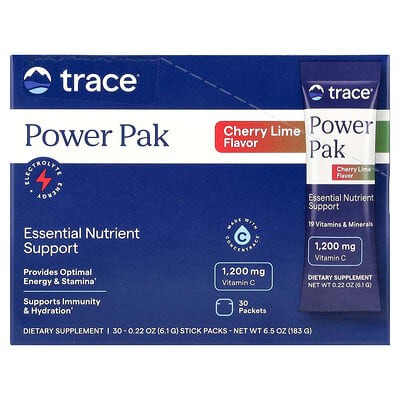
Power Pak Cherry Limeade

Goals
$19.99 $0.62 per serving


Product analysis
Power Pak Cherry Limeade may help fill vitamin and mineral gaps, supporting normal energy use and immune function when intake is low. Incomplete blend details make its contents harder to compare.
AI assessment of the formula, label and price. How scoring works
Nutrient Quality36
Undisclosed forms and blend proportions limit comparison of the mixture. The named potassium citrate does not establish the quality of the entire potassium blend.
Ingredient Transparency73
Amounts and most forms are listed, but blend composition details are missing. That makes it harder to compare the mineral mixtures and the proprietary blend.
Value For Money42
The serving cost is favorable when considered for chloride and potassium, while vitamin C is relatively expensive for the amount provided. Value for many other nutrients remains uncertain.
Customer Satisfaction76
Customers give strongly positive feedback. The review base is moderate, and the ratings do not establish nutritional benefits.
Product Focus14
The formula mainly supports filling nutritional gaps relevant to everyday health and normal immune function. Its long ingredient list and undisclosed blend reduce focus, and extra vitamin C does not reliably improve skin when intake is adequate.
- Format
Powder - Container
- 32 Packet(s)
- Per serving
- $0.62
- Also available
 Power Pak Lemon Lime$19.99
- Customer rating
- 4.9 · 144 ratings
Goals

Impact
High effect
Magnesium · 100 mgVitamin C · 1200 mgZinc · 3 mgSelenium · 35 mcg
Vitamin C may modestly shorten colds with regular supplementation, while B6 and B12 can support normal immune-cell function when intake is low. Selenium adds a smaller nutritional contribution. Zinc and folate fall below the saved inclusion criteria. Magnesium receives a saved contribution, but immune-cell and inflammatory-marker observations do not establish routine infection prevention.
How this product is rated for Immunity
Ingredient fit56
The declared amounts provide partial contributions overall, rather than all reaching their saved comparison endpoints.
Goal fit
Vitamin C contributes to the identified immune-related area, while other actives and links to additional goals make the formula less focused.
Dose adequacy
The declared amounts provide partial contributions overall, rather than all reaching their saved comparison endpoints.
Pathways80
The identified contributions cover innate immune cell activity, oxidative and inflammatory balance.
Depth
The strongest identified coverage is in innate immune cell activity.
Breadth
The identified coverage extends to innate immune cell activity, oxidative and inflammatory balance.
Evidence100
Vitamin C has modest regular-use cold-duration support, without establishing general prevention or treatment of an existing cold.
Evidence strength
Vitamin C has modest regular-use cold-duration support, without establishing general prevention or treatment of an existing cold.
Studied preparation
The saved preparation finding accepts the counted forms; no superiority for a particular form or delivery method follows.
Formulation logic100
The counted ingredients meet the minimum amount and partner requirements. No configured ingredient conflict was triggered by the supplied facts.
Partner coverage
Each counted ingredient works alone or has its required partner; this does not establish added clinical benefit from combining them.
Conflicts
No configured ingredient conflict was triggered by the supplied facts.
Effective doses
The counted ingredients reach the saved minimum amount criterion, which is not a proven clinical threshold.

Impact
Highest effect
Folate · 20 mcgVitamin B12 · 30 mcgMagnesium · 100 mgBoron · 175 mcgSelenium · 35 mcgZinc · 3 mgVitamin C · 1200 mg
Vitamin C and selenium supply nutrients associated with antioxidant defences, while B vitamins support normal nutrient metabolism. Magnesium contributes to mineral and energy needs. These nutrients can help fill dietary gaps, without establishing additional health benefits when intake is already adequate. The smaller folate, B12, zinc, boron and calcium declarations were not counted in the saved amount comparison.
How this product is rated for Everyday Health
Ingredient fit73
The formula provides several recognized vitamins and minerals. Amounts vary; folate, B12, zinc, boron and calcium are below the saved counting threshold.
Goal fit
The formula provides several recognized vitamins and minerals.
Dose adequacy
Amounts vary; folate, B12, zinc, boron and calcium are below the saved counting threshold.
Pathways100
Antioxidant defence leads, with energy and blood-formation areas also covered.
Depth
Antioxidant defence leads, with energy and blood-formation areas also covered.
Breadth
The formula reaches the target breadth through several nutrient-related areas.
Evidence86
Magnesium drives the strongest recognized contribution. The finding concerns nutritional availability, without establishing improved outcomes above adequate intake.
Evidence strength
Magnesium drives the strongest recognized contribution. The finding concerns nutritional availability
Studied preparation
The counted nutrient declarations match the saved preparation criteria; no chemical form or delivery superiority is established.
Formulation logic100
No configured formulation conflict was matched. All ingredients included in this amount check meet the saved minimum threshold; that does not establish a clinically effective dose.
Partner coverage
Recognized ingredients can stand alone or have their required partners; this does not establish an added combination benefit.
Conflicts
No configured formulation conflict was matched.
Effective doses
All ingredients included in this amount check meet the saved minimum threshold; that does not establish a clinically effective dose.

Impact
High effect
Vitamin C · 1200 mg
Vitamin C has antioxidant roles, with a CRP reduction confined to people who started with elevated CRP in the supplied trial; the overall trial was null. This does not establish an unconditional clinical anti-inflammatory benefit. Magnesium may help reduce low-grade inflammation when magnesium status is low, but its amount here provides only limited support or falls below the saved requirement. Zinc is below the saved inclusion requirement.
How this product is rated for Inflammation
Ingredient fit49
Relevant ingredients appear within a broader formula, reducing its concentration on this goal. The selected serving receives partial amount recognition relative to the saved comparison, without establishing a clinical dose.
Goal fit
Relevant ingredients appear within a broader formula, reducing its concentration on this goal.
Dose adequacy
The selected serving receives partial amount recognition relative to the saved comparison, without establishing a clinical dose.
Pathways58
The main assigned contribution concerns oxidative and mitochondrial stress; this classification does not prove a clinical anti-inflammatory effect. Coverage was concentrated in one specified mechanism.
Depth
The main assigned contribution concerns oxidative and mitochondrial stress; this classification does not prove a clinical anti-inflammatory effect.
Breadth
Only oxidative and mitochondrial stress reached the saved coverage requirement.
Evidence87
Vitamin C leads the saved comparison. Recognized amounts and preparations do not resolve the clinical and biomarker limitations.
Evidence strength
Vitamin C leads the saved evidence comparison, while the supplied population and biomarker limitations constrain expected benefit.
Studied preparation
The saved comparison recognizes the qualifying preparation; this does not establish that the full product reproduces a clinical trial regimen.
Formulation logic100
The included contributions meet the saved amount requirement, with no missing required partner or identified ingredient conflict.
Partner coverage
No required partner was missing among the included contributions; this does not establish added benefit from combining ingredients.
Conflicts
No ingredient conflict was identified by the supplied checks.
Effective doses
All included contributions met the saved minimum amount requirement, which is not proof of a clinically effective dose.

Impact
Moderate effect
Zinc · 3 mgVitamin C · 1200 mgSelenium · 35 mcg
Vitamin C at 1200 mg supports normal collagen formation, while B6 and riboflavin contribute to skin nutrition and selenium supports antioxidant enzymes. These roles matter most when nutritional needs are not met. More vitamin C does not reliably mean better skin in adequately nourished adults.
How this product is rated for Skin Health
Ingredient fit58
The saved assessment identifies 4 relevant ingredients, alongside 11 other actives. The product is linked to 6 goals. The counted amounts provide partial alignment with the saved benchmarks. Unknown amounts add no support.
Goal fit
The saved assessment identifies 4 relevant ingredients, alongside 11 other actives. The product is linked to 6 goals.
Dose adequacy
The counted amounts provide partial alignment with the saved benchmarks. Unknown amounts add no support.
Pathways8
The strongest saved coverage is in uv antioxidant defence, with partial coverage. 0 of 3 target areas reaches the saved coverage threshold.
Depth
The strongest saved coverage is in uv antioxidant defence, with partial coverage.
Breadth
0 of 3 target areas reaches the saved coverage threshold.
Evidence100
Vitamin C provides the strongest saved evidence contribution at a counted amount. The supplied evidence retains its population and preparation limits. The counted preparations match the saved research criteria.
Evidence strength
Vitamin C provides the strongest saved evidence contribution at a counted amount. The supplied evidence retains its population and preparation limits.
Studied preparation
The counted preparations match the saved research criteria.
Formulation logic100
The counted ingredients can contribute independently or have their required partner present. No configured ingredient conflict was found. 4 of 4 counted ingredients reach the saved minimum amount benchmark.
Partner coverage
The counted ingredients can contribute independently or have their required partner present.
Conflicts
No configured ingredient conflict was found.
Effective doses
4 of 4 counted ingredients reach the saved minimum amount benchmark.
Ingredients
| Ingredient | Amount per serving | Score |
|---|---|---|
Calories | 20 {Calories} | |
Total Carbohydrates | 3 Gram(s) | |
Vitamin C (Ascorbic Acid) | 1200 mg | |
Thiamine (Thiamine Hydrochloride) | 450 mcg | |
Riboflavin | 1 mg | |
Niacin (Vitamin B3) | 5 mg | |
Vitamin B6 (Pyridoxine Hydrochloride) | 10 mg | |
Folic Acid | 20 mcg | |
Vitamin B12 (Cyanocobalamin) | 30 mcg | |
Pantothenic Acid (D-Calcium Pantothenate) | 3 mg | |
Calcium (Calcium Lactate) | 60 mg | |
Magnesium (ConcenTrace, Magnesium Oxide) | 100 mg | |
Zinc (Zinc Oxide) | 3 mg | |
Selenium (Sodium Selenite) | 35 mcg | |
Manganese (Manganese Citrate) | 1 mg | |
Chromium (Chromium Amino Acid Chelate) | 10 mcg | |
Chloride (ConcenTrace) | 18 mg | |
Sodium (Sodium Bicarbonate) | 200 mg | |
Potassium (ConcenTrace, Potassium Citrate) | 200 mg | |
ConcenTrace(R) | 100 mg | |
Alpha Lipoic Acid | 1 mg | |
Boron (Boron Amino Acid Chelate) | 175 mcg |
Potassium (ConcenTrace, Potassium Citrate) · 200 mg OverallScore53
Each serving lists 200 mg of potassium, a moderate amount in this comparison. Potassium citrate is identified among the sources, but another source and the proportions are unknown.
How this ingredient is rated
Active Ingredient Quality & Bioavailability20
Potassium citrate is identified among the sources, but another source and the proportions are unknown.
Potassium Form Quality
Potassium citrate is identified among the sources, but another source and the proportions are unknown.
Dose, Safety & Label Transparency64
Potassium is listed at 200 mg per serving, a moderate amount in this comparison; explicit elemental-potassium wording is not recorded in the saved facts.
Potassium Dosage Potency
The listed 200 mg of potassium per serving is a moderate amount in this comparison.
Elemental Yield Transparency
The label lists 200 mg of potassium per serving; the saved facts do not include explicit elemental-potassium wording.
Value100
A whole-product serving costs about $0.62 and provides 200 mg of potassium.
Potassium Value Efficiency
A whole-product serving costs about $0.62 and provides 200 mg of potassium.
Chloride (ConcenTrace) · 18 mg OverallScore41
Each serving provides 18 mg of chloride, a relatively small amount in this comparison. The saved facts do not identify its specific chemical source.
How this ingredient is rated
Active Ingredient Quality & Bioavailability20
The specific chemical source of chloride is not identified in the saved facts.
Chloride source quality
The specific chemical source of chloride is not identified in the saved facts.
Dose, Safety & Label Transparency42
The serving specifies 18 mg of chloride; its specific chemical source is not identified in the saved facts.
Chloride amount per serving
The 18 mg of chloride per serving is a relatively small amount in this comparison.
Amount and source disclosure
The serving specifies 18 mg of chloride; its specific chemical source is not identified in the saved facts.
Value80
The whole-product serving costs about $0.62, which is moderate among the serving prices compared.
Price per serving
The whole-product serving costs about $0.62, which is moderate among the serving prices compared.
Sodium (Sodium Bicarbonate) · 200 mg OverallScore67
A serving provides 200 mg of sodium, a small amount for replacing sweat losses during intense activity. It also provides 200 mg of potassium and 100 mg of magnesium.
How this ingredient is rated
Active Ingredient Quality & Bioavailability52
Sodium bicarbonate is the identified sodium source. At least one accompanying electrolyte form has relatively low assessed absorption potential. Sodium bicarbonate is present and can provide a buffering function.
Sodium Source Purity & Quality
Sodium bicarbonate is the identified sodium source.
Bioavailability of Supporting Electrolytes
At least one accompanying electrolyte form has relatively low assessed absorption potential.
Trace Mineral Complex & Buffering Forms
Sodium bicarbonate is present and can provide a buffering function.
Dose, Safety & Label Transparency65
Each serving provides 200 mg of sodium. The evaluation regards this as a small amount for replacing sodium lost during intense activity. The sodium amount is individually stated.
Sodium Dosage for Athletic Replenishment
Each serving provides 200 mg of sodium. The evaluation regards this as a small amount for replacing sodium lost during intense activity.
Ingredient Label Transparency
The amounts are stated separately: 200 mg sodium, 200 mg potassium, and 100 mg magnesium per serving.
Artificial Color and Sweetener Disclosure
No artificial colors or sweeteners are identified in the evaluated ingredient information.
Value100
A whole-product serving costs about $0.62.
Price Per Serving vs. Collection Median
A whole-product serving costs about $0.62.
Alternative products
Report alternatives
Sources
Published studies used for the product analysis and the top-ranked studies for each ingredient and goal.
- Effects of boron supplementation on the severity and duration of pain in primary dysmenorrhea.
- Efficacy and safety of tavaborole topical solution, 5%, a novel boron-based antifungal agent, for the treatment of toenail onychomycosis: Results from 2 randomized phase-III studies.
- The efficacy and safety of tavaborole, a novel, boron-based pharmaceutical agent: phase 2 studies conducted for the topical treatment of toenail onychomycosis.
- Boron neutron capture therapy (BNCT) for glioblastoma multiforme: a phase II study evaluating a prolonged high-dose of boronophenylalanine (BPA).
- Effects of Calcium Fructoborate on Levels of C-Reactive Protein, Total Cholesterol, Low-Density Lipoprotein, Triglycerides, IL-1β, IL-6, and MCP-1: a Double-blind, Placebo-controlled Clinical Study
- Intakes of Folate, Vitamin B6, and Vitamin B12 in Relation to All-Cause and Cause-Specific Mortality: A National Population-Based Cohort.
- The responsiveness of plasma homocysteine to small increases in dietary folic acid: a primary care study.
- Associations of Serum Folate and Homocysteine Concentrations with All-Cause, Cardiovascular Disease, and Cancer Mortality in Men and Women in Korea: the Cardiovascular Disease Association Study.
- The concept of folic acid supplementation and its role in prevention of neural tube defect among pregnant women: PRISMA.
- Systematic review of adverse health outcomes associated with high serum or red blood cell folate concentrations.
- Perioperative systemic magnesium to minimize postoperative pain: a meta-analysis of randomized controlled trials.
- Long-term outcome after intravenous magnesium sulphate in suspected acute myocardial infarction: the second Leicester Intravenous Magnesium Intervention Trial (LIMIT-2).
- Association of magnesium sulfate use with mortality in critically ill patients with sepsis: a retrospective propensity score-matched cohort study.
- Hypomagnesemia and Mortality in Incident Hemodialysis Patients.
- The effects of magnesium supplementation on abnormal uterine bleeding, alopecia, quality of life, and acne in women with polycystic ovary syndrome: a randomized clinical trial.
- Associations of selenium status with all-cause and cause-specific mortality: a systematic review and meta-analysis of cohort studies.
- Dietary Antioxidants, Circulating Antioxidant Concentrations, Total Antioxidant Capacity, and Risk of All-Cause Mortality: A Systematic Review and Dose-Response Meta-Analysis of Prospective Observational Studies.
- The efficacy and safety of selenium supplementation versus placebo in the treatment of Graves' orbitopathy: A systematic review and meta-analysis of randomised controlled trials.
- Associations of plasma metal concentrations with the risks of all-cause and cardiovascular disease mortality in Chinese adults.
- Updates on clinical studies of selenium supplementation in radiotherapy.