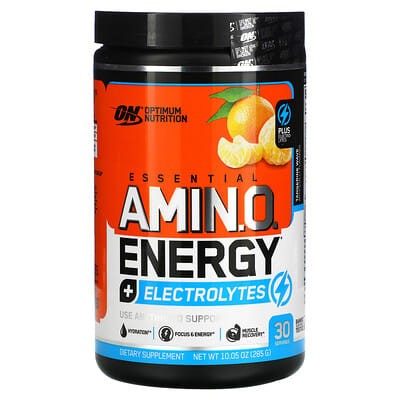
Essential AmiN.O. Energy + Electrolytes Tangerine Wave

Essential AmiN.O. Energy + Electrolytes Tangerine Wave

ON Optimum Nutrition4.5 (4,658 ratings)
Format:Powder Quantity: 10 Ounce(s) · 30 servings
Goals
$23.99 $0.79 per serving

Product analysis

44 out of 100

Essential AmiN.O. Energy + Electrolytes Tangerine Wave uses caffeine to support short-term alertness and attention. Unclear blend contents make the additional amino-acid and performance contributions harder to judge.

AI assessment of the formula, label and price. How scoring works

Nutrient Quality20

The forms and blend breakdowns are not clearly identified. That leaves the quality of much of the formula uncertain.

Ingredient Transparency50

Amounts are given for the listed entries, but the forms and both blend breakdowns are unclear. The blend totals do not show how much of each component you would take.

Value For Money50

The serving cost is favourable in the sodium comparison, moderate for chloride and less favourable for caffeine. There is not enough information for a reliable value judgment on the remaining ingredients.

Customer Satisfaction84

Customer ratings are positive across thousands of responses. The broad feedback reflects satisfaction without proving performance effects or safety.

Product Focus36

Caffeine provides the clearest short-term benefit for alertness, attention and exercise drive. Unclear blend contents limit expectations for the other ingredients, while lasting weight-loss benefits remain uncertain.

Format
Powder
Container
10 Ounce(s)
Per serving
$0.79
Customer rating
4.5 · 4,658 ratings
Report analysis

Goals

Energy
Impact
High effect
C Ingredient FitD PathwaysA+ EvidenceA- Formulation Logic
Magnesium · 60 mgCaffeine · 100 mg

Caffeine supports acute alertness and reduced sleepiness, providing the clearest energy connection. The beta-alanine amount is unresolved, so its contribution toward a repeated exercise regimen cannot be established. Several amino-acid and potassium facts also remain unresolved; the small magnesium amount does not establish a meaningful fatigue-related contribution.

How this product is rated for Energy

Ingredient fit60

Energy-related ingredients appear alongside ingredients aimed at other purposes, making the formula less specifically focused on energy.
Goal fit
Energy-related ingredients appear alongside ingredients aimed at other purposes, making the formula less specifically focused on energy.
Dose adequacy
The supplied serving makes a partial contribution toward the relevant amount comparisons; a serving does not establish the repeated regimens used in trials.

Pathways47

The strongest saved connection concerns alertness, with partial support from the supplied amounts.
Depth
The strongest saved connection concerns alertness, with partial support from the supplied amounts.
Breadth
One energy-related function reaches the saved coverage threshold, indicating a relatively narrow set of connections.

Evidence100

Caffeine supplies the strongest evidence connection, specifically for acute alertness and reduced sleepiness.
Evidence strength
Caffeine supplies the strongest evidence connection, specifically for acute alertness and reduced sleepiness.
Studied preparation
The saved preparation match is favorable; it does not remove differences in exercise context, duration or individual response.

Formulation logic88

No specified ingredient conflict is triggered by the supplied facts; this finding is separate from personal suitability.
Partner coverage
No missing required partner limits the included ingredients under the supplied findings; this does not establish added benefit from combining them.
Conflicts
No specified ingredient conflict is triggered by the supplied facts; this finding is separate from personal suitability.
Effective doses
The beta-alanine amount is unresolved and cannot support the amount comparison; caffeine meets the minimum comparison.
Study evidence
Caffeine Supportive 68 studies
Magnesium Supportive 4 studies
Weight Loss
Impact
Moderate effect
C- Ingredient FitF PathwaysC EvidenceA+ Formulation Logic
Magnesium · 60 mgGreen Tea · 50 mgCaffeine · 100 mg

Caffeine at 100 mg may temporarily increase energy expenditure, although tolerance can reduce the effect and sustained weight loss remains uncertain. The 50 mg green-tea amount is small and cannot be treated as a declared EGCG dose.

How this product is rated for Weight Loss

Ingredient fit59

Caffeine is the main relevant ingredient. Caffeine provides partial dose support; green tea and magnesium fall below the saved minimum.
Goal fit
Caffeine is the main relevant ingredient.
Dose adequacy
Caffeine provides partial dose support; green tea and magnesium fall below the saved minimum.

Pathways14

Energy expenditure leads, with a smaller connection to fat and glucose metabolism.
Depth
Energy expenditure leads, with a smaller connection to fat and glucose metabolism.
Breadth
No mechanism reaches the saved threshold for broad support across several areas.

Evidence62

Caffeine provides the strongest saved evidence at a meaningful amount. The ingredients at meaningful amounts use preparations accepted in the saved assessment.
Evidence strength
Caffeine provides the strongest saved evidence among the ingredients at meaningful amounts.
Studied preparation
The ingredients at meaningful amounts use preparations accepted in the saved assessment.

Formulation logic100

The 1 assessed ingredient meets the saved minimum amount, and no conflicts were identified.
Partner coverage
The assessed ingredients can contribute independently or have their required partner.
Conflicts
No ingredient conflicts were identified in the saved checks.
Effective doses
All 1 assessed ingredient meets the saved minimum amount.
Study evidence
Caffeine Disputed 14 studies
Green Tea Supportive 42 studies
Magnesium Supportive 17 studies
Productivity Boost
Impact
Moderate effect
C- Ingredient FitD- PathwaysB EvidenceA+ Formulation Logic
Magnesium · 60 mgCaffeine · 100 mg

Caffeine can help with alertness and attention in the short term by blocking signals that promote sleepiness. The declared 100 mg per serving is the relevant amount; tea and coffee extract weights are not added as extra caffeine. Timing, tolerance and effects on sleep can change the practical benefit, and improved attention does not automatically mean more work completed.

How this product is rated for Productivity Boost

Ingredient fit59

Caffeine supplies the clear alertness connection. Tyrosine remains unresolved and the small magnesium amount adds no separate contribution.
Goal fit
Caffeine supplies the clear alertness connection. Tyrosine remains unresolved and the small magnesium amount adds no separate contribution.
Dose adequacy
Caffeine's amount receives partial recognition against the saved amount benchmark; that benchmark is not a proven productivity dose.

Pathways40

Caffeine contributes through blocking sleepiness signals, with partial coverage in the saved findings. Only one assessed process has substantial coverage, so the findings remain narrow.
Depth
Caffeine contributes through blocking sleepiness signals, with partial coverage in the saved findings.
Breadth
Only one assessed process has substantial coverage, so the findings remain narrow.

Evidence76

Caffeine has direct short-term attention evidence, but sustained work productivity is a different outcome.
Evidence strength
Caffeine has direct short-term attention evidence, but sustained work productivity is a different outcome.
Studied preparation
The included ingredient preparations are accepted in the saved findings; that recognition does not establish better work performance or superiority of a nutrient form.

Formulation logic100

The included ingredients have no required partner missing, and no assessed conflict was found.
Partner coverage
Each included ingredient can contribute without a missing required partner.
Conflicts
No assessed ingredient conflict was found in the supplied facts.
Effective doses
All of the included ingredient's amount reach the saved minimum for inclusion, which is not a universal effective productivity dose.
Study evidence
Caffeine Supportive 108 studies
Magnesium Supportive 10 studies
Mental Focus
Impact
High effect
B Ingredient FitC PathwaysB EvidenceA+ Formulation Logic
Magnesium · 60 mgCaffeine · 100 mg

Caffeine can support alertness, vigilance and performance on attention tasks. Its explicitly declared amount per serving provides the clearest immediate connection to focus here; botanical mass does not establish additional caffeine. The size of the effect depends on factors such as habitual caffeine use and sleep loss, which are not supplied.

How this product is rated for Mental Focus

Ingredient fit79

Caffeine account for the main saved ingredient findings. The declared amounts fully meet the saved amount comparison; this does not establish an effective focus dose.
Goal fit
Caffeine provide the main connection to focus; the product’s broader purposes also affect its saved fit.
Dose adequacy
The declared amounts fully meet the saved amount comparison; this does not establish an effective focus dose.

Pathways60

The saved findings emphasize alertness through adenosine blockade. Other evaluated pathways did not reach the coverage requirement.
Depth
The strongest saved pathway finding concerns alertness through adenosine blockade.
Breadth
Only alertness through adenosine blockade reached the coverage requirement.

Evidence79

Caffeine has direct acute adult attention and vigilance findings. The saved findings recognize the declared preparation, without establishing that every claimed attention benefit applies to it.
Evidence strength
Caffeine has direct acute adult attention and vigilance findings.
Studied preparation
The saved findings recognize the declared preparation, without establishing that every claimed attention benefit applies to it.

Formulation logic100

The saved findings identify no missing required ingredient partner. No configured conflicts were detected, and the counted ingredients passed the minimum amount threshold.
Partner coverage
The saved findings identify no missing required ingredient partner.
Conflicts
No configured ingredient conflict was detected in the supplied facts. This does not establish overall safety.
Effective doses
All ingredients counted in the saved findings passed its minimum amount threshold; that threshold does not prove clinical effectiveness.
Study evidence
Caffeine Supportive 128 studies
Magnesium Supportive 6 studies
Metabolism Support
Impact
Moderate effect
D+ Ingredient FitF PathwaysC+ EvidenceA- Formulation Logic
Magnesium · 60 mgGreen Tea · 50 mgCaffeine · 100 mg

Caffeine may briefly increase the energy your body uses at rest. The declared 100 mg serving gives a concrete basis for that modest, short-lived effect. A temporary increase in calorie burning doesn't tell you whether the effect will persist with regular use or lead to lasting fat loss, so expectations should stay focused on an acute effect.

How this product is rated for Metabolism Support

Ingredient fit52

Caffeine can briefly raise resting energy use.
Goal fit
Caffeine can briefly raise resting energy use.
Dose adequacy
The serving provides Caffeine-bearing botanicals 10 mg, Green Tea 50 mg, Caffeine 100 mg. These amounts alone don't predict an increase in calorie burning.

Pathways16

The relevant connection is stimulation of energy use, with the size and persistence of any effect uncertain.
Depth
The relevant connection is stimulation of energy use, with the size and persistence of any effect uncertain.
Breadth
The connection is limited to stimulation of energy use, rather than several distinct effects on calorie burning.

Evidence66

Caffeine can briefly raise resting energy use.
Evidence strength
Caffeine can briefly raise resting energy use.
Studied preparation
The declared ingredient forms match the relevant preparation descriptions; this alone does not predict the size of a benefit.

Formulation logic88

No particular ingredient conflict or missing required partner is identified.
Partner coverage
No required companion ingredient is missing for the ingredient roles described here.
Conflicts
No particular ingredient conflict is identified.
Effective doses
Caffeine is declared at 100 mg; taurine is present, but its individual amount remains unresolved.
Study evidence
Caffeine Disputed 40 studies
Green Tea Supportive 31 studies
Magnesium Supportive 61 studies
Taurine Supportive 11 studies
Fitness
Impact
Moderate effect
D+ Ingredient FitD- PathwaysB EvidenceA- Formulation Logic
Magnesium · 60 mgCaffeine · 100 mg

The 100 mg caffeine serving may help exercise drive and fatigue perception, especially during endurance activity. Sodium and magnesium support normal fluid and muscle function, while unspecified amino-acid and taurine amounts limit conclusions about recovery or broader performance benefits.

How this product is rated for Fitness

Ingredient fit50

Relevant ingredients sit within a broader formula with several other purposes, limiting its focus on fitness. The assessed amounts provide partial coverage of the saved reference levels, with undisclosed quantities limiting the assessment.
Goal fit
Relevant ingredients sit within a broader formula with several other purposes, limiting its focus on fitness.
Dose adequacy
The assessed amounts provide partial coverage of the saved reference levels, with undisclosed quantities limiting the assessment.

Pathways40

The strongest saved connection is central drive and fatigue perception, with moderate coverage. One fitness pathway reaches the saved coverage threshold; the wider range of pathways remains uncovered.
Depth
The strongest saved connection is central drive and fatigue perception, with moderate coverage.
Breadth
One fitness pathway reaches the saved coverage threshold; the wider range of pathways remains uncovered.

Evidence77

Caffeine supplies the strongest saved evidence finding at the assessed amount; the scope of its actual cognitive evidence still matters. The effective entries are classified as studied preparations in the saved findings.
Evidence strength
Caffeine supplies the strongest saved evidence finding at the assessed amount; the scope of its actual cognitive evidence still matters.
Studied preparation
The effective entries are classified as studied preparations in the saved findings.

Formulation logic88

The assessed ingredients can work alone or have their required partner. No configured ingredient conflict was found in the supplied assessment. Some assessed ingredients fall below the saved minimum amount threshold: Taurine.
Partner coverage
The assessed ingredients can work alone or have their required partner.
Conflicts
No configured ingredient conflict was found in the supplied assessment.
Effective doses
Some assessed ingredients fall below the saved minimum amount threshold: Taurine.
Study evidence
Caffeine Supportive 255 studies
Magnesium Disputed 29 studies
Sodium Supportive 96 studies
Taurine Supportive 21 studies

Ingredients

IngredientAmount per servingScore
Calories
5 Calorie(s)
Total Carbohydrates
1 Gram(s)
Magnesium
60 mg
Chloride
200 mg 68
Sodium
115 mg 49
Amino Blend
5 Gram(s)
Electrolyte Blend
440 mg
Caffeine
100 mg 64
Green Tea leaf extract
50 mg 24
Green Coffee bean extract
10 mg
Adults 18–50
Report overview
Chloride · 200 mg OverallScore68
C- Active Ingredient Quality & BioavailabilityA- Dose, Safety & Label TransparencyD+ Value
The serving provides 200 mg of chloride. Sodium chloride and potassium chloride are recorded sources; their individual shares are unknown.
How this ingredient is rated

Active Ingredient Quality & Bioavailability56

Sodium chloride and potassium chloride are recorded sources; their individual shares are unknown.
Chloride source quality
Sodium chloride and potassium chloride are recorded sources; their individual shares are unknown.

Dose, Safety & Label Transparency90

The recorded 200 mg of chloride comes from sodium and potassium chloride, though their individual shares are unknown.
Chloride amount per serving
The serving provides 200 mg of chloride.
Amount and source disclosure
The total chloride amount is 200 mg per serving, and both salt sources are identified; their shares are unknown.

Value50

The whole-product serving costs about $0.80 and provides 200 mg of chloride.
Price per serving
The whole-product serving costs about $0.80 and provides 200 mg of chloride.
Caffeine · 100 mg OverallScore64
D- Active Ingredient Quality & BioavailabilityA+ Dose, Safety & Label TransparencyD- Value
Each serving contains 100 mg of caffeine, an amount the evaluation considers moderate. A whole-product serving costs about $0.80, on the higher side of the compared prices.
How this ingredient is rated

Active Ingredient Quality & Bioavailability40

Caffeine is identified, but the specific form is unknown in the saved facts; no particular release profile can be inferred.
Advanced Bioavailability and Release Profiles
Caffeine is identified, but the specific form is unknown in the saved facts; no particular release profile can be inferred.

Dose, Safety & Label Transparency100

The stated amount is 100 mg per serving, an amount the evaluation considers moderate. The evaluated label lists no other stimulants.
Caffeine Dose Transparency
The caffeine amount is stated as 100 mg per serving.
Dosage Efficacy and Safety Margin
The serving has 100 mg of caffeine, an amount the evaluation considers moderate.
Secondary Stimulant Disclosure and Risk
The evaluated label lists no other stimulants.

Value40

A whole-product serving costs about $0.80, on the higher side of the compared prices.
Price Per Serving vs. Collection Median
A whole-product serving costs about $0.80, on the higher side of the compared prices.
Sodium · 115 mg OverallScore49
D Active Ingredient Quality & BioavailabilityF Dose, Safety & Label TransparencyA+ Value
A serving provides 115 mg of sodium, an amount the evaluation considers low for exercise-related replacement. Sodium chloride is listed, but its contribution to the total and the potassium amount are unknown.
How this ingredient is rated

Active Ingredient Quality & Bioavailability45

Sodium chloride is identified, while the sodium total’s source and the amount from each source remain unresolved. A supporting electrolyte form has comparatively lower absorption potential.
Sodium Source Purity & Quality
Sodium chloride is identified, but its contribution to the sodium total and the remaining source are unknown.
Bioavailability of Supporting Electrolytes
The evaluation identifies a supporting electrolyte form with comparatively lower absorption potential.
Trace Mineral Complex & Buffering Forms
No trace-mineral complex or sodium bicarbonate is identified in the evaluated facts.

Dose, Safety & Label Transparency27

The serving supplies 115 mg of sodium, a low amount for exercise-related replacement in the evaluation. The potassium amount is not established.
Sodium Dosage for Athletic Replenishment
A serving provides 115 mg of sodium, an amount the evaluation regards as low for exercise-related replacement.
Ingredient Label Transparency
Sodium is quantified, but the potassium amount per serving is not established in the saved facts.
Artificial Color and Sweetener Disclosure
The available ingredient information identifies artificial color and an artificial sweetener.

Value100

The whole-product serving costs about $0.80; that price covers all ingredients, not just sodium.
Price Per Serving vs. Collection Median
A whole-product serving costs about $0.80.
Report alternatives

Sources

Published studies used for the product analysis and the top-ranked studies for each ingredient and goal.

  1. Cognitive and mood improvements of caffeine in habitual consumers and habitual non-consumers of caffeine.
    Haskell CF; Kennedy DO; Wesnes KA; Scholey AB · Psychopharmacology · 2005
    Randomized trial48 participantsEnergy forCaffeine
  2. Caffeine-containing energy drink improves physical performance of elite rugby players during a simulated match.
    Del Coso J; Ramírez JA; Muñoz G; Portillo J; Gonzalez-Millán C; Muñoz V; Barbero-Álvarez JC; Muñoz-Guerra J · Applied physiology, nutrition, and metabolism = Physiologie appliquee, nutrition et metabolisme · 2016
    Randomized trial26 participantsEnergy forCaffeine
  3. Differential cognitive effects of energy drink ingredients: caffeine, taurine, and glucose.
    Giles GE; Mahoney CR; Brunyé TT; Gardony AL; Taylor HA; Kanarek RB · Pharmacology, biochemistry, and behavior · 2013
    Randomized trial48 participantsEnergy forCaffeine
  4. Does Single or Combined Caffeine and Taurine Supplementation Improve Athletic and Cognitive Performance without Affecting Fatigue Level in Elite Boxers? A Double-Blind, Placebo-Controlled Study.
    Ozan M; Buzdagli Y; Eyipinar CD; Baygutalp NK; Yüce N; Oget F; Kan E; Baygutalp F · Nutrients · 2022
    Randomized trial20 participantsEnergy forCaffeine
  5. Trait Energy and Fatigue Modify the Effects of Caffeine on Mood, Cognitive and Fine-Motor Task Performance: A Post-Hoc Study.
    Fuller DT; Smith ML; Boolani A · Nutrients · 2021
    Randomized trialEnergy forCaffeine
  6. Magnesium-L-threonate improves sleep quality and daytime functioning in adults with self-reported sleep problems: A randomized controlled trial.
    Hausenblas HA; Lynch T; Hooper S; Shrestha A; Rosendale D; Gu J · Sleep medicine: X · 2025
    Randomized trial80 participantsEnergy forMagnesium
  7. Total magnesium intake and risk of frailty in older women.
    Struijk EA; Fung TT; Bischoff-Ferrari HA; Willett WC; Lopez-Garcia E · Journal of cachexia, sarcopenia and muscle · 2024
    Cohort study81,524 participantsEnergy Fitness forMagnesium
  8. Red blood cell magnesium and chronic fatigue syndrome.
    Cox IM; Campbell MJ; Dowson D · Lancet (London, England) · 1991
    Randomized trial32 participantsEnergy forMagnesium
  9. Exercise, magnesium and immune function.
    Laires MJ; Monteiro C · Magnesium research · 2008
    Narrative reviewEnergy forMagnesium
  10. Effect of caffeine ingestion on cycling performance: a systematic review and meta-analysis.
    Wu J; Xu K; Yin M; Ding X; Wang T; Zhang Q; Wu X; Xiao N · Frontiers in nutrition · 2026
    Meta-analysis226 participants20 studies pooledFitness forCaffeine
  11. Effects of Caffeine Intake on Endurance Running Performance and Time to Exhaustion: A Systematic Review and Meta-Analysis.
    Wang Z; Qiu B; Gao J; Del Coso J · Nutrients · 2023
    Meta-analysis254 participants21 studies pooledFitness forCaffeine
  12. Acute Effects of Caffeine Supplementation on Movement Velocity in Resistance Exercise: A Systematic Review and Meta-analysis.
    Raya-González J; Rendo-Urteaga T; Domínguez R; Castillo D; Rodríguez-Fernández A; Grgic J · Sports medicine (Auckland, N.Z.) · 2021
    Meta-analysis12 studies pooledFitness forCaffeine
  13. Sex Differences in the Ergogenic Response of Acute Caffeine Intake on Muscular Strength, Power and Endurance Performance in Resistance-Trained Individuals: A Randomized Controlled Trial.
    Montalvo-Alonso JJ; Ferragut C; Del Val-Manzano M; Valadés D; Roberts J; Pérez-López A · Nutrients · 2024
    Randomized trial76 participantsFitness forCaffeine
  14. Can I Have My Coffee and Drink It? A Systematic Review and Meta-analysis to Determine Whether Habitual Caffeine Consumption Affects the Ergogenic Effect of Caffeine.
    Carvalho A; Marticorena FM; Grecco BH; Barreto G; Saunders B · Sports medicine (Auckland, N.Z.) · 2022
    Meta-analysis60 studies pooledFitness forCaffeine
  15. Dietary Magnesium May Be Protective for Aging of Bone and Skeletal Muscle in Middle and Younger Older Age Men and Women: Cross-Sectional Findings from the UK Biobank Cohort.
    Welch AA; Skinner J; Hickson M · Nutrients · 2018
    Cross-sectional study156,575 participantsFitness forMagnesium
  16. Dietary Magnesium Is Positively Associated With Skeletal Muscle Power and Indices of Muscle Mass and May Attenuate the Association Between Circulating C-Reactive Protein and Muscle Mass in Women.
    Welch AA; Kelaiditi E; Jennings A; Steves CJ; Spector TD; MacGregor A · Journal of bone and mineral research : the official journal of the American Society for Bone and Mineral Research · 2016
    Cross-sectional study2,570 participantsFitness forMagnesium
  17. Nutritional intake as a determinant of high-speed resistance and multicomponent training efficacy on strength in older women at risk of sarcopenia. A randomized clinical trial.
    Polo-Ferrero L; Recio-Rodriguez JI; González-Manzano S; Martín-Vallejo J; Barbero-Iglesias FJ; Montero-Errasquín B; Cruz-Jentoft AJ; Méndez-Sánchez R · Clinical nutrition (Edinburgh, Scotland) · 2025
    Randomized trial80 participantsFitness forMagnesium
  18. Minerals and Sarcopenia in Older Adults: An Updated Systematic Review.
    van Dronkelaar C; Fultinga M; Hummel M; Kruizenga H; Weijs PJM; Tieland M · Journal of the American Medical Directors Association · 2023
    Systematic review45 studies pooledFitness forMagnesium
  19. Additive effects of beta-alanine and sodium bicarbonate on upper-body intermittent performance.
    Tobias G; Benatti FB; de Salles Painelli V; Roschel H; Gualano B; Sale C; Harris RC; Lancha AH; Artioli GG · Amino acids · 2013
    Randomized trial37 participantsFitness forSodium
  20. Sodium Hyperhydration Improves Performance With No Change in Thermal and Cardiovascular Strain in Female Cyclists Exercising in the Heat Across the Menstrual Cycle.
    Convit L; Orellana L; Périard JD; Carr AJ; Warmington S; Beaugeois M; Abraham A; Snipe RMJ · International journal of sport nutrition and exercise metabolism · 2025
    Randomized trial12 participantsFitness forSodium