
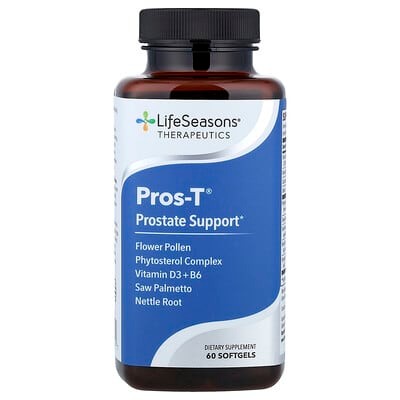

$48.99 $1.63 per serving


Product analysis
Pros-T combines botanicals with zinc, which may help when low intake affects hair health or testosterone. Unspecified botanical preparations make it difficult to apply findings from the particular extracts that have been tested.
AI assessment of the formula, label and price. How scoring works
Nutrient Quality30
Some nutrient forms are named, but their quality cannot be compared confidently. Several botanical preparations and the selenium form are unspecified, limiting a closer comparison.
Ingredient Transparency63
Amounts are disclosed for all listed ingredients, making basic serving comparisons possible. Many forms and the makeup of the phytosterol mixture remain unspecified.
Value For Money37
The full serving is expensive when chosen for its stinging nettle content. Other ingredient contributions cannot be compared reliably, leaving the value of the complete mix uncertain.
Customer Satisfaction70
Customer ratings are positive. The small review base leaves more uncertainty about how widely that satisfaction is shared.
Product Focus68
Zinc offers the clearest conditional contribution to hair and testosterone support when intake is low. The botanical preparations do not establish equivalence to the specific hair-study products.
- Format
Softgel - Container
- 60 Softgel(s)
- Per serving
- $1.63
- Customer rating
- 4.6 · 93 ratings
Goals

Impact
High effect
Vitamin D · 50 mcgZinc · 15 mg
Saw palmetto and pumpkin seed oil relate to androgen-associated thinning, but the supplied trials concern specific preparations or formulations. This product uses unidentified versions, so their hair effects cannot be assumed equivalent; its pumpkin oil amount is also below the trial comparison exposure. Zinc can help when intake is inadequate. Vitamin D and selenium receive saved recognition without establishing routine regrowth in adults with adequate nutrient status.
How this product is rated for Hair Health
Ingredient fit77
The declared formula is closely focused on the ingredients recognized for this goal. Recognized amounts receive a mixture of full and partial support against the saved comparison references.
Goal fit
The declared formula is closely focused on the ingredients recognized for this goal.
Dose adequacy
Recognized amounts receive a mixture of full and partial support against the saved comparison references.
Pathways19
The strongest saved category is dht and androgen signalling; this mapping does not itself establish a clinical hair outcome. None of the evaluated pathways meets the saved coverage threshold.
Depth
The strongest saved category is dht and androgen signalling; this mapping does not itself establish a clinical hair outcome.
Breadth
None of the evaluated pathways meets the saved coverage threshold.
Evidence91
Zinc leads the recognized evidence contribution, but preparation matching is incomplete for Saw Palmetto, Pumpkin Seed Oil.
Evidence strength
Zinc provides the strongest recognized evidence contribution at its declared amount; its practical limits are described with the ingredient above.
Studied preparation
Preparation matching is partial; Saw Palmetto, Pumpkin Seed Oil does not match the preparation recognized as studied.
Formulation logic100
No unmet partner requirement or configured conflict was found. The counted amounts meet the saved minimum comparison threshold.
Partner coverage
The recognized ingredients have no unmet partner requirement in the supplied findings.
Conflicts
No configured ingredient conflict was identified; this finding is limited to the interactions evaluated.
Effective doses
Every counted ingredient meets the saved minimum amount threshold; that threshold is not a proven effective hair-growth dose.
Impact
High effect
Zinc · 15 mgVitamin D · 50 mcg
Zinc can help support testosterone when low zinc status is responsible for reduced levels. Vitamin D findings do not establish enhancement in adequately nourished adults. Selenium's fertility-related evidence and B6's cofactor role do not establish an additional routine hormone benefit, while nettle falls below the saved inclusion threshold.
How this product is rated for Testosterone Support
Ingredient fit69
Four nutrients are retained; nettle falls below the inclusion threshold.
Goal fit
Four nutrients are retained; nettle falls below the inclusion threshold.
Dose adequacy
Zinc, selenium and B6 receive partial amount recognition, while vitamin D reaches its endpoint.
Pathways11
The retained findings provide limited testosterone-synthesis coverage.
Depth
Testosterone synthesis receives partial coverage.
Breadth
No hormone category reaches the coverage threshold.
Evidence91
Zinc leads the retained evidence finding, with practical relevance to deficiency-related low testosterone.
Evidence strength
Zinc leads the retained evidence finding, with practical relevance to deficiency-related low testosterone.
Studied preparation
B6 is not accepted as studied in the saved preparation finding; other retained preparations are accepted.
Formulation logic100
No required partner is missing. No configured conflict is triggered; this does not establish overall safety.
Partner coverage
No required partner is missing for retained ingredients; this does not establish added benefit from combining them.
Conflicts
No configured conflict is triggered; this does not establish overall safety.
Effective doses
All 4 retained ingredients meet the comparison amount threshold, which is not proof of an effective testosterone dose.
Stinging Nettle Not classified
No linked studies yet.
Vitamin B6 Not classified
No linked studies yet.

Impact
High effect
Vitamin D · 50 mcg
Vitamin D has mixed inflammatory-marker findings, including a transient hsCRP reduction in older adults at two years that was absent at four years. Other cytokines were unchanged. This does not establish broad, sustained anti-inflammatory benefit, and correcting deficiency is a separate conditional use.
How this product is rated for Inflammation
Ingredient fit67
Vitamin D provides the main relevant connection. The amount findings are partial rather than a confirmed clinical dose.
Goal fit
Vitamin D supplies the main relevant ingredient connection.
Dose adequacy
Known eligible amounts receive partial comparison recognition; unresolved amounts cannot establish an additional dose contribution.
Pathways57
The strongest retained connection concerns inflammatory gene signalling (nf-kb); this identifies a pathway link rather than proven clinical relief.
Depth
The strongest retained connection concerns inflammatory gene signalling (nf-kb); this identifies a pathway link rather than proven clinical relief.
Breadth
One pathway reaches the saved coverage threshold; broader coverage is not established.
Evidence93
Vitamin D supplies the strongest retained evidence connection, although sustained inflammatory benefit remains unestablished.
Evidence strength
Vitamin D supplies the strongest retained evidence connection, although sustained inflammatory benefit remains unestablished.
Studied preparation
Eligible material meets the saved preparation criteria; this does not establish clinical benefit from the exact product.
Formulation logic100
No unmet required partner or configured conflict was identified. Meeting amount criteria does not establish added benefit from combining ingredients.
Partner coverage
No unmet required partner was identified for the retained ingredients; their combination does not establish extra benefit.
Conflicts
No configured ingredient conflict was identified in the supplied findings.
Effective doses
Eligible ingredients meet the saved amount threshold; this is not proof of an effective treatment dose.
Ingredients
| Ingredient | Amount per serving | Score |
|---|---|---|
Zinc (Zinc Amino Acid Chelate) | 15 mg | |
Vitamin B6 (Pyridoxine Hydrochloride) | 10 mg | |
Selenium | 50 mcg | |
Vitamin D3 (Cholecalciferol) | 50 mcg | |
Phytosterol Complex (Beta-Sitosterol, Soy) | 800 mg | |
Swedish Flower pollen extract | 350 mg | |
Saw Palmetto berry extract | 320 mg | |
Nettle root extract | 100 mg | |
Pumpkin Seed Oil | 100 mg |
Stinging Nettle · 100 mg OverallScore74
Each serving provides 100 mg of stinging nettle extract. The evaluation identifies root or leaf, but the supplied facts do not show which.
How this ingredient is rated
Composition and Label Disclosure80
The evaluation identifies root or leaf, but the supplied facts do not show which. Nettle is identified as an extract; further preparation detail is not available in the supplied facts.
Root or Leaf Identity Disclosure
The evaluation identifies root or leaf, but the supplied facts do not show which.
Nettle Preparation and Marker Detail
Nettle is identified as an extract; further preparation detail is not available in the supplied facts.
Composition and Label Disclosure100
The serving lists 100 mg of stinging nettle extract.
Nettle Amount Disclosure
The serving lists 100 mg of stinging nettle extract.
Commercial Price and Usability10
A whole-product serving costs about $1.63.
Selected-Serving Price Comparison
A whole-product serving costs about $1.63.
Saw Palmetto · 320 mg OverallScore25
Each serving lists 320 mg of saw palmetto berry extract. The fatty-acid percentage is not recorded in the supplied facts, limiting comparisons of composition.
How this ingredient is rated
Composition and Label Disclosure30
The recorded form is saw palmetto berry extract, but its fatty-acid percentage is unavailable.
Marker and Preparation Disclosure
The supplied facts do not give a fatty-acid percentage for the saw palmetto berry extract.
Composition and Label Disclosure20
The saw palmetto amount is recorded for the serving, while fatty-acid content is unknown.
Amount and Label Disclosure
A serving lists 320 mg of saw palmetto berry extract; no fatty-acid percentage is recorded.
Commercial Price and Usability
No price assessment is available for saw palmetto.
Alternative products
Report alternatives
Sources
Published studies used for the product analysis and the top-ranked studies for each ingredient and goal.
- The Safety and Efficacy of a Proprietary Bioactive Fatty Acids Extract From Saw Palmetto (Serenoa repens) for Promoting Hair Growth and Reducing Hair Loss in Adults With Self-Perceived Thinning Hair: 90-Day Results.
- Effects of dietary supplements on androgenetic alopecia: a systematic review and network meta-analysis.
- The Safety and Efficacy of a Novel Saw Palmetto (Serenoa repens) Extract for Promoting Hair Growth in Adults With Self-Perceived Thinning Hair: 180-Day Results.
- Beyond Minoxidil: Off-Label Therapies for Male Androgenetic Alopecia-A Systematic Review with Network Meta-Analyses.
- Comparitive effectiveness of finasteride vs Serenoa repens in male androgenetic alopecia: a two-year study.
- Beyond Efficacy: 0.6% Selenium Disulfide Shampoo Matches 2% Ketoconazole for Seborrheic Dermatitis with Superior Cosmesis.
- Selenium Disulfide-based shampoo applied for 4 weeks significantly improves dandruff and seborrheic dermatitis.
- A Comparative Randomized Clinical Study Assessing the Efficacy of a 1% Selenium Disulfide-Based Shampoo versus 2% Ketoconazole Shampoo in Subjects with Moderate to Severe Scalp Seborrheic Dermatitis.
- Changes of serum trace elements level in patients with alopecia areata: A meta-analysis.
- Scientific opinion on the tolerable upper intake level for selenium.
- Increased prevalence of vitamin D deficiency in patients with alopecia areata: a systematic review and meta-analysis.
- Intralesional vitamin D3 in treatment of alopecia areata: A randomized controlled clinical trial.
- Vitamin D and its Analogs in Treatment of Mild to Moderate Alopecia Areata: Systematic Review and Meta-Analysis.
- Topical calcipotriol vs narrowband ultraviolet B in treatment of alopecia areata: a randomized-controlled trial.
- Serum 25 hydroxyvitamin D in non-scarring alopecia: A systematic review and meta-analysis.
- The effects of minoxidil, 1% pyrithione zinc and a combination of both on hair density: a randomized controlled trial.
- Incubatory environment of the scalp impacts pre-emergent hair to affect post-emergent hair cuticle integrity.
- A comparison of hair quality and cosmetic acceptance following the use of two anti-dandruff shampoos.
- BMI and levels of zinc, copper in hair, serum and urine of Turkish male patients with androgenetic alopecia.
- Analysis of serum zinc and copper concentrations in hair loss.