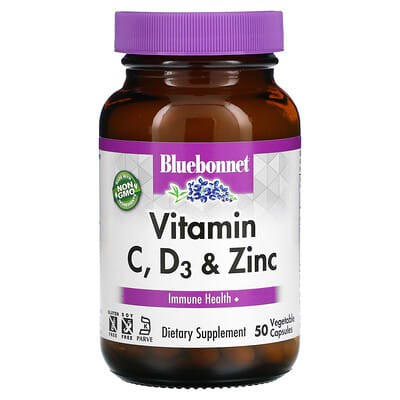

Vitamin C D3 & Zinc

Vitamin C D3 & Zinc

Bluebonnet4.7 (1,011 ratings)
Format:Capsule Quantity: 50 Capsule(s) · 50 servings
Goals
$9.20 $0.18 per serving

About this product

The supplied vitamin D declaration needs verification before a usage decision. It is recorded as 50 mg, an exceptionally large amount that cannot be silently interpreted as 50 mcg. The nutritional roles of vitamin D do not establish benefit or suitability at that recorded exposure.

The 50 mg zinc serving is also substantial and exceeds the supplied adult daily upper intake limit of 40 mg. Its bisglycinate source is a favorable form choice, but a favorable form does not offset an excessive daily amount. Copper content is not established, leaving the mineral balance unresolved.

Vitamin C at 250 mg and the other nutrients can support normal nutritional functions when intake falls short. They do not establish extra hair growth, improved routine vision or higher testosterone when needs are already met. The relatively low cost of the zinc contribution does not resolve the vitamin D unit concern or high-zinc suitability issue.

Who is it for
  • Adults assessing a combined nutrient supplement after its vitamin D unit and serving amount have been verified

Pros

  • Zinc bisglycinate is a favorable identified source
  • Vitamin C amount is clearly stated

Cons

  • Recorded vitamin D amount prevents a reliable routine-use assessment
  • Higher nutrient amounts do not establish stronger nutritional benefits
  • Copper content is unknown

Warnings

  • The supplied vitamin D declaration is 50 mg per serving; confirm the actual label amount and unit before taking it, as the recorded amount is exceptionally high.
  • The 50 mg zinc serving exceeds the supplied 40 mg adult daily upper intake limit and is unsuitable for casual ongoing use without an assessed reason.
  • Regular high zinc intake without adequate copper raises a copper-depletion concern; the supplied information does not establish copper content.


Product analysis

87 out of 100

Bluebonnet Vitamin C D3 & Zinc combines three nutrients intended to support immunity. Each capsule contains 250 mg of vitamin C and 50 mg of zinc as bisglycinate, and the label lists an exceptionally high 50 mg of vitamin D. Verify that vitamin D amount with the manufacturer or a healthcare professional before use because it poses a potential toxicity risk if accurate, and the zinc amount also exceeds the adult upper limit for long-term daily use.

AI assessment of the formula, label and price. How scoring works

Nutrient Quality84

Vitamin D3 and zinc bisglycinate are favorable nutrient forms, while vitamin C is supplied as L-ascorbic acid. Good forms do not offset the concern about very high nutrient amounts.

Ingredient Transparency100

The amounts and forms of all three ingredients are listed. The unusually high declared vitamin D amount warrants confirmation before use.

Value For Money90

The $0.18 capsule provides economical amounts of zinc and vitamin C. The favorable vitamin D price comparison uses the unusually high declared amount, so it should not be taken as a reason to use the product.

Customer Satisfaction82

Customer feedback averages 4.74 out of 5. There are 1,011 ratings, giving that positive feedback a substantial base.

Product Focus78

The three ingredients are well aligned with the intended immune-support purpose and also support other assessed nutritional goals. The focused formula avoids additional ingredients but contains substantial doses.

Format
Capsule
Container
50 Capsule(s)
Per serving
$0.18
Customer rating
4.7 · 1,011 ratings
Report analysis

Goals

Impact
Highest effect
B+ Ingredient FitC PathwaysB+ EvidenceA Formulation Logic
Zinc · 50 mgVitamin C · 250 mg

Vitamin C D3 & Zinc is a poor routine eye-health choice until its vitamin D declaration is verified. The supplied label records 50 mg of vitamin D3, an unusually large declared amount, and the 50 mg zinc serving lacks copper in the supplied formula. Vitamin C at 250 mg contributes to retinal and lens antioxidant defense, while zinc's eye-health evidence concerns a defined combination for selected people.

Study evidence
Zinc Supportive
Impact
Highest effect
A- Ingredient FitD- PathwaysA+ EvidenceA+ Formulation Logic
Vitamin D · 50 mgZinc · 50 mgVitamin C · 250 mg

Vitamin C D3 & Zinc offers nutrient support for hair health, led by zinc, but its vitamin D declaration needs verification before choosing it. The supplied serving lists 50 mg vitamin D, equivalent to 50,000 mcg, and suitability at that exposure is unassessed. Zinc at 50 mg may help when inadequate zinc contributes to shedding, while 250 mg vitamin C supports normal collagen synthesis and iron absorption.

Study evidence
Zinc Supportive
Testosterone Support
Impact
High effect
B+ Ingredient FitF PathwaysA EvidenceA Formulation Logic
Zinc · 50 mgVitamin D · 50 mg

Vitamin C D3 & Zinc requires clarification of its vitamin D declaration before it is a practical testosterone-support choice: the stored amount is 50 mg, equivalent to 50,000 mcg. Its 50 mg of zinc also triggers the documented zinc-without-copper concern. Zinc and vitamin D have conditional hormone relevance when their nutritional status is inadequate.

Study evidence
Zinc Disputed
Skin Health
Impact
High effect
B- Ingredient FitF PathwaysA+ EvidenceA+ Formulation Logic
Zinc · 50 mgVitamin C · 250 mg

Vitamin C D3 & Zinc has a limited skin-health fit centred on nutritional support when intake is inadequate. Vitamin C at 250 mg as l-ascorbic acid supports collagen formation. Zinc at 50 mg supports normal skin maintenance when zinc status is low.

Study evidence
Zinc Supportive
Immunity
Impact
Highest effect
B+ Ingredient FitA+ PathwaysA+ EvidenceA Formulation Logic
Vitamin C · 250 mgZinc · 50 mgVitamin D · 50 mg

Vitamin C D3 & Zinc requires verification of its vitamin D declaration before a practical immunity choice can be made: the supplied amount is 50,000 mcg per serving. Its 50 mg of zinc supports normal immune-cell function but raises a high-zinc-without-copper concern. The 250 mg of vitamin C adds a narrower connection to modest cold-duration support with regular use.

Study evidence
Zinc Supportive
Everyday Health
Impact
Highest effect
B+ Ingredient FitB+ PathwaysB+ EvidenceA Formulation Logic
Vitamin D · 50 mgZinc · 50 mgVitamin C · 250 mg

Vitamin C D3 & Zinc needs its recorded vitamin D amount checked against the label before routine use: the supplied record says 50,000 mcg per serving. Zinc at 50 mg without copper also carries a copper-deficiency concern. Vitamin C at 250 mg contributes to normal antioxidant and immune functions, while vitamin D’s nutritional role is calcium handling and bone maintenance.

Study evidence
Zinc Supportive

Ingredients

IngredientAmount per servingScore
Vitamin C (L-Ascorbic Acid)
250 mg
Vitamin D (Cholecalciferol)
50 mg
Zinc (Zinc Bisglycinate Chelate)
50 mg 80
Gluten Free Adults 18–50 Kosher Dairy Free Sugar Free
Report overview
A+ Active Ingredient Quality & BioavailabilityD+ Dose, Safety & Label TransparencyA+ Value
Bluebonnet Vitamin C D3 & Zinc provides 50 mg zinc per serving; it uses zinc bisglycinate. The 50 mg dose exceeds the adult upper limit for long-term daily use without supervision. The copper amount is unknown, so the zinc-to-copper balance cannot be determined. Its zinc comparison price is low at $0.04 per 10 mg of zinc; a serving of the full formula costs $0.18.
Report alternatives

Sources

Published studies used for the product analysis and the top-ranked studies for each ingredient and goal.

  1. Dietary intake and blood concentrations of antioxidants and the risk of cardiovascular disease, total cancer, and all-cause mortality: a systematic review and dose-response meta-analysis of prospective studies.
    Aune D; Keum N; Giovannucci E; Fadnes LT; Boffetta P; Greenwood DC; Tonstad S; Vatten LJ; Riboli E; Norat T · The American journal of clinical nutrition · 2019
    Meta-analysis69 studies pooledEveryday Health forVitamin C
  2. Scientific Opinion on the substantiation of a health claim related to vitamin C and increasing non haem iron absorption pursuant to Article 14 of Regulation (EC) No 1924/2006.
    EFSA Panel on Dietetic Products, Nutrition and Allergies (NDA) · EFSA journal. European Food Safety Authority · 2026
    Guideline / consensusEveryday Health forVitamin C
  3. Vitamin C Depletion and All-Cause Mortality in Renal Transplant Recipients.
    Sotomayor CG; Eisenga MF; Gomes Neto AW; Ozyilmaz A; Gans ROB; Jong WHA; Zelle DM; Berger SP; Gaillard CAJM; Navis GJ; Bakker SJ · Nutrients · 2018
    Cohort study598 participantsEveryday Health forVitamin C
  4. Associations of Serum Biomarkers of Fruit and Vegetable Intake With the Risk of Cause-Specific Mortality and All-Cause Mortality: A National Prospective Cohort Study.
    Pu L; Zhang R; Wang X; Zhao T; Sun H; Han L · Frontiers in nutrition · 2022
    Cohort study12,530 participantsEveryday Health forVitamin C
  5. Relation between plasma ascorbic acid and mortality in men and women in EPIC-Norfolk prospective study: a prospective population study. European Prospective Investigation into Cancer and Nutrition.
    Khaw KT; Bingham S; Welch A; Luben R; Wareham N; Oakes S; Day N · Lancet (London, England) · 2001
    Cohort study19,496 participantsEveryday Health forVitamin C
  6. Vitamin D supplementation for prevention of mortality in adults.
    Bjelakovic G; Gluud LL; Nikolova D; Whitfield K; Wetterslev J; Simonetti RG; Bjelakovic M; Gluud C · The Cochrane database of systematic reviews · 2014
    Meta-analysis95,286 participants159 studies pooledEveryday Health forVitamin D
  7. Effect of vitamin D on gastrointestinal symptoms and health-related quality of life in irritable bowel syndrome patients: a randomized double-blind clinical trial.
    Abbasnezhad A; Amani R; Hajiani E; Alavinejad P; Cheraghian B; Ghadiri A · Neurogastroenterology and motility · 2018
    Randomized trial90 participantsEveryday Health forVitamin D
  8. The impact of vitamin D administration on mortality in COVID-19 patients: a systematic review and meta-analysis of randomized controlled trials.
    Kow CS; Ramachandram DS; Hasan SS; Wong Z; Thiruchelvam K · Inflammopharmacology · 2024
    Meta-analysis2,495 participants19 studies pooledEveryday Health forVitamin D
  9. Vitamin D Status and Mortality: A Systematic Review of Observational Studies.
    Heath AK; Kim IY; Hodge AM; English DR; Muller DC · International journal of environmental research and public health · 2019
    Systematic review84 studies pooledEveryday Health forVitamin D
  10. Meta-analysis of long-term vitamin D supplementation on overall mortality.
    Zheng Y; Zhu J; Zhou M; Cui L; Yao W; Liu Y · PloS one · 2014
    Meta-analysis42 studies pooledEveryday Health forVitamin D
  11. Effectiveness of sodium bicarbonate and zinc chloride mouthwashes in the treatment of oral mucositis and quality of life in patients with cancer under chemotherapy.
    Mohammadi F; Oshvandi K; Kamallan SR; Khazaei S; Ranjbar H; Ahmadi-Motamayel F; Gillespie M; Jenabi E; Vafaei SY · Nursing open · 2022
    Randomized trial144 participantsEveryday Health forZinc
  12. Zinc supplementation in young children with acute diarrhea in India.
    Sazawal S; Black RE; Bhan MK; Bhandari N; Sinha A; Jalla S · The New England journal of medicine · 1995
    Randomized trial937 participantsEveryday Health forZinc
  13. Associations of mortality with ocular disorders and an intervention of high-dose antioxidants and zinc in the Age-Related Eye Disease Study: AREDS Report No. 13.
    Clemons TE; Kurinij N; Sperduto RD; AREDS Research Group · Archives of ophthalmology (Chicago, Ill. : 1960) · 2004
    Randomized trial4,753 participantsEveryday Health forZinc
  14. Effects of zinc and probiotic co-supplementation on inflammation, gastrointestinal symptoms, quality of life, and mood in irritable bowel syndrome patients.
    Rezazadegan M; Soheilipour M; Amani R · Scientific reports · 2026
    Randomized trial84 participantsEveryday Health forZinc
  15. Effect of zinc sulfate supplementation on premenstrual syndrome and health-related quality of life: Clinical randomized controlled trial.
    Siahbazi S; Behboudi-Gandevani S; Moghaddam-Banaem L; Montazeri A · The journal of obstetrics and gynaecology research · 2018
    Randomized trial142 participantsEveryday Health forZinc
  16. Role of Oral Vitamin 'C' on Astigmatic Errors in Phacoemulsification.
    Mohan S; Sah K; Khattri M; Ahmad L; Sachan SK · Current eye research · 2021
    Randomized trial400 participantsEye Health forVitamin C
  17. Ascorbic acid metabolites are involved in intraocular pressure control in the general population.
    Hysi PG; Khawaja AP; Menni C; Tamraz B; Wareham N; Khaw KT; Foster PJ; Benet LZ; Spector TD; Hammond CJ · Redox biology · 2019
    Observational studyEye Health forVitamin C
  18. Nutritional modulation of cataract.
    Weikel KA; Garber C; Baburins A; Taylor A · Nutrition reviews · 2014
    Narrative reviewEye Health forVitamin C
  19. Dietary n-3 Fatty Acid, α-Tocopherol, Zinc, vitamin D, vitamin C, and β-carotene are Associated with Age-Related Macular Degeneration in Japan.
    Aoki A; Inoue M; Nguyen E; Obata R; Kadonosono K; Shinkai S; Hashimoto H; Sasaki S; Yanagi Y · Scientific reports · 2017
    Case-control study530 participantsEye Health forVitamin C
  20. Adherence to a Mediterranean diet, lifestyle and age-related macular degeneration: the Coimbra Eye Study - report 3.
    Raimundo M; Mira F; Cachulo MDL; Barreto P; Ribeiro L; Farinha C; Laíns I; Nunes S; Alves D; Figueira J; Merle BM; Delcourt C; Santos L; Silva R · Acta ophthalmologica · 2019
    Case-control study883 participantsEye Health forVitamin C