


Zinc Supportive
$19.12 $0.10 per serving
Product analysis
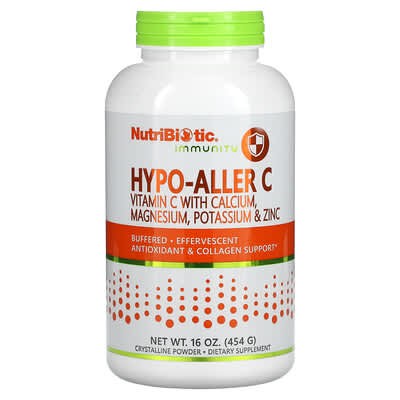
NutriBiotic Immunity Hypo-Aller C offers vitamin C for normal immune function and antioxidant support, with 1,300 mg in a half-teaspoon serving of powder. It dissolves with calcium, magnesium and other minerals to form a buffered, less acidic drink, and provides 175 mg of magnesium alongside the vitamin C. Both nutrients offer good value for their amounts.
AI assessment of the formula, label and price. How scoring works
Nutrient Quality39
The powder supplies L-ascorbic acid and a well-regarded potassium form. Calcium carbonate has moderate assessed absorption potential, while magnesium carbonate and zinc sulfate are less favored forms.
Ingredient Transparency100
All five assessed ingredients have both their amounts and forms identified. The information makes it straightforward to compare the labeled nutrient quantities and sources.
Value For Money86
The vitamin C, magnesium and potassium are very economical when compared by amount. Calcium and zinc also offer good value, though the formula contains only small amounts of some minerals.
Customer Satisfaction85
Customer feedback is very positive at 4.78 out of 5 stars. More than 1,500 ratings give that average a substantial base of feedback.
Product Focus73
The formula is centered on vitamin C and everyday nutritional support, with magnesium providing a complementary role. Five active ingredients and five potential goals keep the formula relatively focused.
- Format
Powder - Container
- 16 Ounce(s)
- Per serving
- $0.10
- Customer rating
- 4.8 · 1,507 ratings
Goals

Impact
High effect
Magnesium · 175 mgVitamin C · 1300 mgZinc · 2 mg
Hypo-Aller C is mainly a vitamin C option for modest regular-use cold-duration support. Its 1,300 mg of vitamin C also supports normal immune-cell activity. The 2 mg zinc amount supplies only a small nutritional contribution to normal immune function.
Vitamin C Supportive
Magnesium Supportive

Impact
High effect
Vitamin C · 1300 mg
Hypo-Aller C is a relatively focused antioxidant formula with a conditional fit for inflammation. Its 1300 mg of vitamin C provides antioxidant support, while 175 mg of magnesium may help when low magnesium status contributes to inflammation. Vitamin C supplies the larger assessed contribution, and magnesium adds a smaller nutritional role.
Zinc Supportive
Vitamin C Supportive
Magnesium Supportive

Impact
High effect
Magnesium · 175 mgZinc · 2 mgVitamin C · 1300 mg
Hypo-Aller C offers focused nutritional support for everyday health. Vitamin C at 1300 mg supplies the main antioxidant and immune-function contribution. Magnesium at 175 mg adds a smaller contribution to normal energy and mineral metabolism.
Magnesium Supportive
Zinc Supportive
Vitamin C Supportive

Impact
High effect
Zinc · 2 mgVitamin C · 1300 mg
Hypo-Aller C has a narrow eye-health fit centered on vitamin C and antioxidant support. Its 1300 mg of L-ascorbic acid supplies vitamin C for the antioxidant defenses of the retina and lens. The formula is therefore more suited to that nutritional role than to broad support across different aspects of vision.
Zinc Supportive
Vitamin C Disputed

Impact
High effect
Zinc · 2 mgVitamin C · 1300 mg
Hypo-Aller C is mainly a vitamin C option for filling a nutritional gap that can affect skin health. Its 1,300 mg of L-ascorbic acid supports collagen formation, with the clearest benefit when vitamin C intake is inadequate. The larger vitamin C amount does not by itself imply a greater skin benefit.
Zinc Supportive
Vitamin C Supportive
Ingredients
| Ingredient | Amount per serving | Score |
|---|---|---|
Vitamin C (L-Ascorbic Acid) | 1300 mg | |
Calcium (Calcium Carbonate) | 125 mg | |
Magnesium (Magnesium Carbonate) | 175 mg | |
Zinc (Zinc Sulfate) | 2 mg | |
Potassium (Potassium Bicarbonate) | 50 mg |
Vitamin C (L-Ascorbic Acid) · 1300 mg OverallScore67
NutriBiotic Immunity Hypo-Aller C offers good value for vitamin C at $0.061 per 1,000 mg vitamin C, with a $0.079 serving price. Each serving supplies 1300 mg. Vitamin C comes as L-Ascorbic Acid. The formula is described as partially buffered. The available other-ingredient information does not flag the listed additive concerns.
Alternative products
Report alternatives
Sources
Published studies used for the product analysis and the top-ranked studies for each ingredient and goal.
- Perioperative systemic magnesium to minimize postoperative pain: a meta-analysis of randomized controlled trials.
- Long-term outcome after intravenous magnesium sulphate in suspected acute myocardial infarction: the second Leicester Intravenous Magnesium Intervention Trial (LIMIT-2).
- Association of magnesium sulfate use with mortality in critically ill patients with sepsis: a retrospective propensity score-matched cohort study.
- Hypomagnesemia and Mortality in Incident Hemodialysis Patients.
- The effects of magnesium supplementation on abnormal uterine bleeding, alopecia, quality of life, and acne in women with polycystic ovary syndrome: a randomized clinical trial.
- Dietary intake and blood concentrations of antioxidants and the risk of cardiovascular disease, total cancer, and all-cause mortality: a systematic review and dose-response meta-analysis of prospective studies.
- Scientific Opinion on the substantiation of a health claim related to vitamin C and increasing non haem iron absorption pursuant to Article 14 of Regulation (EC) No 1924/2006.
- Vitamin C Depletion and All-Cause Mortality in Renal Transplant Recipients.
- Associations of Serum Biomarkers of Fruit and Vegetable Intake With the Risk of Cause-Specific Mortality and All-Cause Mortality: A National Prospective Cohort Study.
- Relation between plasma ascorbic acid and mortality in men and women in EPIC-Norfolk prospective study: a prospective population study. European Prospective Investigation into Cancer and Nutrition.
- Effectiveness of sodium bicarbonate and zinc chloride mouthwashes in the treatment of oral mucositis and quality of life in patients with cancer under chemotherapy.
- Zinc supplementation in young children with acute diarrhea in India.
- Associations of mortality with ocular disorders and an intervention of high-dose antioxidants and zinc in the Age-Related Eye Disease Study: AREDS Report No. 13.
- Effects of zinc and probiotic co-supplementation on inflammation, gastrointestinal symptoms, quality of life, and mood in irritable bowel syndrome patients.
- Effect of zinc sulfate supplementation on premenstrual syndrome and health-related quality of life: Clinical randomized controlled trial.
- Role of Oral Vitamin 'C' on Astigmatic Errors in Phacoemulsification.
- Ascorbic acid metabolites are involved in intraocular pressure control in the general population.
- Nutritional modulation of cataract.
- Dietary n-3 Fatty Acid, α-Tocopherol, Zinc, vitamin D, vitamin C, and β-carotene are Associated with Age-Related Macular Degeneration in Japan.
- Adherence to a Mediterranean diet, lifestyle and age-related macular degeneration: the Coimbra Eye Study - report 3.