


Magnesium Supportive
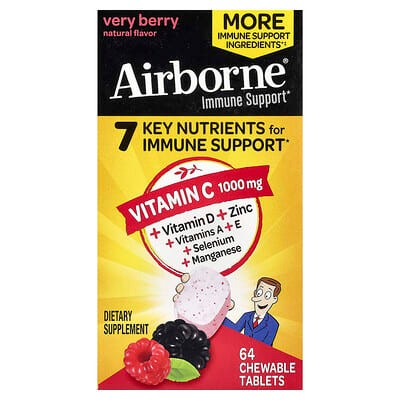
$14.63 $0.91 per serving
Product analysis
Airborne Original Very Berry chewables support normal immune function with 1,000 mg of vitamin C, 8 mg of zinc and 600 mcg of vitamin A per four-tablet serving. The chewable format requires no water, but the full serving contains 3 g of added sugar and the vitamin C represents only moderate value.
AI assessment of the formula, label and price. How scoring works
Nutrient Quality31
The chews pair two forms of vitamin C with zinc and magnesium forms that compare less favorably for absorption. Vitamin C is the main nutritional contribution, and the amount of each herb in the blend is unclear.
Ingredient Transparency69
The label gives clear totals for the four-chew serving and names most nutrient forms. It leaves out how the vitamin C, magnesium and herbal blend totals are divided among their components.
Value For Money39
The vitamin C is fairly priced for a full four-chew serving. Several companion nutrients, especially vitamin E and magnesium, offer less for the money.
Customer Satisfaction81
Customers rate the chews highly. The feedback comes from nearly a thousand ratings, giving a broad view of how buyers feel about them.
Product Focus35
The chewables have a clear immune focus, with vitamin C and zinc doing most of the work. The added nutrients have broader roles, and the herbal blend’s contribution is harder to judge.
- Format
Tablet - Container
- 64 Tablet(s)
- Per serving
- $0.91
- Also available
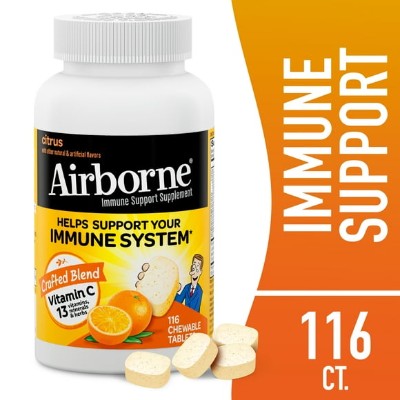 Airborne Original Citrus$21.99
- Customer rating
- 4.7 · 993 ratings
Goals

Impact
High effect
Magnesium · 40 mgSelenium · 15 mcgZinc · 8 mgVitamin C · 1000 mg
Airborne Original Very Berry offers vitamin C and supporting nutrient coverage for everyday health when dietary intake is inadequate. Vitamin C at 1,000 mg per selected serving supports antioxidant and normal immune functions. Zinc at 8 mg adds a smaller contribution to normal immune function.
Selenium Supportive
Zinc Supportive
Vitamin C Supportive
Impact
High effect
Zinc · 8 mgVitamin C · 1000 mgSelenium · 15 mcgVitamin E · 13.5 mg
Airborne Original Very Berry is mainly a nutritional option for skin health when vitamin C or zinc intake is inadequate. Vitamin C at 1000 mg supports collagen formation, while 8 mg zinc supports skin repair; their skin benefit depends on correcting a dietary gap. The optional repeat-use directions do not establish three mandatory daily servings, so these amounts describe one selected serving.
Vitamin A Supportive
Zinc Supportive
Vitamin C Supportive
Vitamin E Supportive
Selenium Supportive

Impact
Highest effect
Magnesium · 40 mgVitamin C · 1000 mgZinc · 8 mgVitamin A · 600 mcgSelenium · 15 mcg
Airborne Original Very Berry offers immune nutrition led by 1000 mg of vitamin C, which supports immune-cell function and may modestly shorten colds with regular use. Zinc at 8 mg supports normal immune function, while vitamin A at 600 mcg RAE helps maintain protective barriers.
Vitamin A Supportive
Zinc Supportive
Vitamin C Supportive
Selenium Mixed
Vitamin E Supportive
Magnesium Supportive

Impact
High effect
Zinc · 8 mgVitamin E · 13.5 mgVitamin C · 1000 mgVitamin A · 600 mcg
Airborne Original Very Berry offers a limited nutritional fit for routine eye health. Vitamin C at 1000 mg (Ascorbic Acid, Sodium Ascorbate) contributes to retinal and lens antioxidant defense. Vitamin A at 600 mcg (Retinyl Acetate) supports the visual cycle when intake is inadequate.
Vitamin A Supportive
Zinc Supportive
Vitamin E Disputed
Vitamin C Disputed
Selenium Supportive

Impact
High effect
Vitamin E · 13.5 mgVitamin C · 1000 mg
Airborne Original Very Berry has a limited inflammation-related fit led by vitamin C, particularly when inflammation markers are already elevated. The 1,000 mg vitamin C serving provides the main antioxidant contribution. Zinc at 8 mg adds a smaller role in correcting inadequate intake that can contribute to inflammatory signaling.
Zinc Supportive
Vitamin C Supportive
Magnesium Supportive
Selenium Supportive
Vitamin E Supportive
Ingredients
| Ingredient | Amount per serving | Score |
|---|---|---|
Calories | 15 Calorie(s) | |
Total Carbohydrates | 3 Gram(s) | |
Vitamin A (Retinyl Acetate) | 600 mcg | |
Vitamin C (Ascorbic Acid, Sodium Ascorbate) | 1000 mg | |
Vitamin E (DL-Alpha-Tocopheryl Acetate) | 13.5 mg | |
Magnesium (Magnesium Oxide, Magnesium Sulfate) | 40 mg | |
Zinc (Zinc Sulfate) | 8 mg | |
Selenium (Selenium Amino Acid Chelate) | 15 mcg | |
Manganese (Manganese Gluconate) | 3 mg | |
Sodium | 40 mg | |
Proprietary Herbal Blend | 35.5 mg |
Manganese (Manganese Gluconate) · 3 mg OverallScore79
Airborne Airborne Original Very Berry provides manganese as manganese gluconate, with 3 mg per serving. The moderate comparison price is $0.60 per 2 mg of manganese, while the full formula costs $0.90 per serving.
Vitamin C (Ascorbic Acid, Sodium Ascorbate) · 1000 mg OverallScore78
Airborne Airborne Original Very Berry offers moderate value for vitamin C, with 1000 mg per serving. The vitamin C source is sodium ascorbate. The mineral ascorbate form is buffered. A sweetener is indicated, but its identity is unspecified. At $0.90 per 1,000 mg of vitamin C per serving for the full formula, the vitamin C comparison is moderate value.
Alternative products
Report alternatives
Sources
Published studies used for the product analysis and the top-ranked studies for each ingredient and goal.
- Perioperative systemic magnesium to minimize postoperative pain: a meta-analysis of randomized controlled trials.
- Long-term outcome after intravenous magnesium sulphate in suspected acute myocardial infarction: the second Leicester Intravenous Magnesium Intervention Trial (LIMIT-2).
- Association of magnesium sulfate use with mortality in critically ill patients with sepsis: a retrospective propensity score-matched cohort study.
- Hypomagnesemia and Mortality in Incident Hemodialysis Patients.
- The effects of magnesium supplementation on abnormal uterine bleeding, alopecia, quality of life, and acne in women with polycystic ovary syndrome: a randomized clinical trial.
- Associations of selenium status with all-cause and cause-specific mortality: a systematic review and meta-analysis of cohort studies.
- Dietary Antioxidants, Circulating Antioxidant Concentrations, Total Antioxidant Capacity, and Risk of All-Cause Mortality: A Systematic Review and Dose-Response Meta-Analysis of Prospective Observational Studies.
- The efficacy and safety of selenium supplementation versus placebo in the treatment of Graves' orbitopathy: A systematic review and meta-analysis of randomised controlled trials.
- Associations of plasma metal concentrations with the risks of all-cause and cardiovascular disease mortality in Chinese adults.
- Updates on clinical studies of selenium supplementation in radiotherapy.
- Dietary intake and blood concentrations of antioxidants and the risk of cardiovascular disease, total cancer, and all-cause mortality: a systematic review and dose-response meta-analysis of prospective studies.
- Scientific Opinion on the substantiation of a health claim related to vitamin C and increasing non haem iron absorption pursuant to Article 14 of Regulation (EC) No 1924/2006.
- Vitamin C Depletion and All-Cause Mortality in Renal Transplant Recipients.
- Associations of Serum Biomarkers of Fruit and Vegetable Intake With the Risk of Cause-Specific Mortality and All-Cause Mortality: A National Prospective Cohort Study.
- Relation between plasma ascorbic acid and mortality in men and women in EPIC-Norfolk prospective study: a prospective population study. European Prospective Investigation into Cancer and Nutrition.
- Effectiveness of sodium bicarbonate and zinc chloride mouthwashes in the treatment of oral mucositis and quality of life in patients with cancer under chemotherapy.
- Zinc supplementation in young children with acute diarrhea in India.
- Associations of mortality with ocular disorders and an intervention of high-dose antioxidants and zinc in the Age-Related Eye Disease Study: AREDS Report No. 13.
- Effects of zinc and probiotic co-supplementation on inflammation, gastrointestinal symptoms, quality of life, and mood in irritable bowel syndrome patients.
- Effect of zinc sulfate supplementation on premenstrual syndrome and health-related quality of life: Clinical randomized controlled trial.