
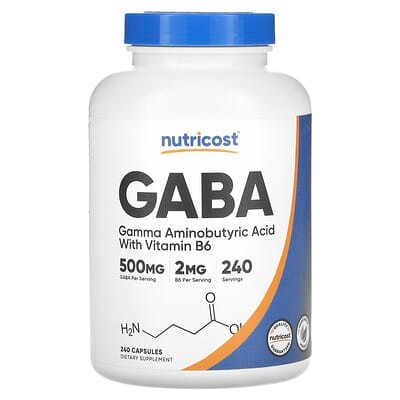

$16.95 $0.07 per serving

Product analysis
GABA 500 mg offers a low-cost GABA supplement with a tentative link to short-term calming effects. The GABA preparation is unspecified, limiting comparison with particular forms.
AI assessment of the formula, label and price. How scoring works
Nutrient Quality27
The vitamin B6 form is identified, but a comparative quality advantage remains unclear. GABA preparation details are missing, limiting comparison with alternatives.
Ingredient Transparency81
Both ingredient amounts are stated, helping you check the serving. The GABA form is unspecified, making preparation comparisons difficult.
Value For Money79
GABA compares favorably on serving cost. Value for the small vitamin B6 addition remains uncertain.
Customer Satisfaction84
Customer feedback is very positive across more than a thousand ratings. Buyer approval does not establish sustained stress relief or better sleep.
Product Focus70
GABA has limited short-term stress findings, while its sleep contribution remains uncertain. The small vitamin B6 addition does not establish an independent sleep benefit.
- Format
Capsule - Container
- 240 Capsule(s)
- Per serving
- $0.07
- Customer rating
- 4.8 · 1,251 ratings
Goals

Impact
Highest effect
GABA · 500 mgVitamin B6 · 2 mg

Impact
Moderate effect
Ingredients
| Ingredient | Amount per serving | Score |
|---|---|---|
Vitamin B6 (Pyridoxine Hydrochloride) | 2 mg | |
Gamma Aminobutyric Acid | 500 mg |
GABA · 500 mg OverallScore85
The selected serving provides 500 mg of GABA at a low cost per serving. The GABA is unbranded, and its source is unspecified. The other ingredients include a flow agent.
How this ingredient is rated
Active Ingredient Quality & Bioavailability70
The GABA is unbranded and its source is unspecified.
GABA Source & Production Method
The GABA is unbranded and its source is unspecified.
Dose, Safety & Label Transparency93
The serving states 500 mg of GABA. The other ingredients include a flow agent.
GABA Dosage Adequacy & Transparency
The selected serving contains 500 mg of GABA.
Label Purity & Excipient Quality
The other ingredients include a flow agent.
Value100
The cost per serving is low.
Price per Effective Dose
The cost per serving is low.
Alternative products
Report alternatives
Sources
Published studies used for the product analysis and the top-ranked studies for each ingredient and goal.
- Safety and Efficacy of Gamma-Aminobutyric Acid from Fermented Rice Germ in Patients with Insomnia Symptoms: A Randomized, Double-Blind Trial.
- Analysis of the Effects of Known Sleep-Support Supplements in Relation to Life Habits, Sleep Conditions, and Sleep Problems.
- Reduced γ-aminobutyric acid in occipital and anterior cingulate cortices in primary insomnia: a link to major depressive disorder?
- GABA Supplementation, Increased Heart-Rate Variability, Emotional Response, Sleep Efficiency and Reduced Depression in Sedentary Overweight Women Undergoing Physical Exercise: Placebo-Controlled, Randomized Clinical Trial.
- Efficacy of vitamins B1 and B6 as an adjunctive therapy to lithium in bipolar-I disorder: A double-blind, randomized, placebo-controlled, clinical trial.
- Therapeutic effects of magnesium and vitamin B6 in alleviating the symptoms of restless legs syndrome: a randomized controlled clinical trial.
- Effects of poly-gamma-glutamic acid and vitamin B6 supplements on sleep status: a randomized intervention study.
- Effects of Vitamin B6 (Pyridoxine) and a B Complex Preparation on Dreaming and Sleep.
- The effect of pyridoxine administration on melatonin secretion in normal men.
- Oral intake of γ-aminobutyric acid affects mood and activities of central nervous system during stressed condition induced by mental tasks.
- Relieving occupational fatigue by consumption of a beverage containing γ-amino butyric acid.
- Cortical gamma-aminobutyric acid and glutamate in posttraumatic stress disorder and their relationships to self-reported sleep quality.
- Comparison of the effects of two amino acids, Gamma-aminobutyric acid (GABA) and L-theanine, on sedation, anxiety, and cognition in preoperative surgical patients - A randomized controlled study.
- Effect of magnesium and vitamin B6 supplementation on mental health and quality of life in stressed healthy adults: Post-hoc analysis of a randomised controlled trial.
- Can Vitamin B6 Help to Prevent Postpartum Depression? A Randomized Controlled Trial.
- RENAL PROTECTIVE EFFECT AND CLINICAL ANALYSIS OF VITAMIN B 6 IN PATIENTS WITH SEPSIS.
- Superiority of magnesium and vitamin B6 over magnesium alone on severe stress in healthy adults with low magnesemia: A randomized, single-blind clinical trial.
- Associations between dietary intake of B-vitamins and psychological disorders among Iranian women: a cross-sectional study.