
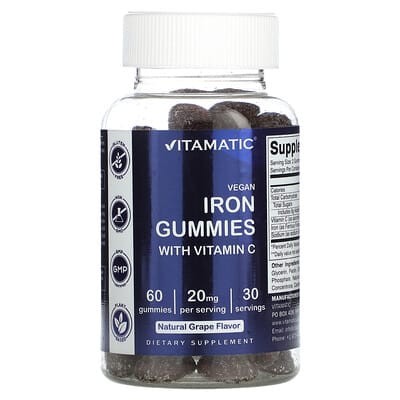
Iron Gummies 20 mg with Vitamin C Natural Grape Flavor

Goals
$11.99 $0.39 per serving

Product analysis
Iron Gummies 20 mg with Vitamin C Natural Grape Flavor provides iron to help fill a dietary gap that can contribute to tiredness. Its clearest role is supporting people whose iron intake or stores are low.
AI assessment of the formula, label and price. How scoring works
Nutrient Quality37
Iron and vitamin C forms are identified, but their quality cannot be compared confidently from the available information. The named forms alone do not establish an absorption advantage.
Ingredient Transparency85
Amounts are listed for all entries, and the iron and vitamin C forms are identified. Some other entries lack form details, so disclosure is useful without being complete.
Value For Money44
The iron contribution offers a middle-range value comparison for the cost of a serving. Vitamin C's value is unresolved, limiting a judgment about the combination as a whole.
Customer Satisfaction74
Customer ratings are positive. The size of the review pool helps put that satisfaction in context, without proving effectiveness or safety.
Product Focus61
Iron is relevant to tiredness, concentration and exercise capacity when low iron is limiting normal function. Those roles do not establish extra energy, hair growth or performance when iron status is adequate.
- Format
Gummy - Container
- 60 Gummy(ies)
- Per serving
- $0.39
- Customer rating
- 4.5 · 645 ratings
Goals

Impact
High effect
Iron · 20 mgVitamin C · 26 mg



Impact
Moderate effect
Iron · 20 mg
Ingredients
| Ingredient | Amount per serving | Score |
|---|---|---|
Calories | 18 Calorie(s) | |
Total Carbohydrate | 5 Gram(s) | |
Vitamin C (Ascorbic Acid) | 26 mg | |
Iron, Microencapsulated (Ferric Saccharate) | 20 mg | |
Sodium (Sodium Citrate) | 5 mg |
Iron (Ferric Saccharate) · 20 mg OverallScore79
Alternative products
Report alternatives
Sources
Published studies used for the product analysis and the top-ranked studies for each ingredient and goal.
- Large-dose intravenous ferric carboxymaltose injection for iron deficiency anemia in heavy uterine bleeding: a randomized, controlled trial.
- The Effect of Parenteral or Oral Iron Supplementation on Fatigue, Sleep, Quality of Life and Restless Legs Syndrome in Iron-Deficient Blood Donors: A Secondary Analysis of the IronWoMan RCT.
- Ferric carboxymaltose vs. oral iron in the treatment of pregnant women with iron deficiency anemia: an international, open-label, randomized controlled trial (FER-ASAP).
- Effect of iron therapy on fatigue symptoms in non-anaemic iron deficient women of reproductive age- A Randomized Controlled Trial.
- Intravenous iron isomaltoside treatment of women suffering from severe fatigue after postpartum hemorrhage.
- Ferric carboxymaltose in patients with heart failure and iron deficiency.
- Marginal iron deficiency without anemia impairs aerobic adaptation among previously untrained women.
- Ferric Carboxymaltose Versus Ferrous Fumarate in Anemic Children with Inflammatory Bowel Disease: The POPEYE Randomized Controlled Clinical Trial.
- Daily iron supplementation for improving anaemia, iron status and health in menstruating women.
- Altered metabolic response of iron-depleted nonanemic women during a 15-km time trial.
- Additive effects of beta-alanine and sodium bicarbonate on upper-body intermittent performance.
- Sodium Hyperhydration Improves Performance With No Change in Thermal and Cardiovascular Strain in Female Cyclists Exercising in the Heat Across the Menstrual Cycle.
- Sodium bicarbonate supplementation improves severe-intensity intermittent exercise under moderate acute hypoxic conditions.
- International Society of Sports Nutrition position stand: sodium bicarbonate and exercise performance.
- The effects of sodium bicarbonate ingestion on swimming interval performance in trained competitive swimmers.
- Inter-individual variability in redox and performance responses after antioxidant supplementation: A randomized double blind crossover study.
- Antioxidant supplementation, redox deficiencies and exercise performance: A falsification design.
- A significant relationship between plasma vitamin C concentration and physical performance among Japanese elderly women.
- Low vitamin C values are linked with decreased physical performance and increased oxidative stress: reversal by vitamin C supplementation.
- Low dietary vitamin C intake is associated with low muscle strength among elderly Korean women.