
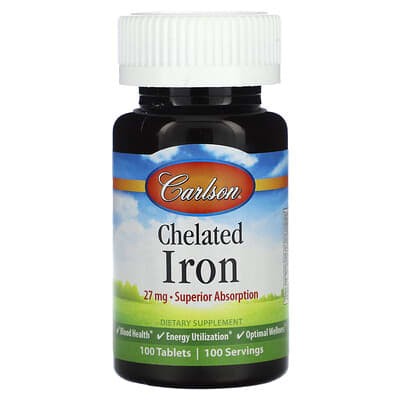

$8.42 $0.08 per serving


Product analysis
Chelated Iron 27 mg offers affordable iron support with a clearly stated amount and form, and may help with tiredness and hair shedding when iron levels are low.
AI assessment of the formula, label and price. How scoring works
Nutrient Quality40
The iron is identified as bisglycinate chelate. That clear declaration does not by itself establish better absorption or health outcomes than alternatives.
Ingredient Transparency100
The amount of iron and its chelated form are both stated. You can readily compare the serving with other iron supplements.
Value For Money100
The iron offers good value through its low serving cost. That is useful for people who need additional iron.
Customer Satisfaction91
Customer satisfaction is very high across several thousand reviews. The large review base strengthens the picture of satisfaction without proving effectiveness or safety.
Product Focus73
The supplement has a clear focus on iron needs. Its potential benefits for tiredness, concentration and hair shedding depend on low iron, rather than extra intake when iron levels are adequate.
- Format
Tablet - Container
- 100 Tablet(s)
- Per serving
- $0.08
- Also available
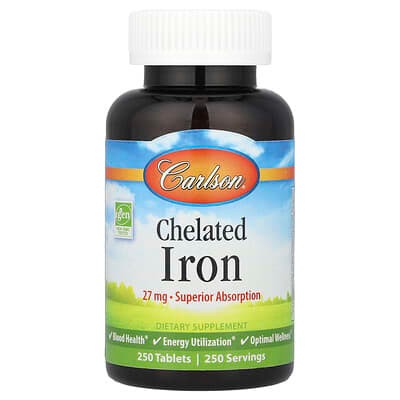 Chelated Iron 27 mg$16.92
- Customer rating
- 4.8 · 4,458 ratings
Goals

Impact
High effect
Iron · 27 mg
Iron can help address diffuse shedding caused by iron deficiency. The selected serving supplies 27 mg as iron bisglycinate chelate and reaches the saved amount comparison. The chelated form does not establish superior hair outcomes, and extra growth with adequate iron is not supported.
How this product is rated for Hair Health
Ingredient fit96
The formula has relevant ingredients, while its broader composition or uses make the hair focus less concentrated. The declared serving reaches the saved amount comparison; that endpoint is not a proven hair-growth dose.
Goal fit
The formula has relevant ingredients, while its broader composition or uses make the hair focus less concentrated.
Dose adequacy
The declared serving reaches the saved amount comparison; that endpoint is not a proven hair-growth dose.
Pathways0
No contribution was assigned to the specified hair mechanisms. No specified mechanism reached the coverage requirement.
Depth
No contribution was assigned to the specified hair mechanisms.
Breadth
None of the specified mechanisms reached the saved coverage requirement.
Evidence78
Iron leads the saved evidence comparison. Nutrient functions and preparation recognition alone do not establish routine hair regrowth.
Evidence strength
Iron provides the strongest recognized evidence here, subject to the supplied population and outcome limitations.
Studied preparation
The saved comparison recognizes the qualifying form or forms; this does not independently prove a hair-growth benefit.
Formulation logic100
The included contributions met the saved minimum amount requirement, with no missing required partner or identified conflict.
Partner coverage
No required partner was missing among the included contributions; this does not demonstrate added benefit from combining them.
Conflicts
No ingredient conflict was identified by the supplied checks.
Effective doses
All included contributions met the saved minimum amount requirement, which is not a proven effective hair-growth dose.

Impact
High effect
Iron · 27 mg
Iron can reduce fatigue and poor concentration when iron status is low, including before anemia. The relevant fatigue trials involved women with low ferritin; they do not establish a productivity benefit when iron intake and status are adequate.
How this product is rated for Productivity Boost
Ingredient fit96
Iron is included in the saved ingredient finding. The declared 27 mg serving reaches the saved amount comparison; this is not proof of an effective productivity dose.
Goal fit
Iron is the main relevant ingredient; links to other goals also affect the saved focus finding.
Dose adequacy
The declared 27 mg serving reaches the saved amount comparison; this is not proof of an effective productivity dose.
Pathways0
No configured productivity pathway receives coverage, despite the nutrient contribution recorded elsewhere. No configured pathway reaches the coverage threshold.
Depth
No configured productivity pathway receives coverage, despite the nutrient contribution recorded elsewhere.
Breadth
No configured pathway reaches the coverage threshold.
Evidence69
Iron leads the saved evidence finding. Nutrient functions and deficiency correction do not establish enhancement in adequately nourished adults.
Evidence strength
Iron leads the saved evidence finding. The supplied context still limits claims about actual work performance.
Studied preparation
The saved finding recognizes the counted preparations; this does not establish a delivery advantage or remove population-specific limits.
Formulation logic100
The counted ingredients have no unmet partner requirement. No configured ingredient conflict was found.
Partner coverage
The counted ingredients work alone or have the partner required by the supplied configuration.
Conflicts
No configured ingredient conflict was found.
Effective doses
All ingredients counted in this finding pass its inclusion threshold; this does not establish a proven effective dose.

Impact
High effect
Iron · 27 mg
Iron supports oxygen transport and can help address fatigue caused by iron deficiency. Benefits from selected low-ferritin study populations do not establish added energy for people whose iron status is adequate. This product supplies iron bisglycinate chelate; its amount and form do not reproduce the higher-dose treatment used in the supplied fatigue trial.
How this product is rated for Energy
Ingredient fit96
Iron is the sole relevant ingredient and its amount is fully recognized.
Goal fit
Iron is the sole relevant ingredient and its amount is fully recognized.
Dose adequacy
The included ingredient amounts are fully or substantially recognized; this does not establish extra benefit above nutritional adequacy.
Pathways0
Iron contributes through nutrient sufficiency rather than the five evaluated energy routes.
Depth
None of the five evaluated energy routes receives coverage; nutrient sufficiency is handled separately.
Breadth
No evaluated route reaches the required coverage level.
Evidence98
Iron leads the evidence finding and is marked as studied, but trial benefits cannot be transferred directly to this chelated product.
Evidence strength
Iron leads the saved evidence finding, subject to the specific limitations described above.
Studied preparation
Iron leads the evidence finding and is marked as studied, but trial benefits cannot be transferred directly to this chelated product.
Formulation logic100
The included ingredients do not require an unmet partner, and no configured conflict was detected.
Partner coverage
No required partner is missing for the included ingredients.
Conflicts
No configured ingredient conflict was detected.
Effective doses
All 1 included ingredients meet the saved minimum amount threshold; that threshold does not prove fatigue relief.
Ingredients
| Ingredient | Amount per serving | Score |
|---|---|---|
Iron (Iron Bisglycinate Chelate) | 27 mg |
Iron (Iron Bisglycinate Chelate) · 27 mg OverallScore91
Each serving supplies 27 mg of iron as iron bisglycinate. A whole-product serving costs about $0.08.
How this ingredient is rated
Active Ingredient Quality & Bioavailability78
The recorded iron form is iron bisglycinate. The saved information does not establish a vitamin C amount, so its contribution to iron absorption is unclear.
Iron Chemical Form & Bioavailability
The recorded iron form is iron bisglycinate.
Absorption Support & Blocker Avoidance
The saved information does not establish a vitamin C amount, so its contribution to iron absorption is unclear.
Dose, Safety & Label Transparency100
Each serving supplies 27 mg of iron.
Elemental Iron Label Clarity
The saved information identifies 27 mg of iron per serving.
Dosage Effectiveness & Safety Range
Each serving supplies 27 mg of iron.
Value100
A whole-product serving costs about $0.08 and supplies 27 mg of iron.
Price per Effective Serving
A whole-product serving costs about $0.08 and supplies 27 mg of iron.
Alternative products
Report alternatives
Sources
Published studies used for the product analysis and the top-ranked studies for each ingredient and goal.
- Large-dose intravenous ferric carboxymaltose injection for iron deficiency anemia in heavy uterine bleeding: a randomized, controlled trial.
- The Effect of Parenteral or Oral Iron Supplementation on Fatigue, Sleep, Quality of Life and Restless Legs Syndrome in Iron-Deficient Blood Donors: A Secondary Analysis of the IronWoMan RCT.
- Ferric carboxymaltose vs. oral iron in the treatment of pregnant women with iron deficiency anemia: an international, open-label, randomized controlled trial (FER-ASAP).
- Effect of iron therapy on fatigue symptoms in non-anaemic iron deficient women of reproductive age- A Randomized Controlled Trial.
- Intravenous iron isomaltoside treatment of women suffering from severe fatigue after postpartum hemorrhage.
- The Association Between Alopecia Areata and Iron Deficiency Anemia: A Large-Scale Population-Based Case-Control Study.
- Iron Deficiency and Nonscarring Alopecia in Women: Systematic Review and Meta-Analysis.
- Comparative Analysis of Postoperative Hair Loss and Micronutrient Deficiencies After One-Anastomosis Gastric Bypass Versus Sleeve Gastrectomy.
- Assessment of Serum Ferritin Levels in Female Patients With Telogen Effluvium.
- Diagnosis and treatment of female alopecia: Focusing on the iron deficiency-related alopecia.
- Effects of daily iron supplementation in primary-school-aged children: systematic review and meta-analysis of randomized controlled trials.
- Consumption of Iron-Biofortified Beans Positively Affects Cognitive Performance in 18- to 27-Year-Old Rwandan Female College Students in an 18-Week Randomized Controlled Efficacy Trial.
- Functional consequences of iron supplementation in iron-deficient female cotton mill workers in Beijing, China.
- The Effect of Iron-Fortified Lentils on Blood and Cognitive Status among Adolescent Girls in Bangladesh.
- Daily iron supplementation for improving anaemia, iron status and health in menstruating women.