
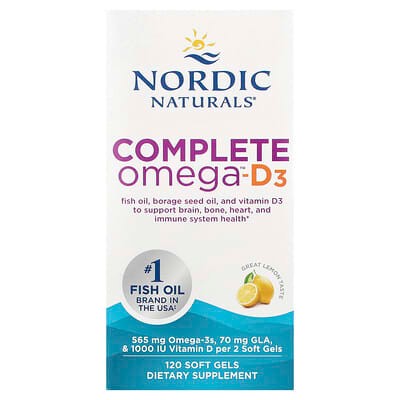

$32.26 $0.53 per serving


Product analysis
Complete Omega-D3 Lemon supplies omega-3 fats that may support the skin's lipid barrier. Broader improvements in skin appearance remain uncertain because evidence depends on specific preparations.
AI assessment of the formula, label and price. How scoring works
Nutrient Quality22
The accompanying manufacturer description identifies a favorable triglyceride oil form. Several other ingredient forms remain unclear, limiting a complete quality comparison.
Ingredient Transparency69
The amounts are disclosed, but only some forms are identified. That provides a clearer picture of serving size than of the full preparation.
Value For Money60
The omega-3 cost is around the middle of its comparison, while omega-6 and omega-9 comparisons are more favorable. A missing vitamin D comparison limits judgment of the full mixture.
Customer Satisfaction85
Customer ratings are favorable, with a substantial review pool. Reviews describe satisfaction without establishing effectiveness or safety.
Product Focus65
Omega-3 fats provide the main skin-related rationale. Limited findings from specific preparations do not establish broad improvements in skin appearance from this mixture.
- Format
Softgel - Container
- 120 Softgel(s)
- Per serving
- $0.53
- Also available
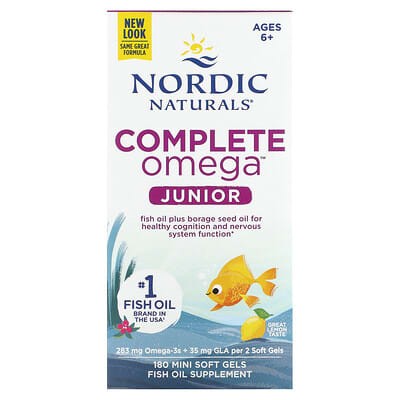 Complete Omega Jr. Lemon$31.41
- Customer rating
- 4.8 · 1,385 ratings
Goals

Impact
Moderate effect
Omega-3 · 565 mg
Omega-3 at 565 mg is the main skin-related ingredient, with a possible role in supporting the skin’s lipid barrier. The supplied evidence is limited to particular preparations and selected outcomes, so a broad improvement in skin appearance is uncertain. GLA remains unresolved in the supplied ingredient records.
How this product is rated for Skin Health
Ingredient fit69
A skin-related ingredient sits alongside ingredients serving other purposes. The assessed amounts partly meet the saved benchmarks.
Goal fit
A skin-related ingredient sits alongside ingredients serving other purposes.
Dose adequacy
The assessed amounts partly meet the saved benchmarks.
Pathways17
The strongest assigned contribution is to the skin’s lipid barrier, with limited coverage in the saved findings. None of the assessed skin processes reaches the saved coverage benchmark.
Depth
The strongest assigned contribution is to the skin’s lipid barrier, with limited coverage in the saved findings.
Breadth
None of the assessed skin processes reaches the saved coverage benchmark.
Evidence78
The saved findings classify the assessed ingredients at qualifying amounts as studied preparations; that does not guarantee a visible benefit. Confidence also depends on how closely the supplied skin evidence applies to the ingredient and intended user.
Evidence strength
Omega-3 provides the strongest evidence contribution at an assessed amount in the saved findings. The ingredient’s normal function and the limits of the supplied human evidence still matter when judging practical skin benefits.
Studied preparation
The saved findings classify the assessed ingredients at qualifying amounts as studied preparations; that does not guarantee a visible benefit.
Formulation logic100
The assessed ingredients have no missing required partners or identified conflicts. All ingredients retained in this part of the assessment meet its saved minimum amount benchmark.
Partner coverage
The assessed ingredients can contribute without a missing required partner in the saved findings.
Conflicts
No ingredient conflicts were identified in the supplied assessment.
Effective doses
All ingredients retained in this part of the assessment meet its saved minimum amount benchmark.
Omega-9 Not classified
No linked studies yet.
Ingredients
| Ingredient | Amount per serving | Score |
|---|---|---|
Calories | 20 Calorie(s) | |
Total Fat | 2 Gram(s) | |
Vitamin D3 (Cholecalciferol) | 25 mcg | |
Total Omega-3 Fatty Acids | 565 mg | |
Omega-6 Fatty Acids | 240 mg | |
Omega-9 Fatty Acids | 225 mg |
Omega-9 · 225 mg OverallScore76
Each serving lists 225 mg of omega-9, including 180 mg identified as oleic acid. The price is about $0.24 per 100 mg of omega-9.
How this ingredient is rated
Active Ingredient Quality & Bioavailability85
A specific oil source is recorded. An antioxidant is recorded, while a processing method is not.
Oil Source & Form Quality
A specific oil source is recorded. Of the 225 mg omega-9, 180 mg is identified as oleic acid; the rest has no identified form in the saved facts.
Extraction & Processing Method
No qualifying extraction or processing method is recorded in the available information.
Oxidation & Stability Protection
The saved information records an antioxidant used for protection; it does not measure the oil’s oxidation.
Dose, Safety & Label Transparency70
The omega-9 amount is clearly listed as 225 mg per serving. Of that, 180 mg is identified as oleic acid; the remaining form is unspecified.
Omega-9 Potency per Serving
A serving provides 225 mg of omega-9.
Label Transparency & Disclosure
The label gives an exact omega-9 amount of 225 mg per serving.
Value70
The whole-product price works out to about $0.24 per 100 mg of omega-9.
Price per 100mg Omega-9
The whole-product price works out to about $0.24 per 100 mg of omega-9.
Omega-6 · 240 mg OverallScore76
A serving provides 240 mg of omega-6, including 70 mg of gamma-linolenic acid (GLA). The remaining omega-6 and the specific oil source are not identified in the saved facts.
How this ingredient is rated
Active Ingredient Quality & Bioavailability64
GLA is identified at 70 mg per serving, but the saved facts do not name its oil source or identify the remaining omega-6. No extraction method is recorded in the saved facts.
Omega-6 Source & GLA Content
GLA is identified at 70 mg per serving, but the saved facts do not name its oil source or identify the remaining omega-6.
Extraction Method & Purity
No extraction method is recorded in the saved facts.
Dose, Safety & Label Transparency85
A serving contains 240 mg omega-6, including 70 mg of GLA; the remaining fatty acids are not identified in the saved facts.
Omega-6 Potency vs. Median
A serving contains 240 mg of omega-6.
Fatty Acid Profile Transparency
GLA is listed at 70 mg per serving; the rest of the omega-6 is not broken down in the saved facts.
Value80
A whole-product serving costs about $0.54.
Price Per Serving Efficiency
A whole-product serving costs about $0.54.
Omega-3 · 565 mg OverallScore74
Each serving provides 270 mg EPA and 180 mg DHA in triglyceride form. The source oil amount is unavailable in the saved facts, so the concentration cannot be determined.
How this ingredient is rated
Active Ingredient Quality & Bioavailability100
The omega-3 is recorded in triglyceride form. The evaluation also records antioxidant inclusion.
Molecular Form & Absorption Potential
The omega-3 is recorded in triglyceride form.
Source Purity & Oxidative Protection
The evaluation records a qualifying oil source and antioxidant inclusion; these facts alone do not confirm freshness.
Dose, Safety & Label Transparency61
EPA and DHA are listed separately, at 270 mg and 180 mg per serving. Their concentration in the oil is unavailable in the saved facts.
EPA & DHA Label Specificity
The serving lists 270 mg EPA and 180 mg DHA separately.
Active Ingredient Concentration
The oil amount is unavailable in the saved facts, so EPA and DHA concentration cannot be determined.
Third-Party Purity Verification
Third-party testing is claimed and a certificate of analysis is available on request; the saved evaluation does not independently verify it.
Value50
A whole-product serving costs about $0.54 and provides 450 mg of combined EPA and DHA.
Price per 1000mg of EPA+DHA
The evaluated cost is about $1.19 per gram of combined EPA and DHA, based on the whole-product price.
Alternative products
Report alternatives
Sources
Published studies used for the product analysis and the top-ranked studies for each ingredient and goal.
- Dietetic intervention in psoriatic arthritis: the DIETA trial.
- Omega-3 fatty acid supplement skin cancer prophylaxis in lung transplant recipients: A randomized, controlled pilot trial.
- Clinical and metabolic response to flaxseed oil omega-3 fatty acids supplementation in patients with diabetic foot ulcer: A randomized, double-blind, placebo-controlled trial.
- Treatment of hard-to-heal wounds in ischaemic lower extremities with a novel fish skin-derived matrix.
- Effect of eicosapentaenoic acid, an omega-3 polyunsaturated fatty acid, on UVR-related cancer risk in humans. An assessment of early genotoxic markers.
- Psychosocial Burden in People with Atopic Dermatitis: Effects of a Substance-Free Basic Skincare in a Randomized Health Care Study.
- Abnormalities in epidermal lipid metabolism in patients with atopic dermatitis.
- Maternal plasma phosphatidylcholine fatty acids and atopy and wheeze in the offspring at age of 6 years.
- Plasma omega-3 and omega-6 concentrations and risk of cutaneous basal and squamous cell carcinomas in Australian adults.
- Maternal PUFA status and offspring allergic diseases up to the age of 18 months.