
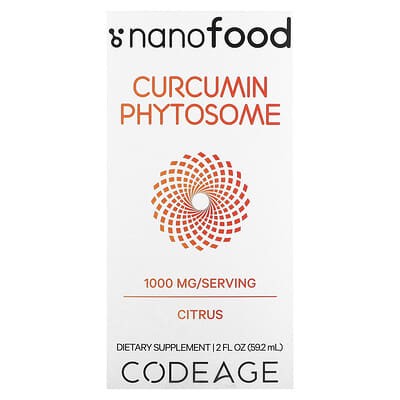
Curcumin Phytosome 1000 mg Citrus

Goals
$24.99 $0.41 per serving




Product analysis
Curcumin Phytosome 1000 mg Citrus may support joint comfort, though results depend on the curcumin preparation. The share of curcumin in the mixture is undisclosed, making comparison with preparations used for joint support difficult.
AI assessment of the formula, label and price. How scoring works
Nutrient Quality36
Curcumin is paired with phospholipids, but a particular quality advantage is not established. The other ingredient forms are unspecified.
Ingredient Transparency58
The amounts and curcumin complex are named. The mixture proportions are undisclosed, so its stated weight does not reveal how much is curcumin.
Value For Money40
The serving cost offers limited value in the available comparison. Uncertain value for the carbohydrate content does not provide a clear reason to view it as better value.
Customer Satisfaction76
Customer feedback is positive across several hundred ratings. Those ratings describe satisfaction without establishing effectiveness.
Product Focus50
Joint comfort is a plausible use, but the support depends on matching the curcumin preparation. Broader benefits for cognition, liver function and general health remain limited or uncertain.
- Format
Liquid - Container
- 2 Fluid Ounce(s)
- Per serving
- $0.41
- Customer rating
- 4.7 · 420 ratings
Goals

Impact
Moderate effect
Curcumin · 1000 mg
The 500 mg curcumin phytosome declaration relates mainly to inflammatory signaling and preparation-specific joint evidence. The mixture is not allocated to a confirmed studied preparation, so its practical contribution remains modest and uncertain.
How this product is rated for Inflammation
Ingredient fit72
The relevant ingredient is the clear focus of the formula. The known amounts provide partial support; they do not represent full coverage of the reviewed dose range.
Goal fit
The relevant ingredient is the clear focus of the formula.
Dose adequacy
The known amounts provide partial support; they do not represent full coverage of the reviewed dose range.
Pathways9
The main connection is cellular inflammatory signaling, with limited coverage in the saved findings. The saved findings show limited coverage across the reviewed inflammation mechanisms.
Depth
The main connection is cellular inflammatory signaling, with limited coverage in the saved findings.
Breadth
The saved findings show limited coverage across the reviewed inflammation mechanisms.
Evidence32
Curcumin provides the strongest evidence among the ingredients counted at a meaningful amount. Its support for this broad goal is limited.
Evidence strength
Curcumin provides the strongest evidence among the ingredients counted at a meaningful amount. Its support for this broad goal is limited.
Studied preparation
The curcumin declaration does not identify an accepted studied preparation.
Formulation logic76
Curcumin lacks the partner required for full support in the saved findings. No ingredient conflicts were identified in the saved assessment.
Partner coverage
Curcumin lacks the partner required for full support in the saved findings.
Conflicts
No ingredient conflicts were identified in the saved assessment.
Effective doses
1 of 1 relevant ingredients reach the saved meaningful-amount threshold.

Impact
Moderate effect
Curcumin · 1000 mg
Curcumin relates to inflammatory processes and may support joint comfort, with evidence depending on the specific preparation. The 500 mg phytosome declaration supplies a partial exposure match in the saved assessment; it cannot be assumed equivalent to the particular extract used in the reviewed joint trials.
How this product is rated for Joint Health
Ingredient fit72
The relevant botanical provides a clear focus on the reviewed joint functions. Ingredient amounts provide a partial match to the saved exposure comparisons.
Goal fit
The relevant botanical provides a clear focus on the reviewed joint functions.
Dose adequacy
Ingredient amounts provide a partial match to the saved exposure comparisons.
Pathways9
The main mechanism in the saved assessment is inflammation control. None of the three target mechanisms reaches the saved coverage threshold.
Depth
The main mechanism in the saved assessment is inflammation control.
Breadth
None of the three target mechanisms reaches the saved coverage threshold.
Evidence27
Curcumin leads the saved evidence finding; normal function or an exposure match does not guarantee symptom improvement. The counted botanical lacks a confirmed match to the relevant studied preparation.
Evidence strength
Curcumin leads the saved evidence finding; normal function or an exposure match does not guarantee symptom improvement.
Studied preparation
The counted botanical lacks a confirmed match to the relevant studied preparation.
Formulation logic100
The counted ingredients can contribute independently or have their required partner. No configured ingredient conflict was found in the supplied assessment. 1 of 1 counted ingredients reach the saved minimum amount criterion.
Partner coverage
The counted ingredients can contribute independently or have their required partner.
Conflicts
No configured ingredient conflict was found in the supplied assessment.
Effective doses
1 of 1 counted ingredients reach the saved minimum amount criterion.

Impact
High effect
Curcumin · 1000 mg
Curcumin has preliminary cognition findings from a particular preparation and selected participants, including people with mild cognitive impairment. Several memory outcomes were uncertain, and a benefit in healthy participants was not established. This phytosome declaration does not establish equivalence to that preparation or evidence of routine preservation of function, dementia prevention or longer life.
How this product is rated for Longevity
Ingredient fit72
The single ingredient makes a focused contribution to the saved amount comparison. This does not establish a broadly applicable aging benefit.
Goal fit
The formula focuses on its single declared ingredient, although that ingredient’s functions extend beyond this goal.
Dose adequacy
The retained amounts contribute unevenly to the supplied comparisons; these are not proven doses for slowing aging.
Pathways40
The retained findings concentrate on chronic inflammation control. They do not establish broad preservation across the other aging-related functions.
Depth
The strongest retained area is chronic inflammation control, which does not establish an overall slowing of aging.
Breadth
Coverage is concentrated in chronic inflammation control; the other areas do not reach the supplied coverage benchmark.
Evidence95
Curcumin leads the retained comparison, but the pilot’s population and uncertain memory findings do not establish routine healthy-adult aging benefit.
Evidence strength
Curcumin leads the retained comparison, but the pilot’s population and uncertain memory findings do not establish routine healthy-adult aging benefit.
Studied preparation
The retained preparations match the supplied comparison, without proving that the whole product reproduces clinical outcomes.
Formulation logic100
The retained contributions have no missing required partners or configured conflicts, and their amounts meet the minimum comparison.
Partner coverage
No required partner is missing among the retained contributions; this does not establish extra benefit from combining them.
Conflicts
No configured ingredient conflict was identified in the supplied facts.
Effective doses
The retained ingredients meet the supplied minimum amount comparison, which is not a proven threshold for slower aging.

Impact
Moderate effect
Curcumin’s main relevance is support for processes involved in oxidative and inflammatory protection. The serving provides 500 mg of a curcumin phytosome mixture, but cognitive findings are specific to particular preparations, so its likely contribution remains modest.
How this product is rated for Brain Health
Ingredient fit92
Curcumin is the sole relevant active, and its amount meets the saved dose comparison.
Goal fit
The formula is focused on curcumin, which relates to brain health as well as several other goals.
Dose adequacy
The 500 mg declaration reaches the saved upper dose comparison.
Pathways16
Support is concentrated in oxidative and inflammatory protection.
Depth
Oxidative and inflammatory protection is the strongest area, with partial coverage.
Breadth
The saved assessment finds no area with substantial coverage.
Evidence22
Curcumin has limited, preparation-specific cognitive evidence.
Evidence strength
The saved evidence finding gives curcumin a modest contribution.
Studied preparation
The declared phytosome mixture is not matched to the studied preparation.
Formulation logic76
The amount is sufficient for the saved comparison, with a missing absorption partner.
Partner coverage
The saved finding flags a missing curcumin partner.
Conflicts
No configured ingredient conflict was found.
Effective doses
Curcumin meets the saved minimum amount comparison.

Impact
High effect
Curcumin · 1000 mg
Curcumin has been studied for inflammation-related outcomes in specific conditions, including osteoarthritis. Those preparation-specific findings do not establish routine broad health improvement in healthy adults. The selected 1 mL serving supplies 500 mg, but this amount and an anti-inflammatory mechanism do not establish a universal effective dose or equivalent results across curcumin preparations.
How this product is rated for Everyday Health
Ingredient fit72
The selected serving makes a partial nutrient contribution relative to the comparison amounts.
Goal fit
The relevant ingredients give this formula a focused connection to the supplied general-health roles.
Dose adequacy
The selected serving makes a partial nutrient contribution relative to the comparison amounts.
Pathways40
The strongest contribution concerns Inflammation balance. Other meaningful coverage is limited to the named nutrient roles.
Depth
The strongest finding concerns Inflammation balance, based on the relevant ingredients and their supplied amounts.
Breadth
Meaningful coverage extends to inflammation balance.
Evidence90
Curcumin leads the saved evidence finding, but condition-specific research does not establish routine broad health benefit or equivalence across preparations.
Evidence strength
Curcumin leads this finding, but narrower condition-specific studies do not establish routine general-health improvements.
Studied preparation
The included preparations meet the preparation criteria; this does not establish superiority of a particular form.
Formulation logic100
The included ingredients can contribute without a missing required partner, and no configured conflict was found. Their amounts pass the saved minimum contribution check.
Partner coverage
The included ingredients can contribute independently or have their required partners; no extra benefit from combining them is established.
Conflicts
No configured ingredient conflict was identified in the supplied facts.
Effective doses
The included amounts all meet the minimum amount used here; that threshold is not a proven clinical dose.

Impact
Lower effect
Curcumin · 1000 mg
Ingredients
| Ingredient | Amount per serving | Score |
|---|---|---|
Calories | 5 Calorie(s) | |
Total Fat | 0.3 Gram(s) | |
Total Carbohydrates | 0.5 Gram(s) | |
Curcumin Phytosome (Curcuma longa Root Extract, Phospholipid Complex) | 1000 mg |
The saved facts specify 500 mg of curcumin per serving in a curcumin phytosome. The declared amount makes it possible to compare the ingredient directly.
How this ingredient is rated
Composition and Label Disclosure100
The saved facts record 500 mg of curcumin per serving in a curcumin phytosome.
Curcuminoid Amount Disclosure
The saved facts record 500 mg of curcumin per serving in a curcumin phytosome.
Composition and Label Disclosure40
The saved facts record 500 mg of curcumin per serving in a curcumin phytosome.
Preparation and Marker Disclosure
The saved facts record 500 mg of curcumin per serving in a curcumin phytosome.
Commercial Price and Usability40
The whole-product price is about $0.42 per labeled serving.
Commercial Price per Labeled Serving
The whole-product price is about $0.42 per labeled serving.
Alternative products
Report alternatives
Sources
Published studies used for the product analysis and the top-ranked studies for each ingredient and goal.
- [Curcumin in children with autism spectrum disorder: systemic inflammation, sensory regulation, and gut-brain interaction disorders. A randomized, double-blind, placebo-controlled clinical trial (CURATEA)].
- Short-term curcumin supplementation enhances serum brain-derived neurotrophic factor in adult men and women: a systematic review and dose-response meta-analysis of randomized controlled trials.
- Curcumin-Rich Curry Consumption Is Associated with Lower Risk of Cognitive Decline and Incidence of Mild Cognitive Impairment or Dementia: An Asian Population-Based Study.
- Curcumin-Rich Curry Consumption and Neurocognitive Function from 4.5-Year Follow-Up of Community-Dwelling Older Adults (Singapore Longitudinal Ageing Study).
- The effects of oral administration of curcumin-galactomannan complex on brain waves are consistent with brain penetration: a randomized, double-blinded, placebo-controlled pilot study.
- Efficacy and safety of turmeric and curcumin in lowering blood lipid levels in patients with cardiovascular risk factors: a meta-analysis of randomized controlled trials.
- Effects of nanocurcumin supplementation on metabolic syndrome: A systematic review and meta-analysis of randomized controlled trials.
- The Effects of Curcumin on Glycemic Control and Lipid Profiles Among Patients with Metabolic Syndrome and Related Disorders: A Systematic Review and Metaanalysis of Randomized Controlled Trials.
- Nano-curcumin improves glucose indices, lipids, inflammation, and Nesfatin in overweight and obese patients with non-alcoholic fatty liver disease (NAFLD): a double-blind randomized placebo-controlled clinical trial.
- Curcumin Nanomicelle Improves Lipid Profile, Stress Oxidative Factors and Inflammatory Markers in Patients Undergoing Coronary Elective Angioplasty; A Randomized Clinical Trial.
- The effect of curcumin supplementation on clinical outcomes and inflammatory markers in patients with ulcerative colitis.
- The synergistic effects of nano-curcumin and coenzyme Q10 supplementation in migraine prophylaxis: a randomized, placebo-controlled, double-blind trial.
- Efficacy and Safety of a Novel Low-Dose Water-Dispersible Turmeric Extract in the Management of Knee Osteoarthritis: A Randomized, Double-Blind, Placebo-Controlled Clinical Trial.
- Effectiveness of curcuminoids in the treatment of knee osteoarthritis: a systematic review and meta-analysis of randomized clinical trials.
- Effectiveness and safety of turmeric for the treatment of COVID-19: An updated systematic review and meta-analysis of randomized controlled trials.
- The Effect of Curcumin Supplementation on Pulse Wave Velocity in Patients with Metabolic Syndrome: A Randomized, Double-Blind, Placebo-Controlled Trial.
- The Effects of Nano-curcumin on Metabolic Status in Patients With Diabetes on Hemodialysis, a Randomized, Double Blind, Placebo-controlled Trial.
- Curcumin supplementation improves the clinical outcomes of patients with diabetes and atherosclerotic cardiovascular risk.
- The Effect of Curcumin on Reducing Atherogenic Risks in Obese Patients with Type 2 Diabetes: A Randomized Controlled Trial.
- Effect of curcumin on inflammatory markers and disease activity in patients with rheumatoid arthritis: A meta-analysis.